Digger is Ambitious and Deeply Flawed - That's What Makes It Represent the Kind of Art We Need
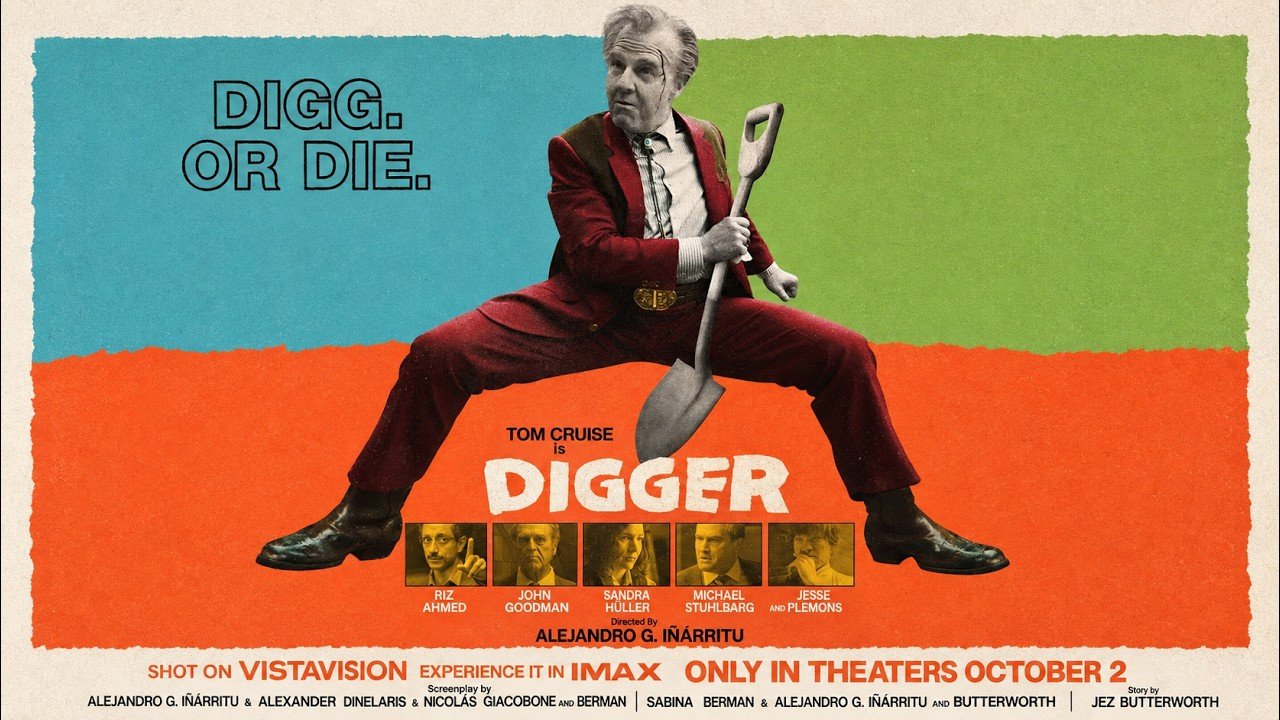
Digger is emblematic of a type of film that may not exist for much longer. In the age of corporate consolidation and most media being owned by a small handful of companies, risky and out-there stories may become a rarity. The tragedy here is that these risky, out-there stories are the most important art that we need to engage with more than anything else. // Image: Warner Bros. Pictures
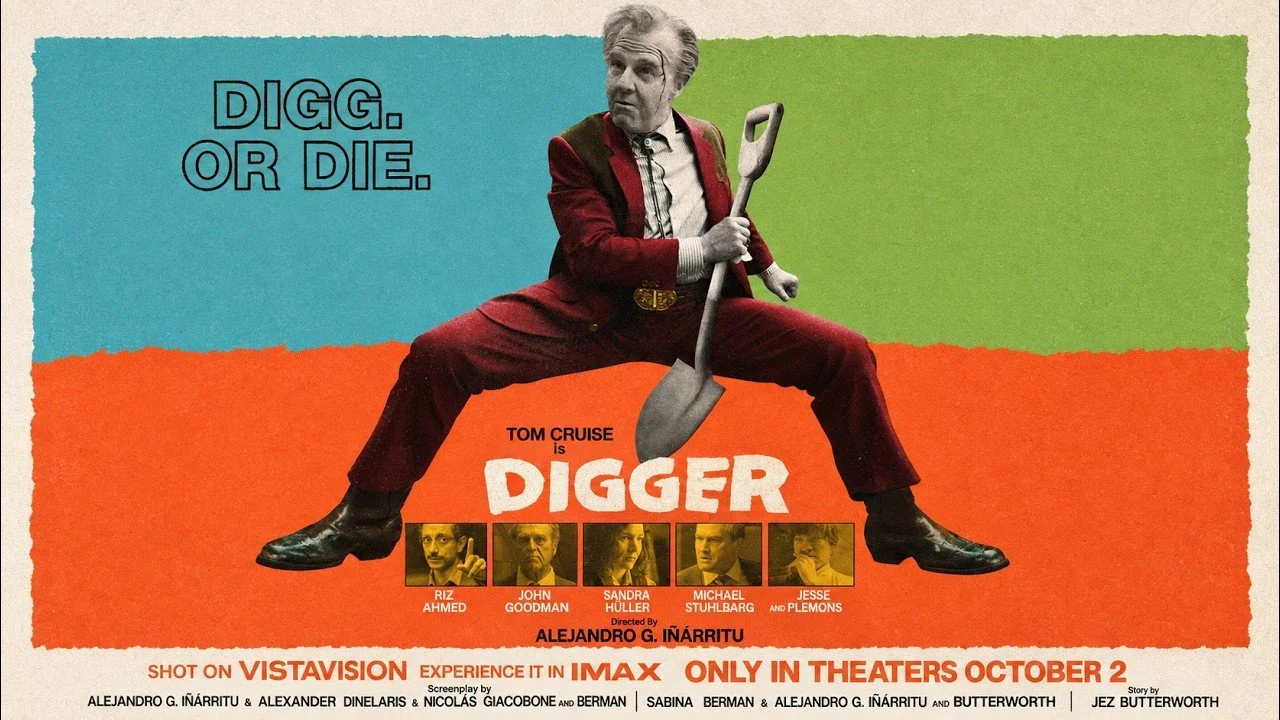
Digger is ostensibly one of the year’s biggest flops. The satirical black comedy made only $20 million USD in its opening weekend, a small fraction of its $180 million USD budget. Having seen the film, it’s not hard to imagine why. It’s a difficult film to describe to people, and this difficulty in conveying what the film even is was reflected in the film’s bizarre marketing. The film’s first trailer barely showed much of the movie at all, instead opting to lean into the fact that Tom Cruise was headlining the film. While the novelty of Digger being a non-franchise film for Cruise - an absolute rarity over the last fifteen years - was enough to put eyes on the film, the little of the film that was shown to audiences didn’t clearly convey what kind of movie they would be in for.
Later instances of marketing didn’t clear up matters too much. Given that prestigious and acclaimed director Alejandro G. Iñárritu helms the film, it was assured that the film was going to attract the hardcore film enthusiast crowd, but on a $180 million USD budget, the film needed to strike a chord with a larger, more mainstream audience to make a profit. While this seems risky on paper, especially for a major film distributor like Warner Bros. Pictures and Legendary Pictures, the premise isn’t entirely unprecedented.
In 2025, Warner Bros. distributed two ambitious films from respected film directors. Bong Joon Ho’s Mickey 17 was a bizarre, satirical sci-fi follow-up to Parasite. The film made $133 million USD on a $118 million USD budget, meaning that the film likely broke even after marketing costs. Not long after, Warner Bros. Pictures also put out Sinners - a film that became one of the year’s greatest success stories. Sinners made $371 million USD off of a $100 million USD budget. Both instances show us that larger film distributors greenlighting beloved, acclaimed directors to create large-budget films that present new, ambitious ideas. These new, ambitious ideas turned out to be financially viable, if not financially lucrative. For each Mickey 17-like instance of breaking even, there could also be an instance of Sinners - a movie that performs very well and proves that moviegoers are interested in seeing original ideas and not just sequels and reboots of older ideas.
Digger is very much in that same category of release from Warner Bros. Pictures. It’s a large-budget project given to Alejandro G. Iñárritu, most known for 2014’s Birdman and 2015’s The Revenant. Moreover, Digger theoretically had a similar appeal as The Revenant - a movie that serves as an ideal opportunity for a legacy actor to have a shot at winning an Oscar. Part of the buzz of The Revenant upon release was the intrigue to see whether Leonardo DiCaprio’s performance was good enough to justify him finally winning an Oscar for a performance - and that intrigue was enough to pull in a wide audience. Digger could have had a similar pull, being an opportunity for Cruise to potentially win an Oscar for a performance after being an industry icon for four decades.
But that didn’t happen, largely because audiences weren’t quite sure what Digger even was. I wasn’t quite sure what Digger even was. While I’ve grown accustomed to being interested in seeing movies I know next to nothing about, I recognize that I and moviegoers like myself are outliers. Generally speaking, people like to know what kind of movie they’re going to be in for before they buy a ticket. Pair this with the fact that Digger is a black-comedy that heavily satirizes political and economic concepts in a far-from-subtle way, and this film is practically destined to have a limited audience.
On top of that, Digger is perhaps too strange to win over word-of-mouth appeal, like how Sinners did a year earlier. Despite being labeled as a comedy, Digger isn’t all that funny. Its characters aren’t particularly likable. Its sociopolitical and economic commentary is so on-the-nose that it will cause many viewers to consistently roll their eyes or not even want to watch the film in its entirety. Even the process of having a conversation about Digger is practically impossible without discussing a major spoiler that occurs at the end of the film’s first act. There are so many factors against Digger that all come together to justify why it has bombed at the box office as much as it has.
Despite all of this, however, I can’t stop thinking about Digger. I was won over by the film’s dark blend of commentary and subtle humor. Most importantly, I left the theater feeling something. In many ways, Digger is as profound as it is upsetting. It’s a film that leaves the viewer with a harrowing sense of defeat, anger, hopelessness, and reluctant empathy about why the story of Rockwell Digger is being told and why people want to tell it.
Digger is a deeply flawed movie and is perhaps too ambitious for its own good, but it’s undeniably a movie that will make you feel. Behind all of the pretention, over-the-top performances, and metanarrative revelations, Digger tells a story designed to make the viewer feel lots of different emotions that are so complex to unpack that the film is destined to linger in the viewer’s mind long after they’ve left the theater. Even over a week after I’ve seen the film, I can’t help but keep thinking about it and keep wondering about why I felt the way that I did when credits started rolling. It’s a deeply complex film that, while flawed, is something that I’m incredibly glad exists.
Unfortunately, I find myself fearing for the future of films like this. Although I see Digger as a flawed triumph, I fear that studios like Warner Bros. Pictures will simply look at it as a data point of why these types of films and projects don’t make sense and shouldn’t continue to be made. With the recent news that the media landscape is continuing to consolidate thanks to the completion of Skydance’s acquisition of Warner Bros. Discovery, the film industry might become even more averse to original big-budget movies like Mickey 17, Sinners, and Digger. If this becomes the case, it will be a catastrophic shame. These movies precisely embody the kinds of stories and pieces of art that the world needs more of.
As difficult as it is to market, discuss, and straightforwardly praise Digger, it’s effortless for me to see it as what film ought to be: challenging, ambitious, different, and weird. All art should be that.
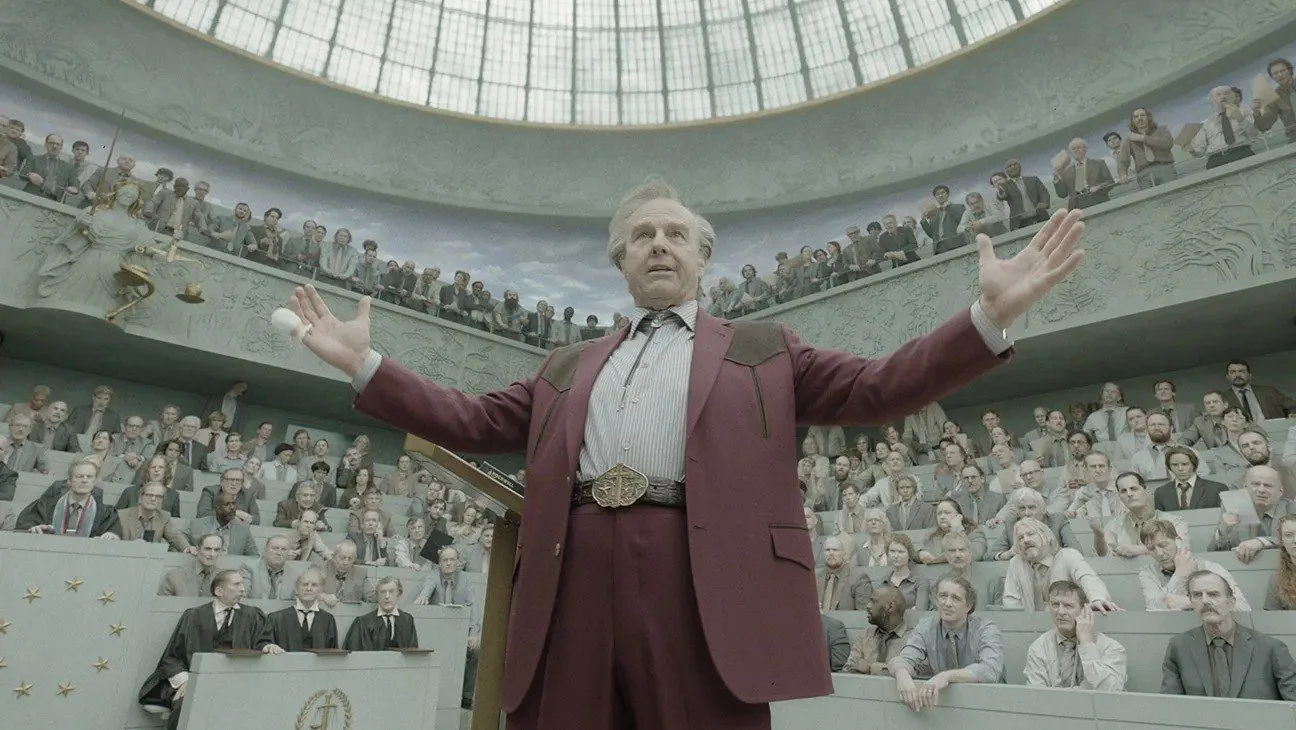
Digger is a certified flop, but it’s a deeply engaging film that’s doubtless to become a cult classic that viewers will grow a deeper appreciation for in the years to come. To write off the film’s legacy as a box office bomb that’s used to justify major distributors to invest less in auteur projects does a disservice to what Digger accomplishes. // Image: Warner Bros. Pictures, Legendary Pictures
The following section discusses spoilers for Digger. Proceed to the next session to avoid spoilers.
In what has practically become my catchphrase on this blog at this point, the most effective pieces of art are the ones that linger in our minds long after we’ve walked away from them. Although I wouldn’t say that Digger is anywhere near my favorite films of the year, it has demanded space in my mind. My biggest takeaway after having seen the film paired with having some distance from it is that this film is destined to build a cult following in the years to come.
Digger features many of Iñárritu’s trademark stylings, particularly with how big certain scenes feel by way of how the action is framed. The courtroom scene pictured above and most consistently featured in the film’s marketing is a vertical slice of Digger when it’s at its best. In this scene, the titular character confesses that the allegations against him and his company are true, which is met by vigorous hatred and distaste from his audience. But he gradually twists the narrative into something that makes people look at him a different way. This scene goes on for multiple minutes, featuring no cuts and elements of the set that change (namely a rotating part of the ground that Digger walks across that gives the scene more spectacle). Most prominently, the way the set is designed, the way the entire scene is shot, and the contrast of Rockwell Digger’s red suit against the bleak lifelessness of the courtroom around him creates a striking image that’s hard to look away from.
Not only is Digger a visually remarkable film, but it’s one of consistent substance - even if that substance leads to complex, often unpleasant feelings. Digger features various characters that are shamelessly greedy, misogynistic, narcissistic, and inarguably evil. But therein lies the point to which the framing of this story makes sense. After the film’s first act, it gets revealed that Digger is, in truth, a metanarrative - a story being told within a story. The story of Rockwell Digger is a play, Fossil Fools, and depicts the story of the men that allowed environmental catastrophes to happen. These events effectively destroyed the world that this play is being performed in - and the purpose of the play is to give the people of this broken world an opportunity to cope with the tragedy of the world’s fate. By seeing an over-the-top depiction of how corrupt and immoral Rockwell Digger was and seeing his eventual demise, there is a catharsis and jubilance that’s given to the audience for a moment before they return to a hopeless, dystopian world.
Digger is a movie about the very purpose of art and storytelling, and why we choose to tell the certain stories that we do. What is the utility of storytelling if not to give audiences an opportunity to process certain situations and feelings they can identify with? People come to art for more than mere entertainment in the moment. They come to art to see what the art can say to them. Art informs us how shared certain experiences truly are. Stories can make us feel seen, they can make us recognize that someone somewhere has experienced the same struggles that we have. They can take us to a different world and let us escape the bustle of our day-to-day lives. Alternatively, stories can also immerse us in the busyness of reality and make us think about our life and the world around us in a different way.
The in-universe story of Fossil Fools has a utility to it, even if Curtis Markson, the in-universe actor performing as Rockwell Digger, struggles to see it. In his eyes, the story of Fossil Fools is over-the-top, historically inaccurate, and makes light of a devastating string of events. The comedy of the play is subtle and bizarre, but perhaps misplaced and in poor taste. Despite fears that the play doesn’t have a definitive “point” to it, the final performance of the play ends with thunderous applause from a sold-out theater. People of all ages find themselves teary-eyed in the wake of Rockwell Digger’s demise - and suddenly, it becomes clear that the moment of elation for that audience is extremely necessary. The small glimpse of the outside world that we get to see afterward reveals how joyless life appears for these people. This recontextualizes the entire storytelling of Fossil Fools as being one that deserves to be told.
This isn’t to say that Digger handles its metanarrative perfectly. There’s a subplot with Curtis Markson’s daughter that feels completely unnecessary. The metatextual element also doesn’t even get that much screen time in the film’s 2-hour runtime. However, the metatextual element of this film is essential to making it work in the first place - and it wasn’t included in the film’s marketing whatsoever. The film’s metatextuality isn’t even introduced until half an hour through the movie, effectively marking it as spoiler territory for mere conversation about the film. That, above all else, is likely why Digger is such a difficult film to garner mass appeal and convince people to see it in theaters. Digger is a movie that can’t reveal what it is until people have already bought a ticket and invested half an hour into the film before really knowing what it’s about.
Intentionally marketing a movie a certain way so that it appears to zig when the actual movie zags is a challenging endeavor for any film to accomplish, but it’s by no means undoable. Nope and Fight Club are both movies that have significant twists that are revealed late into their respective runtimes and had to market their films accordingly. It could be argued that this is a deceptive form of advertising, but if it exists in order to preserve the surprise that the direction a story goes in, then there’s no real way to avoid it without just spoiling a major part of the film. In Digger’s case, the twist is such a transformative and significant aspect of the film that, without it, it seems like an obnoxious allegory about oil barons.
I’m not necessarily here to diagnose what made people uninterested in seeing Digger in theaters nor am I interested in engaging with the mediocre critical reception of the film. Rather, my intention is to point out that Digger is more than what it initially seems. There’s a curtain in front of Digger. In front of the curtain, the film is an eyeroll-worthy commentary that’s as conceited and on-the-nose as possible. Behind the curtain, Digger is a story about storytelling and the power that it uniquely holds. The only way to look behind the curtain, unfortunately, is to already invest your time and money into seeing the film - which is a tall order given that many people may be repulsed by the film based on how it looks in front of the curtain.
This contextualizes why Digger is such a noteworthy flop despite being what I would consider to be a well-made, if certainly flawed movie. However, my fear is that this movie will be used as a martyr to justify why films of this type shouldn’t be greenlit anymore. If that becomes the case, then I think we’re all in for an objectively worse media landscape.
This concludes the spoiler section for Digger.
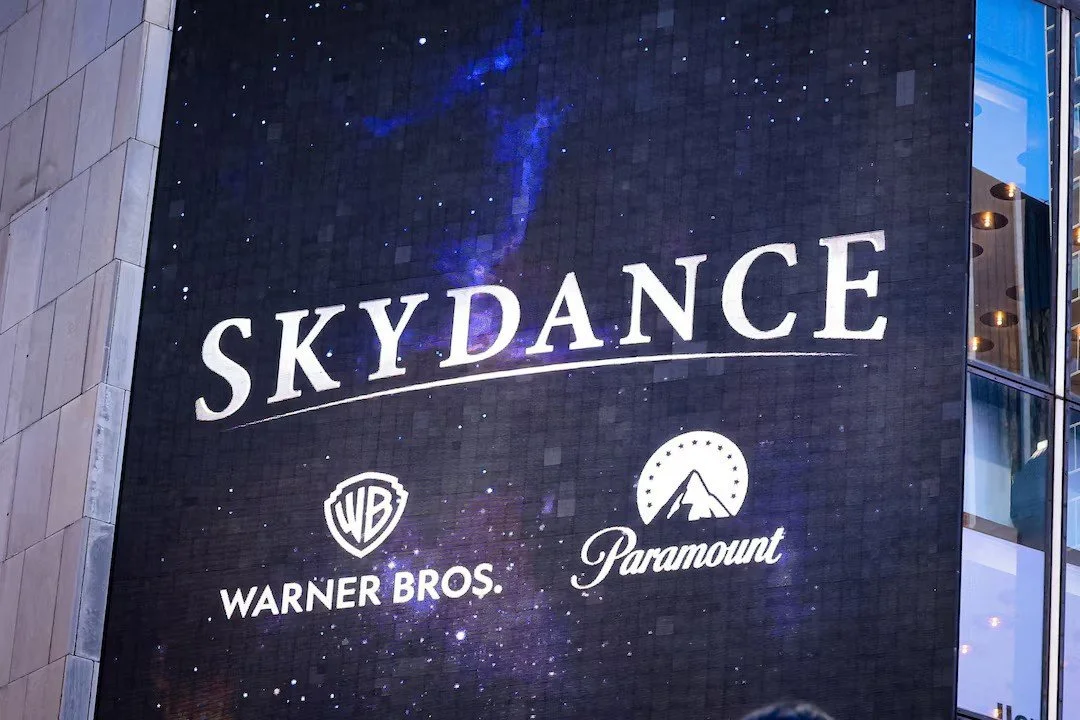
Skydance recently finished their acquisition of Warner Bros. Discovery, meaning that an even smaller number of companies now owns all media. It’s unclear how exactly this will impact what projects get greenlit by the media giant moving forward, but most people are bracing for the worst. Smart, unconventional, and unsafe stories like the one seen in Digger may become a rarity in an age where super corporations prioritize minimizing financial risks. // Image: Reuters
Corporate consolidation is the worst possible thing that can happen to any creative industry. When companies merge or acquire other companies, that usually means that corners end up getting cut to begin making back the money used to make the merge or acquisition possible. This usually takes the form of layoffs, projects getting canceled, and a realignment on what projects get greenlit. These instances often equate to agreeing that any large-scale projects need to be sure-fire hits, and small-scale projects may be considered not important enough to continue supporting whatsoever.
We’re currently seeing this most egregiously in the video games industry. Over the last decade, Microsoft and Sony have spent billions of dollars acquiring development studios. To justify their purchases, these corporations mandated that their new studios make sure-fire hits that will create a return on their investment in these companies. This creates immense pressure on developers to make games as best they can, but if the final product doesn’t perform to their owners’ expectations, their jobs get cut, projects get cancelled, and the development studio is at risk of getting shut down altogether. The cost of consolidation is the human touch that’s essential in creating meaningful art. If people lose their jobs or lose funding for their projects, that means that talent will be unable to create good art. If talent doesn’t exist to make art that’s innovative, ambitious, challenging, and weird, then corporations only really have one thing left to lean on: franchises.
To make a safer return on investment on a project, companies will often decide to greenlight a new installment in a proven intellectual property rather than create a brand-new idea. This is why we’ve seen so many Star Wars and Marvel and remake projects come out of Disney over the last decade and a half - because they are a safer means of securing ticket sales and recouping production costs. But the long-term cost of this is brand fatigue, which then morphs into cynicism from audiences - many of which now no longer wish to support these projects and franchises.
This year has proven that audiences can and will show up for new ideas from emerging talent as showcased by the success of Obsession and Backrooms. But is that enough to make massive corporations feel more comfortable continuing to greenlight brand-new stories that are willing to be unconventional, ambitious, and weird? I don’t know the answer to that, but I wouldn’t hold my breath for large companies to swallow their pride and allow creatives to make art as weird as they want to.
Realistically, I think acquisitions like what we’ve most recently seen with Skydance are only going to create more demand for alternative content. If large companies are only interested in making safe, easily digestible content that they can easily market, then there will inevitably come a greater demand and supply of more meaningful, more ambitious art to get produced by smaller production companies. As people get burnt out by the lack of creativity and ambition from massive companies like Skydance and Disney, there will naturally be more hunger to see what smaller, independent companies output. Audiences will ultimately vote with their wallet and their time over what kind of art they want to see more of, and indies will certainly have an uphill battle to fight against the near-limitless resources and money available at larger companies under Skydance and Disney. With that said, I think the market for independent distributors can become even more vast than it is today in the wake of this.
I stated earlier that Digger may represent a kind of film that may not exist for much longer - that’s only half true. I think that bets like Digger will no longer be made at large companies under Skydance and Disney. These kinds of weird, ambitious movies won’t get hundreds of millions of dollars in funding to realize a storyteller’s vision. That is a casualty that I think we may need to accept in the short-term. Over the next few years, I think we will and should continue to see artistic triumphs that tell meaningful stories - but they will almost exclusively come from smaller distributors like NEON, Bleecker Street, and A24 (who itself is running the risk of morphing into a larger distributor, but that’s a conversation for another time). These companies have less resources and thus are incapable of putting the same amount of money into marketing the movies they output. That means that the types of movies we deserve more of will tragically be marketed less than the safe, franchised content from large corporations - and that’s just going to be how it is. But if the last few years have proven anything, it’s that word of mouth can be more powerful than a multi-million-dollar marketing campaign. If we see movies we love and want to share with other people, then we simply need to share the effects they have on us.
That’s why I felt the need to write a piece involving Digger. While it’s not my favorite movie of the year, it’s a movie I find myself respecting a lot. It’s a movie that I want to see more of, but it’s also one I recognize appears unappealing thanks to how it presents itself via its marketing. I love weird, ambitious art that is comfortable with telling unconventional stories in unconventional ways, and I deeply respect all artists that commit to sharing such stories with the world. I truly think we all need and deserve more of that, and I hope to provide some of those stories myself throughout my life.
Digger is weird, flawed, ambitious, and exactly what I want to see more of - and if large companies like Skydance and Disney won’t greenlight projects like that in the future, then that means it’s more important than ever to support independent filmmaking, smaller distributors, and emerging talent. That’s the only way we can ensure the future of meaningful art in an age where corporations are more averse to risky, ambitious projects than ever before.
Thank you very much for reading! What are your thoughts on ambitious and flawed pieces of art? Do you think Digger represents what all art should strive to be, or are creative industries better off favoring less financially risky projects? As always, join the conversation and let me know what you think in the comments or on Bluesky @DerekExMachina.com!