Kingdom Hearts Retrospective: My Complicated Journey to Learn that Joy is Enough
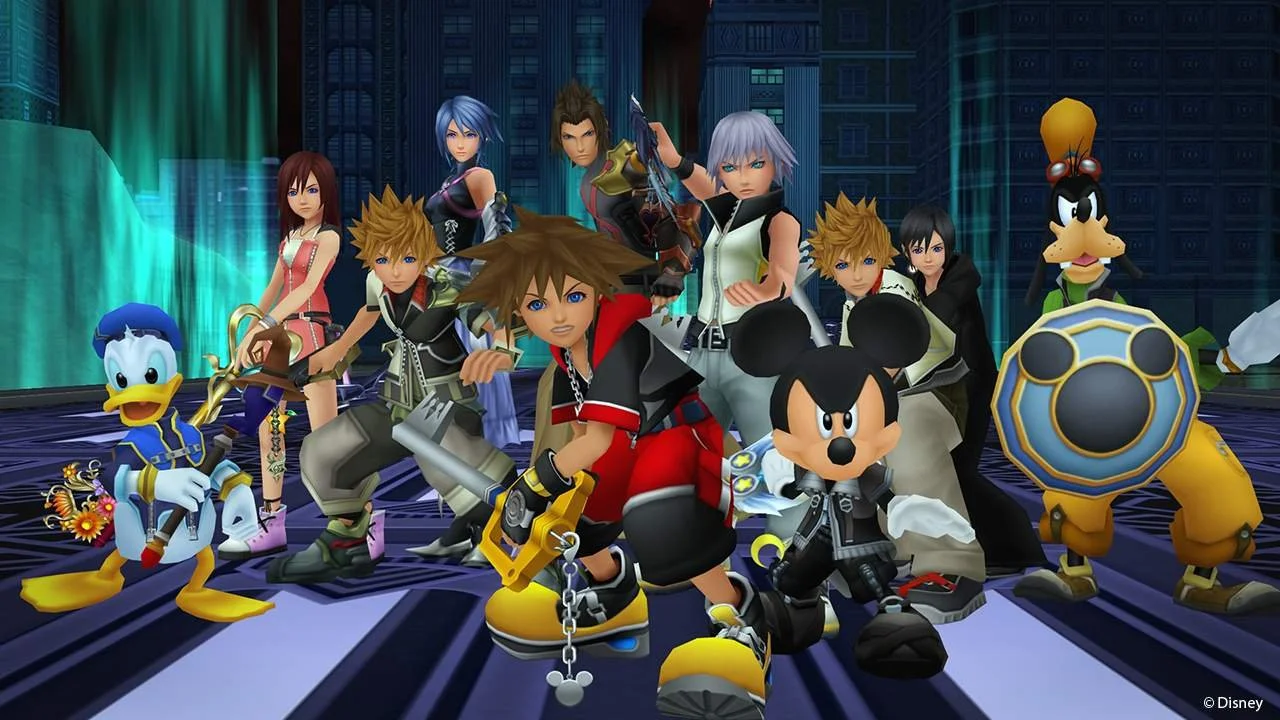
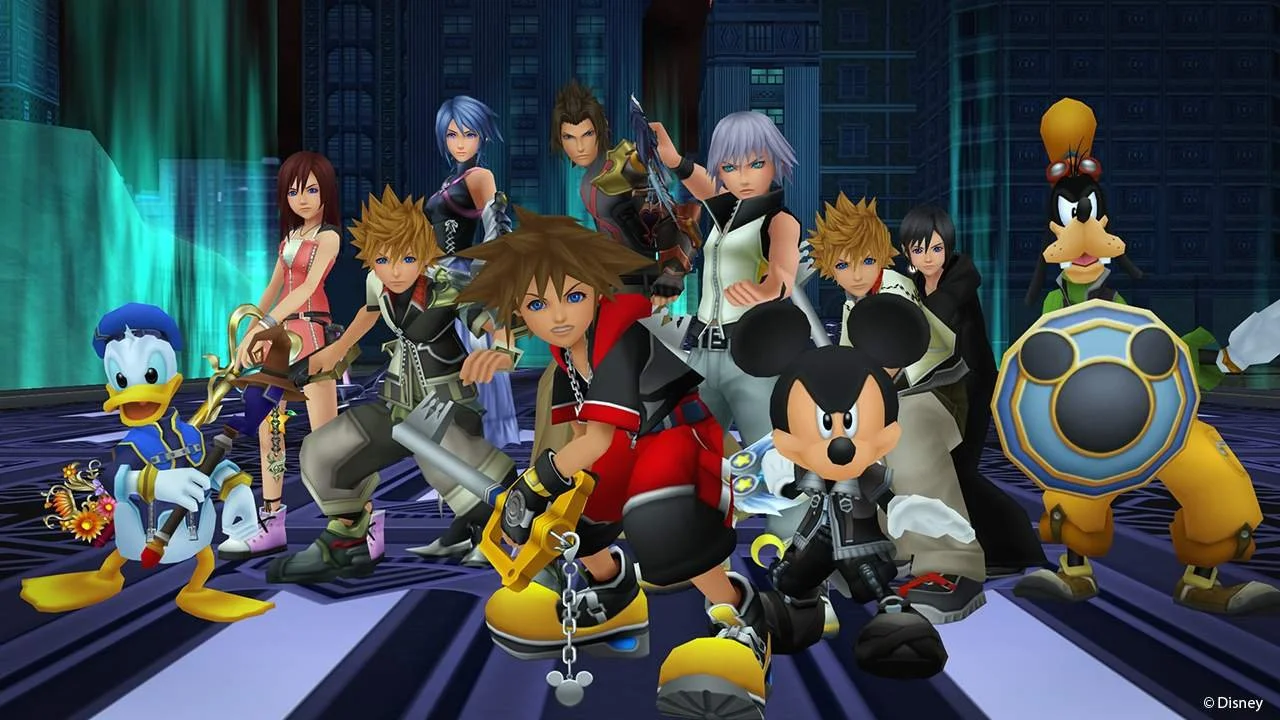
Anyone can tell you that a Square Enix and Disney collaboration on the scale of Kingdom Hearts should never have succeeded on paper - but reality tells a different story. Although I’ve had my flaws with the series before, a recent revisit throughout all Kingdom Hearts entries won me back by reminding me what makes this series special as well as the value of sheer joy. // Image: Square Enix, Disney
It isn’t possible to be normal about Kingdom Hearts.
This Square Enix and Disney collaboration primarily born out of the fact that pre-merger Squaresoft and Disney Japan happened to share an office building circa the late ‘90s and early 2000s went on to become a multimedia franchise that has captured a wide spectrum of players. While younger players would be enticed and possibly introduced to RPGs by way of the franchise’s Disney worlds and characters, more veteran players could still find value in Kingdom Hearts with the legendary pedigree of Squaresoft at this point, as well as the Final Fantasy characters thrown in throughout the game. With the series’ first entry on the PlayStation 2, younger and older players alike would find something worthwhile in Kingdom Hearts, and such a thing would cause multiple generations of players to grow up with this franchise.
Beyond this, Kingdom Hearts’ primary narrative focus is on sentimentality, friendship, youth, innocence, connection, and finding light amidst darkness - a simple premise that anyone of any age can identify with. Like the source material for the many Disney properties showcased within the game, Kingdom Hearts is easy to become nostalgic for thanks to its often heartful, optimistic tone even when its characters stand in the face of devastating stakes. Kingdom Hearts has managed to retain brand recognition and fan loyalty despite the series’ infrequent, disjointed release strategy. The series has spread itself across different platforms (before remasters and modern ports made most installments available on modern, easily accessible hardware) and regularly has made fans wait years for much-anticipated installments. Despite all of that, the series is still remains popular and widely celebrated today.
This series’ resilience, I feel, is largely in thanks to the core, well, heart of the series. Square could have easily rested on their laurels and let the Disney and occasional Final Fantasy fan service carry the experience enough to ascertain good sales. They could have leaned on the storytelling of the various Disney worlds to tell a safe, familiar retread of stories that we’ve seen before. While many KH games do opt for that to an extent, the vast majority of Kingdom Hearts is original and dense. While sharing certain things like spell and ability terminology from Final Fantasy, Kingdom Hearts plays unlike anything Square had produced before - being a fast-paced Action RPG with a fair dose of platforming thrown in. From original combat to original characters and storytelling elements (that only increase in number and density with each installment), Kingdom Hearts is anything but a safe crossover.
This series walks in a bold, weird direction, but it does so with a charming gusto; with a willingness to deliver an RPG experience that is as high quality as anything else from Square’s output circa the mid-90s to the early 2000s. Are the animations and cutscene direction often stiff? Yup. Is the writing regularly corny and filled with predictable tropes and plot conveniences? Absolutely. There are flaws with Kingdom Hearts, but there’s so much unique magic contained within these titles that it never becomes enough to weigh down the entire experience.
…At least, that was the mindset I had when I initially became a fan of Kingdom Hearts when I was a kid and early teenager. Like many series fans, I was first introduced to Kingdom Hearts during my youth. In fact, my first memory of ever hearing about the series is of a 90-second ad for the game that played on the Disney Channel circa 2002. A few years later, around the release of Kingdom Hearts II, I tried out the series and became quickly captivated with the series, despite not necessarily being the biggest Disney fan in the world. As a child of the late ‘90s, I primarily grew up on Renaissance-era Disney animated movies and the bangers that proliferated the first 15 years or so of Pixar’s history making features. Beyond that, I didn’t consider myself necessarily attached to the Disney brand. Indeed, by the time I was introduced to Kingdom Hearts, I was already familiar with Square, Final Fantasy, and JRPGs. As such, I was more drawn to Kingdom Hearts due to my experience with the genre it came from, limited as it may have been at the time.
While the series’ association with Disney and Square’s Final Fantasy gave me the intrigue to check the game out, it was the series’ staple fast-paced combat, vibrant art style, and simple, yet charming storytelling that kept me playing. After finishing Kingdom Hearts, I quickly moved over to Kingdom Hearts II and, like many kids that weren’t even aware that Chain of Memories existed, I was thoroughly unclear on why the game starts with such a different direction. But in time, Kingdom Hearts II became one of my all-time favorite PS2 games, cementing my adoration for the series as a bona fide fan. And so, I convinced my parents and one of my older brothers to help me ensure that I’d have access to each of the games that would release from then on.
From Re:Chain of Memories to 358/2 Days, and watching the cutscenes added for the Japan-only release of Kingdom Hearts II: Final Mix, as well as reading and watching synopses for Birth By Sleep (released exclusively for the PSP, a system I’ve never owned, causing me to miss out on the game originally), I was locked in for Kingdom Hearts throughout my youth. Even at a young age, I could recognize flaws with the series, but I just thought what it was going for was so cool that I convinced myself to look past the elements I didn’t like. These games brought me joy, and that was enough to keep me attached to this series in spite of its shortcomings.
But in the early 2010s, not long after the release of Dream Drop Distance, something snapped in me. At this point in my life, I was well into high school and was spending my free time diversifying my video game repertoire. I started getting into Atlus’ games with Persona 3 and 4, Etrian Odyssey, and Shin Megami Tensei IV. I had gotten to play Xenoblade Chronicles, which itself helped me really define and understand my own tastes and preferences in games. Beyond that, I began seriously educating myself about game development in order to understand why and how games were made in the way that they were. I developed a fascination and appreciation for video game history, development, and work that specifically goes into writing and localization.
All these experiences helped me understand and appreciate my relationship with games on a deeper level. The way I assessed and appreciated the games I played completely evolved during this point in my life. I had started to see behind the curtain of game development and gained a deeper appreciation of video games as a result - but the drawback of that is that there was no going back. I was doomed to critically engage with games on a deep level for the rest of my life (hence the existence of the blog you’re visiting right now).
When I originally played Dream Drop Distance on 3DS in 2012, I found myself not connecting with the experience as much as I had with previous games. I didn’t think the combat or level design was significantly worse than what had come before. I didn’t think the game was un-fun or anything like that, but I found myself getting fed up with the way the series had been going. The writing felt like it featured convoluted details to compensate for the fact that its core storytelling was quite simple. The progression system tied to the Dream Eaters felt different for the sake of being different and not because it was actually adding anything to the experience. I abruptly hit a breaking point with the series that would officially turn me away from the series for a long time.
Even though I was there when Kingdom Hearts III got announced (way too early, might I add) at E3 2013, which sent the internet abuzz alongside the revived Final Fantasy Versus XIII being rebranded to Final Fantasy XV, I didn’t find myself caring that much. Not long after, I would try the series again by replaying the original KH when Kingdom Hearts 1.5 ReMIX first released on PS3, but it just didn’t click with me at the time. I had a hard time really convincing myself that these games were worth my time when I found greater joy and meaning in other games, particularly other JRPGs at that point.
And so, I officially put the series down and declared the end of my Kingdom Hearts fandom. Once KH III finally released in 2019 and I was surrounded by many fans of the series while working a quality assurance job in game development, there was a part of me that had grown cynical about the series. I knew that, behind peoples’ excitement to finally play the next chapter in Sora’s journey was an inevitability that they’d be disappointed by whatever narrative or mechanical gimmicks that Square Enix would throw in to make the game feel different but not necessarily better. I had no curiosity or interest whatsoever in returning to the franchise.
Despite having many friends still into the series, watching reviews and content on the series (for the sake of understanding others’ opinions and perspectives on the games), and vaguely keeping up to date with the series’ releases (since I had long since followed general gaming news by this point in my life), I never felt compelled to give Kingdom Hearts another try. As the JRPG genre was making a significant rebound in the late 2010s, I found myself surrounded by a never-ending supply of games to play. I felt no need to return to a series that I got fed up from.
With all of that in hindsight, I now find the need to ask myself: was I being a shithead?
Maybe my departure from the series was unconsciously a form of angsty teen rebellion. Maybe I just didn’t want to invest the time into the series because it had gotten so popular, that I felt less compelled to give it attention (I admit that I was prone to being a contrarian hipster when I was a teenager…maybe I still am to some extent). Or maybe I had simply outgrown the series and wanted to move on to other things.
But are any of those assessments fair? Was it right to just write off the series and be cynical towards it? As I’ve written previously on this blog, I think there’s immense value in giving stories and pieces of media a second chance. Getting older and having more lived experiences can significantly reform how we feel about certain games, certain stories, and certain experiences. So, why then, should I not apply this very mindset towards a series that I had once loved and had now abandoned?
In late 2025, I felt that it was finally time to heed my own advice: give art a second chance, even if you think you once hated it during a different part of your life. Over the course of half a rotation around the sun, I played through all Kingdom Hearts games accessible on modern hardware to truly assess for myself, as an adult with a fresh, open-minded perspective, what I thought about these games. Some of these playthroughs, such as with Birth by Sleep and Kingdom Hearts III, would be my very first time playing through these games at all.
It’s been a long journey, but I’ve finally finished it. Melody of Memory not withstanding, I am effectively caught up on Kingdom Hearts and can now give this franchise the critical, honest assessment that it deserves. As someone that didn’t feel the need to return to the series for a long time, I certainly find myself grateful for being willing to do so. I have many, many criticisms of this series, and some games I ended up liking far less than online discourse or review scores would lead you to expect, but I walk away from this project with a newfound appreciation for the series.
I’m not quite sure if I would still entirely label myself as a Kingdom Hearts fan today (at least, not in the way that much of the series’ vocal, passionate fanbase is able to), but I can certainly say that giving Kingdom Hearts a second chance with an open mind and open heart was absolutely the right thing to do. Let’s discuss my experience with each of the games, assess each game’s strengths and weaknesses, and fully see this journey assessing my complicated relationship with Kingdom Hearts through to its end.
Kingdom Hearts
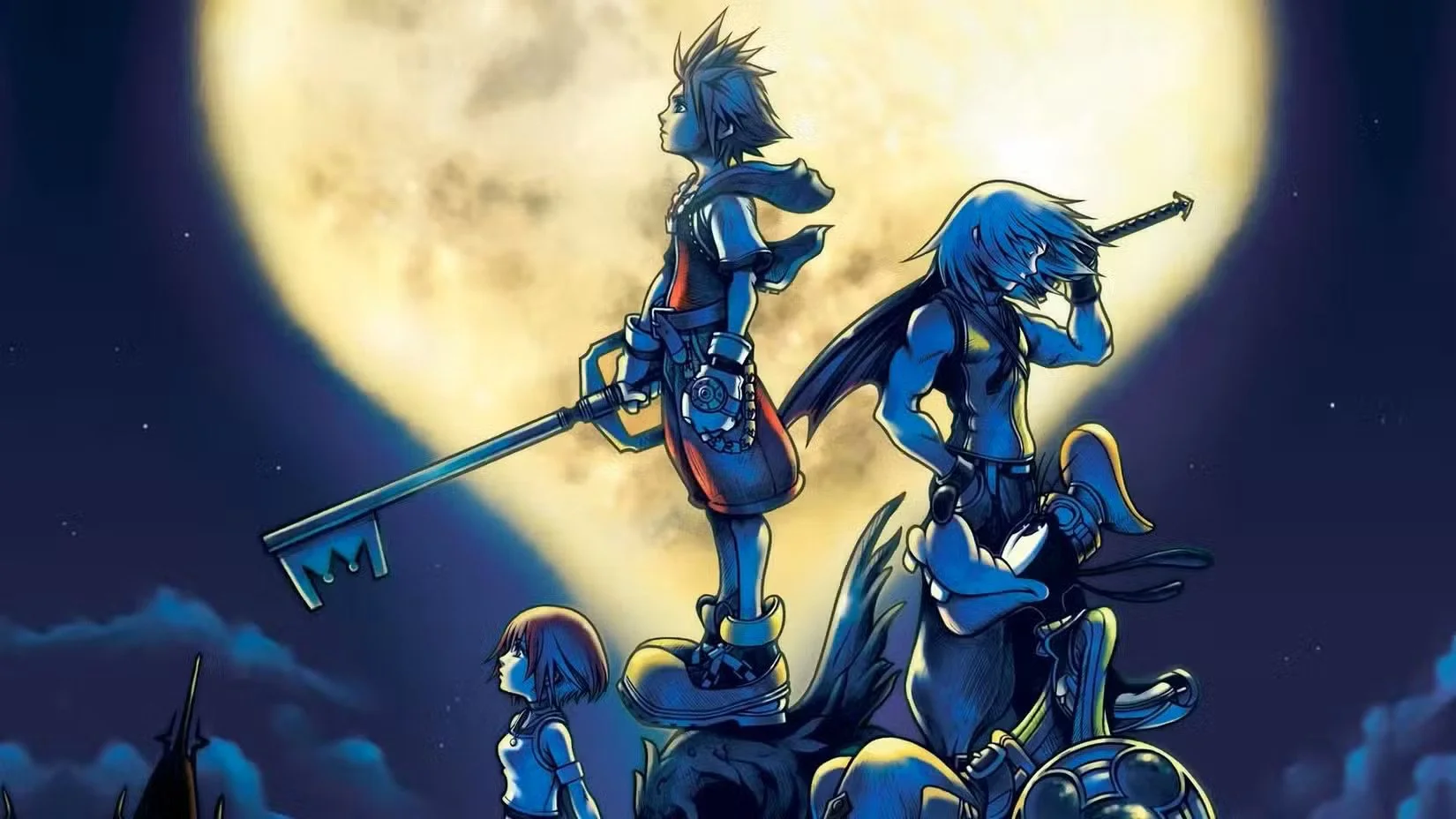
The original Kingdom Hearts is lightning in a bottle. Its combat manages to balance the series’ staple floatiness with primarily grounded combat, and a simple story that never adds more narrative elements than it needs to show off its true heart. // Image: Square Enix, Disney
“First game syndrome”: a term often used to describe the phenomenon of a first entry in a series or a first game made by a certain team or developer that is wrought by shortcomings born out of a lack of experience and confidence in what they want to make. Is Kingdom Hearts a victim of “first game syndrome”? I would argue yes. I would also argue that that is what makes it the best game in the series.
The broader Kingdom Hearts franchise is rife with details. As the series progresses, more nouns get introduced, a wider spectrum of antagonistic forces reveal their hand, and there are far more abilities and capabilities given to Sora. Theoretically, this leads to bigger and better video games. After all, why wouldn’t you want a video game franchise to gradually get bigger in scope and carry greater stakes in order to make new games more epic than what came before? If Kingdom Hearts offers any lesson, it’s that taking a simplistic, straightforward approach and offering fewer combat options can, in turn, make the player have a deeper appreciation for what is there, and thus lead to a more focused, well-rounded experience.
This isn’t to say that Kingdom Hearts features a lack of depth. The primary appeal of Kingdom Hearts is in its storytelling, exploration, and combat, all three of which benefit from doing more with less.
After being separated from his friends after the Destiny Islands get consumed by darkness, Sora looks for his friends Riku and Kairi alongside Donald Duck and Goofy as they search for King Mickey. And truthfully, this search for friends is at the very core of what the series is all about. While there is a specific focus on Riku gradually becoming more and more deceived by Maleficent and becomes jealous towards Sora to the point that he becomes consumed by darkness, this dynamic is always framed through the value of friendship. Riku only falls from grace as far as he does because he feels threatened from having his friendship and connection with Sora replaced. He sees Sora’s camaraderie with Donald and Goofy as a threat.
This can perhaps feel juvenile, but the simplicity and straightforwardness of this conflict in spite of Sora’s good-hearted nature and way in which he treats others makes this an easy narrative to get behind. As the audience, we see the purity of Sora’s perspective along with the way in which he trusts and believes in others. That becomes the essential narrative framing to make any player want to see Sora’s relationship with Kairi and Riku get mended and brought back to how it used to be. It’s an effective premise because it doesn’t allow details to get in the way. Kingdom Hearts knows its story is simple - and like the many Disney stories whose source material is referenced or featured in this game, the simplicity of relatable conflict is enough to make a story worth telling.
As a writer and admirer of dense worldbuilding and lore, even I can admit that sometimes, details can get in the way of making a story reach its true potential. In lieu of the prevalence of details, Kingdom Hearts’ story shines. It’s a real no-brainer that this game was able to capture the imaginations and hearts of any player regardless of age.
That said, there are certainly denser aspects of the narrative to chew on for those seeking such a thing. Specifically, the collectable Ansem Reports provide more narrative exploration of the Heartless, the in-universe understanding of “hearts” (which is more akin to the real-world discourse and philosophy about the soul), as well as the in-universe darkness that plays such a major role in every conflict in the series. This isn’t a narrative without details, to be sure, but those details are tucked away in corners to prevent themselves from ever feeling like an obstacle that prevents the narrative from achieving what it needs to.
Exploration and level design are other key components of Kingdom Hearts - ones that I think are where the game perhaps shows its age the most. Kingdom Hearts is composed of various worlds, most of which are realizations of various Disney films, while a few are original to Kingdom Hearts. As such, the player will be spending 97% of the game traveling through this worlds, with the other 3% (if that) being spent on traveling between worlds.
This is done through the Gummi Ship, a feature in the game that isn’t capable of realizing its potential largely through its limited nature. Gummi Ship sequences are on-rails shooters not unlike stages in Star Fox, complete with flying through obstacles, shooting at enemies, and dispensing ammo for special weapons. Where the Gummi Ship fails to be a compelling part of the game is its level design, sense of speed and vivacity, as well as the fact that it’s ultimately a small portion of the game’s runtime.
Traveling between each world via the Gummi Ship isn’t exciting largely because the courses that the player has to fly through aren’t challenging or even interesting to navigate. There’s a lack of speed and urgency to Gummi Ship sequences, with the overall number of enemies and obstacles on-screen never feeling like a genuine obstacle that the player needs to overcome.
To make these sequences faster and perhaps more of a power fantasy, there exists a Gummi Ship editor - something that will be present in each numbered KH title. The issue with this feature’s presence in the original Kingdom Hearts, however, is that its existence is never justified. Why bother spending a significant amount of time in the Gummi Ship editor and switching out different parts when the default Gummi Ship gets through all of the Gummi Ship sequences without any issue? Moreover, even if the player does spend the time to customize their ship, this is still a remarkably small part of the overall experience, making the mechanic overall here feel like a lack of realized potential.
Thankfully, Kingdom Hearts realizes its on-foot exploration far better through leaning on platforming, some minor puzzle-solving, and the presence of collectables. Square was heavily inspired to make a platforming-focused game in response to the explosion of 3D platformers circa the late’90s. While the company had experimented with featuring platforming in some of their titles like Xenogears and Brave Fencer Musashi, Kingdom Hearts leans into its platforming as an essential component of the overall gameplay. Certain worlds like Wonderland, Deep Forest, and Hollow Bastion ask the player to take movement and elevation as critical components into both level navigation and combat.
To make this an easier pill to swallow, there are a lot in these levels that make running and jumping through them interesting. Beyond regular encounters and frequently-placed treasure chests containing items and equipment, Kingdom Hearts features collectibles via the previously mentioned Ansem Reports that provide more lore, the 99 Dalmatians that gradually give meaningful rewards to the player, and the Trinity Symbols that incentivize backtracking to previous levels. Barring the Ansem Reports, this focus on collectables and backtracking in environments would be largely downplayed throughout much of the rest of the series.
While the level design of Kingdom Hearts is solid, the way in which the player is asked to move through these levels leaves a lot to be desired. Deep Jungle is perhaps the most egregious level in the game since it features a sequence of rooms that the player is to walk back-and-forth between. While in this world, the player is repeatedly tasked with navigating from the campsite, climbing to the treetops, up to the treehouse at the top of the level. This sequence never gets iterated upon or evolves in any way - the player just has to go through each room in this level multiple times. This type of mission design reeks of developers not fully knowing how to best merge their level design and narrative design.
Other levels have mixed levels of novelty in their design. Monstro is effectively a puzzle-focused world that features multiple exits in each room, tasking the player to map out how rooms are connected and how to progress to the end of the maze. Hollow Bastion, the game’s most complex world, regularly asks the player to navigate between different floors and solve puzzles to open doors to different areas. When Kingdom Hearts’ level design works, it works quite well, but it’s prone to being repetitive at best and annoying at worst. Atlantica is a particular pressure point that’s a love-it or hate-it world, depending on who you ask, given that world’s awkward swimming controls and at-times confusing map design.
The design for each level and the mission design that commands how players move through each level are both representative of a team still figuring out how to make a game of this nature. Its execution is flawed, but Kingdom Hearts sets the right pieces into place for building a foundation for more level-driven, platforming-focused levels. Unfortunately, this aspect of Kingdom Hearts would go on to become a point of stagnation throughout the series, as very few titles in this series push the boundaries and challenge of platforming as Sora.
Of course, the primary appeal of Kingdom Hearts is its stylish Action RPG combat. While I’ve praised other aspects of how this title’s straightforward design help elevate it into something greater, I truly think the combat is what makes this simple, grounded philosophy of Kingdom Hearts’ design work so uniquely well. While the player certainly has aerial combat options, there’s a limit to them. Sora can only complete a single aerial combo, then falls back to the ground or a significant distance below before being able to initiate another combo. This is a seemingly small aspect of Kingdom Hearts’ combat model, and yet it’s absolutely foundational at setting something in this combat system that isn’t nearly as present in that of later game: limitation.
The best combat systems in games understand that limitation breeds creativity. Instead of giving the player a plethora of options to take into consideration for combat, games can give the player access to a smaller number of combat options. This, in turn, forces the player to think more critically about the options that they do have access to and apply them more tactfully. Sora learns various abilities throughout Kingdom Hearts, including but not limited to a Dodge Roll, a Guard option that can lead to counterattacks, combo extensions, combo finishers, and more. Even as Sora’s combat options grow throughout the game, there is still a decisive conservatism with regard to how much Sora is able to do at a time.
Sora can’t perform multiple air combos in quick succession nor can he quickly integrate spells mid-combo. There is a smaller number of options that the player has at their fingertips at any given moment, and the game is better for that. Later games give the player access to more options that ultimately lead to flashier, more visually and mechanically busy combat - but that expansion of options causes something to be lost. By having fewer options to take advantage of, players are forced to become more intimately familiar with Sora’s more limited moveset here. Players still have a healthy amount of playstyles available to them thanks to the many offensive and defensive abilities the player can gain access to throughout their journey, but there is something of a purity to Kingdom Hearts’ combat. It reaches the perfect level of satisfying depth without ever losing itself in a multitude of details.
It’s that commitment to remaining reasonably grounded that ultimately makes the original Kingdom Hearts feel like the most well-rounded game in this series, despite over twenty years’ worth of refinements seen in the various successors to this game. Kingdom Hearts understands that quality doesn’t hinge on detail. There doesn’t need to be various narrative elements to make a story engaging to see unfold. There doesn’t need to be various mechanics to take into account during combat to make for a compelling playthrough. There’s a restraint that Kingdom Hearts employs - one that prevents itself from getting lost in making a game more detailed, more complex than it needs to be.
I came back to the Kingdom Hearts franchise after a long hiatus with a playthrough of this game, and I found myself charmed by that very restraint. It’s a unique trait that sets this game apart from all that would come after, and that’s what makes it stick out in my mind as being so well made. While it perhaps lacks some of the polish and refinement that later games would have, I think Kingdom Hearts captures the essence of the series the best out of any KH game. Kingdom Hearts still carries with it the charm and quality that attracted so many players nearly half a century ago. That attraction is what turned this game into the successful franchise that has endured ever since, and it can still make the same impact on a new player that picks the game up today.
The problem for Kingdom Hearts moving forward will be to retain that attraction in order to entice players to come back for more.
Kingdom Hearts: Chain of Memories
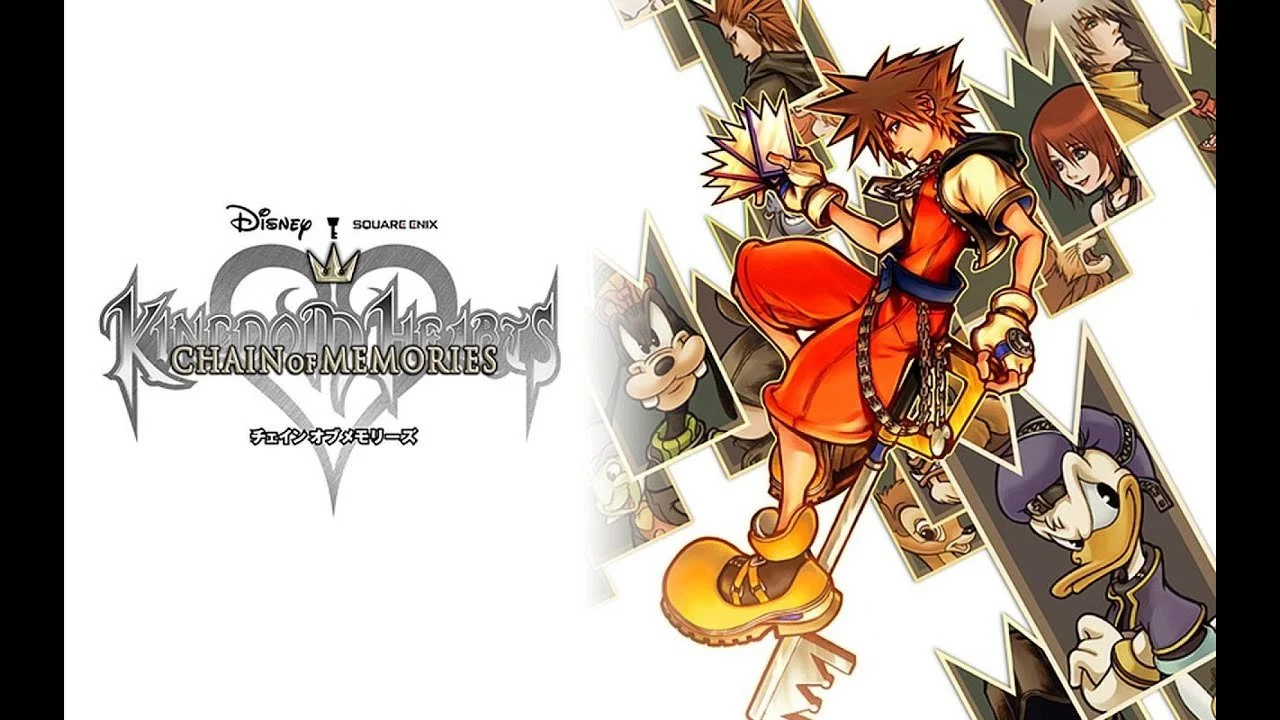
Originally released as a Game Boy Advance title, Chain of Memories caught many players off-guard by not being a meager spin-off, but an essential bridge between the first two numbered KH games. Despite recycling lots of content and being prone to repetition, Chain of Memories is perhaps the most mechanically interesting game in the series. // Image: Square Enix, Disney
Kingdom Hearts would very much succeed at capturing the hearts and imaginations of players again in due time, but the way in which it would do so would itself go on to challenge peoples’ expectations of a typical franchise trajectory.
A few years after the release of the original game, Sora’s story would continue in Kingdom Hearts: Chain of Memories. However, this game would break the typical expectation placed upon handheld games for franchises by being an essential bridge between the first two numbered games on the PlayStation 2.
This flies in the face of the typical burden that’s placed upon handheld games. Throughout most of video game history, there have been different perceptions of different types of video game platforms. Games released on consoles and PCs are typically expected to be “full” games, whereas games released exclusively for handheld platforms have historically been expected to be compromised, maybe “less important” versions of those “full” experiences. Think about whenever you have a conversation about the God of War franchise, for example. Whenever people talk about that series, they typically discuss the “full” iterations of that franchise. The first three numbered games, God of War (2018), and Ragnarök are what’s typically discussed in that series by its fans (along with the occasional weirdo that remembers God of War Ascension exists).
Chains of Olympus and Ghost of Sparta are typically given less attention because they’re victims of how portable games are perceived as inherently “compromised” and “lesser” than their console/PC peers. They aren’t given the same merit or value by fans largely due to the fact that they were released on hardware that necessitated compromises that didn’t exist for the franchise’s console entries. These games seemed to be designed with that perception and expectation in mind, as the PSP God of War games aren’t necessary steppingstones to understand the plot of the numbered God of War titles.
This is a flawed perception worth being challenged and addressed, but the reality is that handheld games are often expected to be inessential experiences compared to their console/PC counterparts. Kingdom Hearts directly challenges this by having its next chapter be told on a different platform. As bold as this strategy was, it ultimately left a lot of Kingdom Hearts players waiting for a sequel in the dark. Donning a subtitle, releasing on a different platform in an era where games media and journalism wasn’t as accessible as it is today, and it’s hard to blame fans that thought Chain of Memories was a spin-off for hardcore fans or for those without a PS2 instead of what it actually was: a full follow-up to Kingdom Hearts.
This caused a lot of players to skip Chain of Memories and go straight to Kingdom Hearts II, oblivious to the importance of the GBA title. This infamously led to two problems. Firstly, it led to a lot of players feeling blindsided by KH2’s infamously long opening that doesn’t give a clear answer over what exactly happened between the end of the first game and the start of the second game. Players became confused and many may not have known that Chain of Memories even existed. Secondly, this led to Kingdom Hearts being a series spread across multiple platforms. For a time, if a Kingdom Hearts fan wanted to experience the entire story of the series, they would need to own a PlayStation 2, a Game Boy Advance, a Nintendo DS, a PlayStation Portable, and a Nintendo 3DS in order to get the full story - a difficult, expensive ask for a target demographic of kids and teenagers.
Both of these issues would be addressed as the series received remasters that would be ported to all modern platforms. All games are now available on any platform of a player’s choosing, and the remastered collections organize each game in the ideal play order to boot - but that doesn’t take away that keeping track of this franchise was a pain for the generation most of these games launched during.
But the past is past - Chain of Memories, like all of the handheld KH entries now exists as part of the Kingdom Hearts collections through a remaster of the PS2 remake: Re:Chain of Memories. Originally released as a bonus disc to the Japan-exclusive Kingdom Hearts II Final Mix+, Re:Chain of Memories saw a standalone release on PS2, which served as my introduction to the game. Re:Chain of Memories has a special place in my heart, as it was the first game in the series that I properly owned and didn’t borrow from a neighbor. Beyond that, Re:Chain of Memories was one of the first games that I purchased with my own money, making it even more of a turning point in my connection with games. No longer was I at the mercy of acquiring games as birthday gifts or borrowing them from my brothers, friends, and neighbors - I was now able to start buying games for myself.
Re:Chain of Memories bizarrely may be the game in this series that I have the most connection to. While this entry is often critiqued by series fan for its often repetitive gameplay, I had wondered for a time if I was blinded by nostalgia regarding my perception of Re:Chain of Memories. Upon this replay, I’ve found that very little has changed about my assessment of this game. This is an immensely fun time if you can withstand its grindy and repetitive nature.
I wouldn’t describe Kingdom Hearts as being a collection of grindy games. These games often balance intrinsic and extrinsic progression so that players can overcome challenges even if they’re theoretically underleveled or underpowered for a boss fight. These games leave the door open for player skill to be enough to carry a player through their experience - which has caused Level 1 challenge runs to be a popular challenge within the community. Moreover, most Kingdom Hearts titles don’t make becoming high-level feel like a necessity. Players never have to get particularly high level in order to comfortably roll credits, and they can even get by not having to be anywhere near the level cap to take on each game’s superbosses. This is largely due to the fact that levelling up in most Kingdom Hearts games is merely an increase to stats and the occasional new ability. At a certain point and with smart equipment and ability allocation, players can have solid stat allocation in lieu of grinding out levels.
I bring all this up because Re:Chain of Memories is a kind of antithesis to this philosophy. This is an ostensibly grindy game due to its radically different gameplay - one that’s built around using cards to gain the upper hand in combat. I would argue that it’s the most fun combat system in the series once fully understood.
Instead of having the ability to freely attack, cast spells, and use items, Chain of Memories locks every action behind using a card, ranging between 0-9. Cards of a higher value break cards of a lower value, with the exception being a 0 card, which can itself break a card of any value, but can also be broken by a card of any value. On top of this, up to three cards can be queued together, and certain combinations create a Sleight - Chain of Memories’ version of abilities. Queuing three Cure cards together creates a Curaga spell, queuing three attack cards of the same type with a certain sum creates a Sliding Dash ability, and so on. The drawback of Sleights is that the first of the three cards queued will be removed from the deck for the rest of the battle unless the player uses an item that can return them to the deck. Once all cards are depleted in the deck, the player has to reload their deck by holding a button while standing in place.
The card system completely transforms the play experience of Chain of Memories, which makes it distinct from other Kingdom Hearts games. The fun of combat doesn’t necessarily come from the moment-to-moment gameplay of attacking, casting spells, and moving around your opponent. Rather, the fun of Chain of Memories is more in the prep that happens before combat - it comes in the form of building an effective deck of cards.
Optimizing one’s deck of cards for combat will look different for every player - but for me, I typically built my decks in order to maximize Sleights that could be used back-to-back. I built my deck in order to create an onslaught of abilities like Blitz, Sonic Blade, and Lethal Frame, among others. And since these moves are built with cards that create a high sum, they can only be broken by either another enemy’s high-sum Sleight (which are typically only used by Bosses), or with a 0 card. If an enemy tries to attack with a card or Sleight with a sum lower than the currently active card or Sleight, then that lower value attack automatically gets cancelled.
I built my deck in a way that accounted for the first card of each Sleight being removed during the next reload of the deck. Taking this into account, my second roll through my deck contained a different rotation of Sleights, meaning the onslaught could keep coming. After a second rotation through my deck, I’d typically use an Elixir in order to reset all cards in my deck, and let the process repeat - which would typically be more than enough to end any fight. Depending on how judiciously players are able to build their decks, much of Chain of Memories’ combat, including many of its boss fights, can be trivialized. This was the case for me, as my deck became so optimized throughout my playthrough that only a few fights towards the end of the game required me to use a strategy other than plow through my queue of Sleights.
On one hand, creating an overpowered deck that breaks the game is immensely satisfying. Dominating opponents is effectively a reward for taking the time to smartly construct a deck. On the other hand, having so much of the game become trivialized through optimally building your character reveals one of Chain of Memories’ greatest weaknesses - it creates shockingly few fights that meaningfully interrupt and change up the card-based combat. Many boss encounters become trivialized because the player is able to cancel out all attacks that a boss is capable of. If I’m fighting Larxene and all of my high-value Sleights never get broken by a higher-value Sleight or 0 card, then I never get to see any of her attacks. The fight effectively just becomes an onslaught of Sora performing consecutive attacks while the opponent doesn’t get a chance to do anything in response.
It isn’t until towards the end of Sora’s playthrough that boss fights start to play around with the card mechanics, with the final fight against Marluxia being a particularly brilliant test of the player’s understanding and adaptability within the card system. In this fight, certain attacks empty the entire deck and the player has to pick up individual cards scattered across the arena, making the player’s deck appear out of order. This forces the player to adapt and continue the fight with a jumbled deck - a meaningful challenge that prevents the player from leaning on deck structures they’ve gotten long used to.
As fun as it is to optimize your deck and overpower foes as a result, I think Chain of Memories would have been a better game overall if it was willing to play with this system more than it actually does. As is, the card system feels remarkably unbalanced at the cost of being fun and satisfying to break.
To create such broken decks in the first place, though, players need to level up to increase their HP, CP (the resource that dictates how many cards can be in the player’s deck) and learn Sleights. More conventional stats like Strength, Defense, and Magic are not affected by levels and are instead determined by cards. As such, gaining levels has far greater value in Chain of Memories because it opens the door to the player being able to access more and more Sleights during combat.
Levels having greater value inevitably means that the player is incentivized to get as high level as possible in order to realize their envisioned deck optimization. This causes Chain of Memories to become incredibly grindy. While the player gains experience points and therefore gains levels fairly quickly, that still means that much of Chain of Memories is spent in gauntlets of combat in order to gain levels that grant the player access to a bigger and better deck. Once the player has access to strong Sleights like Blitz that can target and defeat multiple Heartless quickly, this process starts to become mindless. Indeed, grinding levels in Chain of Memories mostly boils down to spamming certain Sleights with no contest whatsoever - only further highlighting the limited design and balance of this card system, fun as it may be.
Let’s talk about other mechanics that lead to certain issues. During fights, the player will also gain access to party member cards that populate the battlefield, which add additional cards to the player’s deck, opening the door to even more potential Sleights. This injects just a bit of experimentation and emergent gameplay when it comes to creating new Sleights and card uses on the fly during combat. This largely replaces the emergent gameplay born out of navigating combat arenas, as all of Chain of Memories’ fights happen in flat, square-shaped or circular arenas with no obstacles or verticality to take advantage of. Unlike other KH games where fights begin seamlessly in the game’s environments, walking into an enemy takes the player to a separate arena where battles take place - not dissimilar to other encounter-based JRPGs.
This unfortunately means that level design is nowhere near Chain of Memories’ strong suit. Instead of having intentionally designed levels that give each Disney world its own identity, every Disney world is now a maze of diorama-like levels that are generated depending on the different map cards that the player uses for each room. While creating different rooms that have different gimmicks to them is a novel idea, this design approach unfortunately causes each level in the game to blend in with one another. Levels being built this way can be somewhat forgiven considering the game’s origins as a GBA title with an isometric perspective, however it ultimately makes exploring levels feel remarkably vapid.
Most worlds devolve into whacking certain interactable bits of level geometry to pick up health refills, new cards, and Moogle Points (Chain of Memories’ currency). Outside of that, level progression exclusively consists of using map cards to navigate a maze of rooms that can be as easy or challenging as the player pleases. Each door may necessitate using map cards of a certain type or sum, leading to some variety in the types of rooms that the player makes. Beyond that, there’s nothing that diversifies level progression.
What doesn’t help is that level progression in each Disney world is effectively just walking to an area to trigger a cutscene, a second cutscene, then a boss fight. This formulaic structure never deviates aside from the brief trip to the combat-free Hundred Acre Wood, and the late game worlds of Twilight Town and Castle Oblivion. This repetitive structure could be masked through engaging narrative design and storytelling, but this is unfortunately where Chain of Memories also struggles.
Indeed, Chain of Memories’ Disney worlds retread the plot beats of the original game. Going through the worlds of Atlantica, Olympus Coliseum, Wonderland, and Agrabah all go mostly the same as they did in the previous game. Maybe there is an additional focus on the concept of memories, Chain of Memories’ main narrative theme in its original storytelling, but that’s about it. The plots that unfolded in the Disney worlds in Kingdom Hearts could feel like filler at times, but that’s absolutely the case in every Disney world here.
Every Disney world traveled to in Chain of Memories feels like an obligation rather than something that adds to overall gameplay experience. Retreading very similar narrative beats takes away from what came before. Even for those theoretically coming to Chain of Memories on GBA without having played the original game, I still don’t find these retellings of Disney stories to be particularly memorable or holding a candle to the source material. Simply put, the stories told in the Disney worlds feel inconsequential at best and detrimental to the game’s pacing at worst.
Indeed, the bulk of Chain of Memories’ narrative comes from the original storytelling bits that take place between each Disney world. The end and beginning of each floor is where the bulk of Chain of Memories’ storytelling is told. The story told here, which properly introduces elements like Organization XIII and Nobodies to the Kingdom Hearts universe, is compelling enough to incentivize a full playthrough. There’s enough mystery to make uncovering what’s going on in Castle Oblivion to feel fun, even if a lot of the narrative built up here doesn’t see proper payoff until the next game.
Some of the story’s best moments see the good-hearted Sora slowly get corrupted and lose his sense of self, reaching a point where he practically abandons all his friends in pursuit of chasing a friend he’s been convinced that he’s forgotten. It leads to character moments that feel out-of-place for Sora in the best way possible. Chain of Memories is absolutely an essential part of the greater KH canon not only because it connects the events of KH I and II, but also because it reveals certain character information that we don’t quite get to see elsewhere. Chain of Memories grants an opportunity to see a side of Sora that we don’t get to see in other games, making the journey here feel interesting and worth taking.
This extends, perhaps even more so, to Riku’s side of Chain of Memories. Once rolling credits in Chain of Memories as Sora, the player gains access to a second, smaller story starring Riku. This story focuses on Riku grappling with having been taken control of by the darkness and accepting that it is now a part of him. He grapples with trying to learn how to control balancing darkness and light.
Having his playable debut in this title, Chain of Memories takes Riku, a character we don’t get to see a true redemption of until the very end of the first game, and makes him feel like a more fully realized character. By getting to see more of his perspective, Riku becomes a more sympathetic and likable character due to what he goes through in Chain of Memories. His story here is definitely one that feels just as, if not more essential than Sora’s journey in this game.
It helps that Riku’s story also features gameplay that, I argue, addresses some of the issues in Sora’s side of this package. Unlike with Sora, players are unable to freely customize Riku’s deck. Rather, his deck changes in every world, making the player have to adjust to a different flow to combat, as well as new mechanics. Riku introduces the Duel and Dark Mode mechanics. Duels are triggered when using a card of the same value as the opponent, tasking the player with having to quickly play cards that beat the opponent’s. Dark Mode, meanwhile, transforms Riku with a new moveset after breaking opponents enough times.
These new mechanics breathe new life and diversity into Chain of Memories’ combat model. The player has to consistently adapt to new decks, preventing them from getting too comfortable with a deck and becoming potentially overpowered. Like my assessment of Kingdom Hearts’ combat, I think the limitations put in place here work to the game’s benefit, as a lower amount of options given to the player make them appreciate what few options they do have even more. As Riku, I found myself engaging with the card system in a way that felt more in line with the intentions of the developers. This side of Chain of Memories feels more intentional, more balanced, and more challenging as it forces players to have to engage with mechanics to see success in challenging fights. This is a shorter experience, but it helps complete the package by offering more narrative and mechanical meat to chew on.
Chain of Memories is ostensibly flawed. It’s grindy, it’s repetitive, the Disney worlds are a massive letdown, and the lack of balance in Sora’s gameplay can make the experience feel completely trivial and mindless at times. But there’s an ostensible satisfaction with reaching that point that I can’t help but admire and have fun with. This is largely how I felt with the game when I first played it nearly twenty years ago, and it’s how I feel now. This game’s greatest drawback, I find, is that it offers little besides its combat excellence and occasional narrative intrigue. There are no substantial breaks in combat aside from the brief visit to Hundred Acre Wood, and that largely causes Chain of Memories to feel exhausting by the end. The lack of diverse gameplay besides, combat, combat, combat made me feel glad to be done with the game by the time I finished Riku’s story.
A game that makes you feel relieved to be done with it unfortunately has a ceiling on how great you can rate the overall experience. While Chain of Memories has high highs thanks to the capabilities of its fun card-based combat, it has a lot of low lows thanks to its structure and imbalance that make it still be an inferior experience to the original game - one that’s difficult to recommend to play given how grindy it can be. There’s fun to be had here for those that can stomach this game’s shortcomings. For better and for worse, Chain of Memories is an outlier to the rest of the series. From here on out, the series would become far less experimental in its primary gameplay systems. While I do find that to be a shame to an extent, it’s hard to argue that what would come next wasn’t a valiant effort to evolve what this franchise is capable of.
Kingdom Hearts II
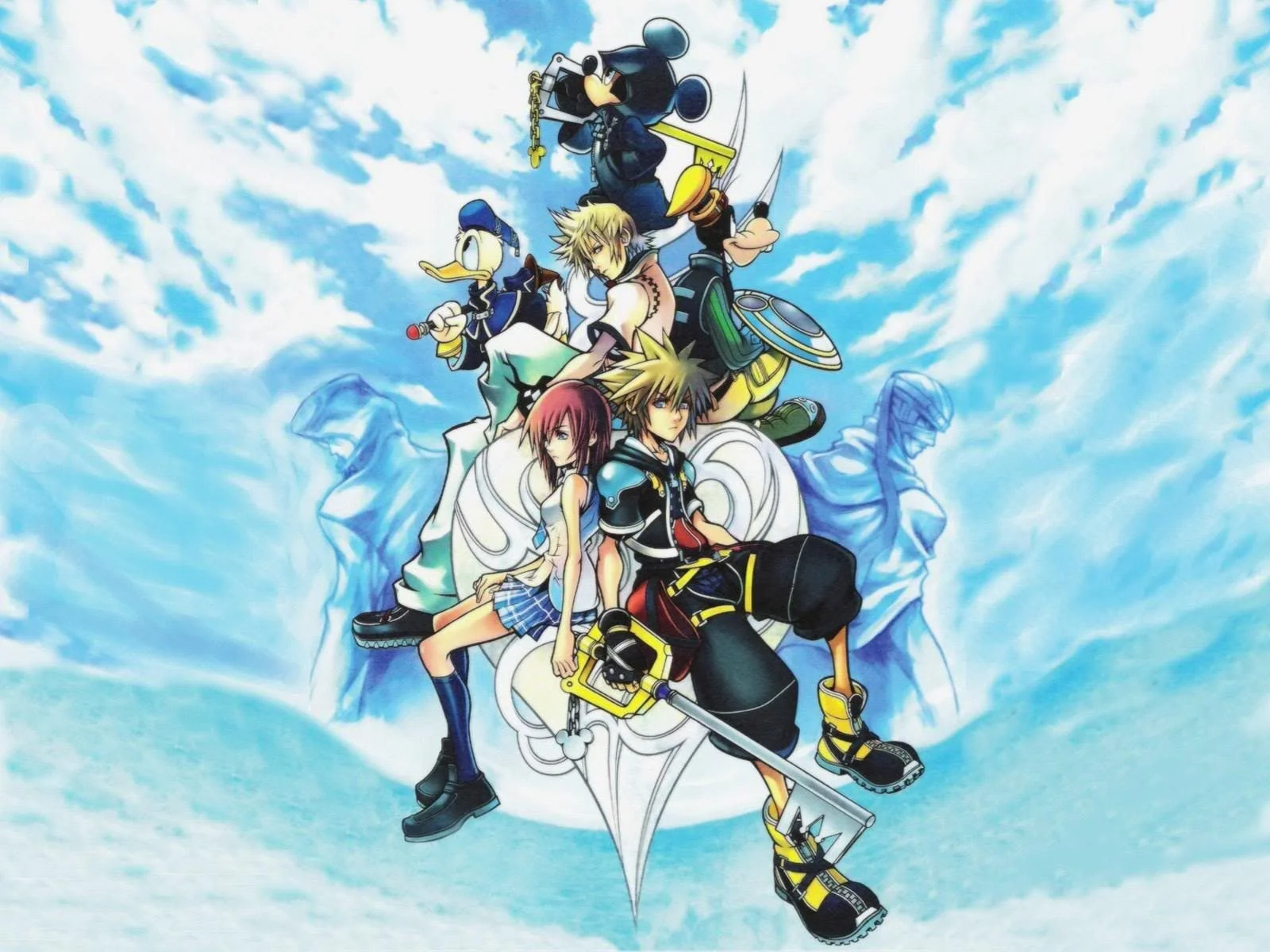
Often regarded as the best game in the series, there’s a lot to like about Kingdom Hearts II. It’s bigger, features fights that are more cinematic and mechanically involved, and offers a massive improvement in presentation. However, details start muddying the clarity that made the previous two games feel more focused. // Image: Square Enix, Disney
This is it: the big one. Conversations about Kingdom Hearts can easily turn into a Kingdom Hearts II glazing session sometimes, and it’s understandable why. On its surface, Kingdom Hearts II is a fantastic sequel that does everything a second numbered game ought to do: it’s bigger, more feature-rich, and is more ambitious than what’s come before. There are more Disney worlds here complete with revisits that make the stories told within them feel more involved. In fact, many original characters part of Organization XIII intertwine themselves with the story of most Disney worlds, making the various worlds that Sora travels to feel as though they contribute to the broader narrative.
Kingdom Hearts II also stands alongside Final Fantasy XII as a showcase of how much Square Enix had mastered working with the PS2 - the visuals on display here feel so much more ambitious and grand despite being on the same hardware as the original. Additionally, KH II pushes the hardware a lot more, with many more enemies being able to be onscreen - as is best showcased by the famous battle of 1,000 Heartless. Character models are more detailed, facial animations are more impressive - KH II is a good looking game!
The biggest visual upgrade of Kingdom Hearts II is with regard to the fluidity of combat. Kingdom Hearts II is decidedly a flashier game, and that largely comes down to how smoothly Sora moves around during combos both on the ground and especially in the air. There is far more visual variety with how Sora zips around the battlefield and takes down enemies, which is largely in thanks to how many more options that Sora has to engage in combat.
Kingdom Hearts II frankly dwarves the amount of abilities that Sora learns in comparison to the first game. While combat can feel relatively basic and not too dissimilar from the first game, the combat transforms significantly throughout the game. Endgame combat can be almost challenging to navigate just by how vivaciously Sora moves through the air as he gains access to longer, stronger, and more intricate combos.
The visual spectacle on display is partially the appeal of Kingdom Hearts as a whole, but it’s with Kingdom Hearts II that it truly feels like the series attains a cohesive visual identity in totality. While Kingdom Hearts certainly had a cohesive vision to its aesthetics, Kingdom Hearts II effectively becomes the blueprint for how all Kingdom Hearts games will look in the future. The UI and overall visual style here, even for small things like level up notifications and prompts for collecting new equipment, becomes the standard for all future games.
It could be argued that Kingdom Hearts II is the first game in the series that fully understands what it wants to be and accomplish as a Disney and Square Enix crossover. The game continues to serve as a mashup of original characters, Final Fantasy cameos, and Disney worlds and stories to inhabit, but it does so with so much more to appreciate and for everything to feel grander.
On its surface, I can’t help but agree with the sentiment that Kingdom Hearts II evolves the series enough to warrant being considered as the best game in the series. On paper, it very well may be. But in execution, I think there are some glaring weaknesses that hold the game back just enough to never quite match the strong pacing and overall cohesion of the original game.
The biggest culprit of this is the level design, which I argue takes an unfortunate nosedive in quality compared to the first game. While many of Kingdom Hearts’ levels contain a good deal of platforming challenges, verticality, and interesting ideas for many of its areas, Kingdom Hearts II’s level design primarily consists of linear hallways that don’t accomplish anything interesting. Worlds such as the Underworld in Olympus Coliseum, the Pride Lands, and the Land of Dragons are primarily composed of linear hallways that rarely if ever ask the player to perform any kind of interesting level navigation, platforming, or puzzle solving. Levels feel remarkably flat as a result.
What makes this additionally frustrating is the fact that Kingdom Hearts II introduces a plethora of new movement options for Sora to take advantage of. Sora acquires various Drive forms throughout the adventure, each of which can be leveled up. Valor Form gives Sora a higher jump, Master Form lets Sora double jump, and so on. Once leveled up, these movement abilities graduate from being only available while in each ability’s respective Drive form to becoming a mobility options that Sora has access to at all times.
While gaining access to these abilities makes movement snappier, flashier, and genuinely useful during combat, the level design in the original release of Kingdom Hearts II doesn’t task the player with making smart use of these abilities at all. Having access to a higher jump, an aerial slide, a double jump, and a glide become far less interesting when no parts of level design ask you to use these abilities in challenging, interesting ways.
It wouldn’t be until KH II’s Final Mix rerelease (that only became internationally accessible with the ReMIX rereleases) that Kingdom Hearts II would finally give players a reason to use these abilities in creative ways. Firstly, Final Mix adds puzzle pieces that can be collected throughout each level - most of which can only be acquired through using these movement options. Secondly, Final Mix adds a new area within Hollow Bastion / Radiant Garden: the Cavern of Remembrance. This dungeon is designed in a way that requires the player to showcase their mastery of these different movement options through tight platforming challenges.
This sequence is so good that it begets wanting more - something that Kingdom Hearts II simply doesn’t do. This optional dungeon reserved for gaining access to postgame superbosses is the only part of the game that truly feels like an instance of interesting level design, which is a great shame. As is, moving through many of Kingdom Hearts II’s levels is an uninteresting process that is only made slightly less laborious with abilities that make movement through them take less time.
Weak level design means that the Disney worlds need more than just fun level design to carry the experience of navigating through different levels. Kingdom Hearts II accomplishes this with mixed results. A lot of the Disney worlds are now peppered with minigames or alternative means of progression. On top of the typical minigame fare of the Hundred Acre Wood, each level usually contains some kind of minigame. While some are fun deviations from the typical gameplay, such as Space Paranoid’s Light Cycle races that feel like a perfect realization of the world of Tron, other minigames are remarkably lame. The kind-of-minigame-kind-of-quicktime-events in Beast’s Castle that task Sora with working alongside the various Beauty and the Beast characters are relatively uninteresting tests in patience and resource management.
Some levels play completely differently from others. Timeless River, on top of being perhaps the most aesthetically well-realized world in the series, is less of a regular Disney world and more of a collection of disconnected combat challenges. In a way, this different structure works as a great representation of the smaller, more disconnected storytelling of early-era Disney animation. On the other end of the spectrum is the infamous inclusion of Atlantica, which has been converted from a full world in KH I to a series of poorly executed rhythm games. This world’s sections get so much flak because they’re incredibly clumsy and not nearly as involved as a quality rhythm game ought to be.
Kingdom Hearts II’s levels have a lot more experimentation within them, which I can appreciate. But with that experimentation comes a few duds and an overall lack of polish that’s inherent throughout all parts of the game. While some levels are certainly better than others, I struggle to find any particular Disney world as a highlight of the entire experience.
So what, then, is the highlight of the entire experience? Simply put, it’s the consistently fun combat that has been tweaked to offer a constant feeling of progression.
Kingdom Hearts II adds Bonus Levels - what will become yet another staple throughout much of the rest of the series. While regular levels are still granted via accumulated experience points, Bonus Levels ensure that every major battle in Kingdom Hearts II grants the party new abilities. Now, every boss fight is guaranteed to grant Sora, Donald, and Goofy an increase in their health, magic, more inventory slots, or new abilities. This is a small thing that makes each fight have a more satisfying payoff to it simply through becoming stronger in a way that goes beyond just accruing more experience points. The inclusion of Bonus Levels also ensures that players will gain access to more combat abilities steadily throughout the game, which unlocks more that Sora can do.
This leads to the flashy, extensive combat that I’ve already mentioned. This turns combat into being flashy, cool, fun…and rarely challenging. Because Sora has a far greater toolkit, including having access to Drive Forms that can quickly turn the tide of battle, combat becomes remarkably easier. More tools means that there are more ways to deal with combat situations. On one hand, this leads to more dynamic gameplay, but on the other hand, it can become quickly apparent that these tools make Sora a dominating force.
To the game’s credit, Kingdom Hearts II balances its combat pacing the rate at which options become available the best out of any game from here on out. However, Kingdom Hearts II is the first instance of option inflation in the series, and it creates a messy precedent of the series that makes the series become less reliant on becoming intimately familiar with a controlled amount of tools. Rather, Kingdom Hearts II prioritizes style and variety in its combat, which, while appreciated, doesn’t change the fact that Kingdom Hearts combat is still relatively simple in practice. Much of combat still devolves into attacking and occasionally casting spells, but the inclusion of more tools can inject more diversity into the way players overcome threats. This even extends to the returning Gummi Ship sections, which provide far more fun and spectacle, but are still notably easy to get through.
Truthfully, I find the overall easier difficulty of Kingdom Hearts II to be a non-issue until the postgame enter the conversation. While Kingdom Hearts and its Final Mix rerelease featured superbosses, the gap between the difficulty of the game’s final bosses and the bosses that could be tackled after the main story wasn’t overwhelming to a point that it felt like grinding was a necessity. That gap in Kingdom Hearts II, however, is gargantuan - especially in Final Mix. While defeating Xemnas is a comfortable challenge, the real difficulty of Kingdom Hearts II kicks in during the aforementioned Cavern of Remembrance. This initiates battles with all Organization XIII members, culminating in a final test with the Lingering Will, the game’s ultimate test.
My primary issue with these fights is that they’re simply way too significantly more challenging than anything else offered in the game. There’s a largely smooth difficulty curve throughout Kingdom Hearts II, with a reasonable uptick with Sephiroth. But once the Data Battles and Lingering Will enter the equation, that difficulty curve spikes into the stratosphere - to the point that I think it does these postgame fights a disservice. Instead of the game gradually building up the player’s ability to take on more challenging fights, the Data Battles and postgame content of Final Mix feel more like a wall that the player has to suddenly overcome. This can be slightly mitigated through grinding for experience points and resources to make Ultima Weapon, but at a certain point, the main requisite for success in these fights is pure skill and mastery of the game’s combat.
This is yet another issue that later games will only double down on. It’s a shame, because the postgame content that’s here is plentiful, and the fights themselves are mostly well-designed encounters. But they crank up the challenge too abruptly to feel like a natural evolution of the game’s challenge.
Kingdom Hearts II features a lot more details within its gameplay, but many of the game’s additional details come into view with its narrative. The paradox of Kingdom Hearts II’s story, however, is that it remains a remarkably simple story at its core - there are just a lot of details that get in the way of seeing that. On one hand, I think the scale of the lore and worldbuilding in Kingdom Hearts II is impressive and succeeds at making the stakes of this game feel greater. On the other hand, though, the explosion of details dilute what makes the core of Kingdom Hearts storytelling so effective. At its core, Kingdom Hearts II still tells a story of Sora trying to reunite with his friends, but the degree to which Organization XIII and their antics are interlaced throughout the game make the story seem more confusing and complicated than it actually is.
This, I feel, is the product of clumsy narrative design and writing. I think Kingdom Hearts’ storytelling is truly at its best when it embraces the simplicity of what it wants to say about friendship and connection. The inclusion of more narrative details doesn’t necessarily make Kingdom Hearts’ messages about friendship deeper or more profound - rather, it just becomes bloated with details for the sake of it.
That said, there are times when the details make the core themes of Kingdom Hearts II’s story better, most notably with Roxas’ story and his relationship with Axel. Narrative threads like these help elevate Kingdom Hearts II in its mission to realize a simple but effective story. Lengthy cutscenes where Organization XIII members vaguely talk about their Evil Plans, however, just add more detail with no substance. And unfortunately, this is something that the remainder of the series will struggle with.
That would eventually be the straw that made me get fed up with the series - however, its presence in Kingdom Hearts II never becomes overwhelming to the point of detracting from what makes this game work.
Kingdom Hearts II indeed still feels like the big one, but it carries with it a certain kind of bloat that makes it feel less focused and refined than its predecessor. While I no longer see it as the crown jewel of the series, I still think there’s a lot of value in playing Kingdom Hearts II today. What it gets wrong is largely balanced out by what it gets right, and given the game’s overall ambitious scale, I think that’s a solid achievement.
Up to this point in my series playthrough, I found myself having a great time with each installment. While each game so far carries with it an undeniable set of flaws, I found myself finding a newfound appreciation for these games as an adult. The next batch of releases, though, would be where my issues with the series would largely begin to arise.
Kingdom Hearts: 358/2 Days
Aside from having one of the worst subtitles of any video game, Kingdom Hearts 358/2 Days is distinct from the rest of the series by being ostensibly more character-driven and narrative-focused than the rest of the series. However, its mission structure and lack of original gameplay content makes it a weak game. Its story also doesn’t have the emotional punch it thinks it does. // Image: Square Enix, Disney
Kingdom Hearts 358/2 Days (read: 358 Days over two) only exists in the modern Kingdom Hearts collections as a collection of cutscenes, making its gameplay legacy on the series not as apparent to some. In truth, I see 358/2 Days as equally responsible as Kingdom Hearts II for sowing the seeds of the pitfalls that the later Kingdom Hearts games would victim to. 358/2 Days is nowhere near as ambitious as Chain of Memories on a gameplay front - if anything, it feels like a paired down version of KH I’s combat and level navigation - which is actually quite impressive considering the hardware this game was developed for. The Nintendo DS was significantly less powerful than a PS2, and yet many of the worlds made for previous games reappear here and stay true to how they were presented in previous games.
Cutscenes are prerendered and significantly scaled down to render properly on the low-resolution screen of the Nintendo DS, but the fact that the DS is able to run cutscenes of this length and scale at all is impressive regardless. In many ways, 358/2 Days is a showcase for what the DS was capable of with regard to 3D games.
There isn’t much to note with 358/2 Days on a gameplay ront except for what I consider to be its most annoying aspect: its approach to progression. 358/2 Days is the beginning of an awkward era for Kingdom Hearts, where each game begins injecting bizarre progression systems for the sake of it. While levels and abilities gradually make Roxas stronger throughout the course of the game, each level and ability has to be equipped via a grid - not dissimilar to Resident Evil 4’s suitcase inventory system.
Of course, Resident Evil 4’s innovative method of managing inventory worked as well as it did because it made the player have to consider what weapons and restorative items that had access to more critically. In the case of 358/2 Days, having to decide between being higher level or having more abilities or having access to more items is a neat concept in theory, but it makes the actual process of creating a build and strategy for boss fights feel more annoying than it needs to be.
Unlike previous games, 358/2 Days employs a mission structure, which creates shorter nuggets of gameplay to accommodate for the game’s portable nature. Unfortunately, much of the mission design is pretty bland and rarely asks the player to do anything interesting.
But for most people engaging with 358/2 Days, the gameplay hardly matters given that its presence in remasters is in the form of a cutscene compilation. 358/2 Days’ greatest strength is often considered to be its tragic story. Acting as yet another bridge between Kingdom Hearts I and II, 358/2 Days provides even more contextual information that makes the events of Kingdom Hearts II more meaningful. It even adds greater context to the events of Chain of Memories, as this story provides a lot more of Organization XIII’s perspective. That said, the core of the story in this game centers around the relationship between Roxas, Axel, and the mysterious Xion. The shot of the train station / clock tower in Twilight Town has a bittersweet coziness to it, as the game regularly returns to it after each mission. It’s also heavily featured in a large portion of the game’s cutscenes.
But what actually gets accomplished in this narrative? 358/2 Days is decisively a more character-driven story crafted to highlight the disconnect Roxas has between his sense of self and the organization that he is forced to work for. This comes to a head through the troubled relationship that he has with the only two friends he’s able to make at the Organization: Axel and Xion.
For a game whose focus relies so heavily on narrative to the point that it’s preserved as a movie for series collections, I find 358/2 Days’ story to be regularly stiff and emotionally weak. There are countless videos on the internet of people crying while watching the game’s ending, but I truthfully had a hard time caring about the events at the end of the game.
Perhaps I’m being unfair in that assessment, though, as I’m more recently experiencing this game with the hindsight afforded by Kingdom Hearts III, a game that makes character deaths not matter much at all in retrospect. While Xion’s death is the turning point that forces Roxas to leave the Organization and kick off the events of Kingdom Hearts II, the tragedy of her death fails to hit in a meaningful way due to the largely wooden script on display here. There are glimmers of intricate character writing that helps make these characters easy to like and feel for, but it’s just not enough to build up to a tragic climax that makes you feel something. The fact that Xion’s death ends up not mattering in the long run anyway due to characters seamlessly coming back from the dead during the events of Kingdom Hearts III just gives this already-weak ending even less oomph.
I look back on 358/2 Days as being kind of a nothing experience. It’s an ambitious and impressive showcase for what the Nintendo DS is capable of, but the gameplay does little more than getting the job done. The progression is weird for the sake of it and the story fails to make any meaningful impact. This game isn’t bad per se, but it’s mediocrity makes it a hard game to feel much of anything about. This is certainly the weakest game in the series so far.
While Birth by Sleep may be not as mediocre of an experience as 358/2 Days, it’s at least a game that I could feel something about.
Kingdom Hearts: Birth by Sleep
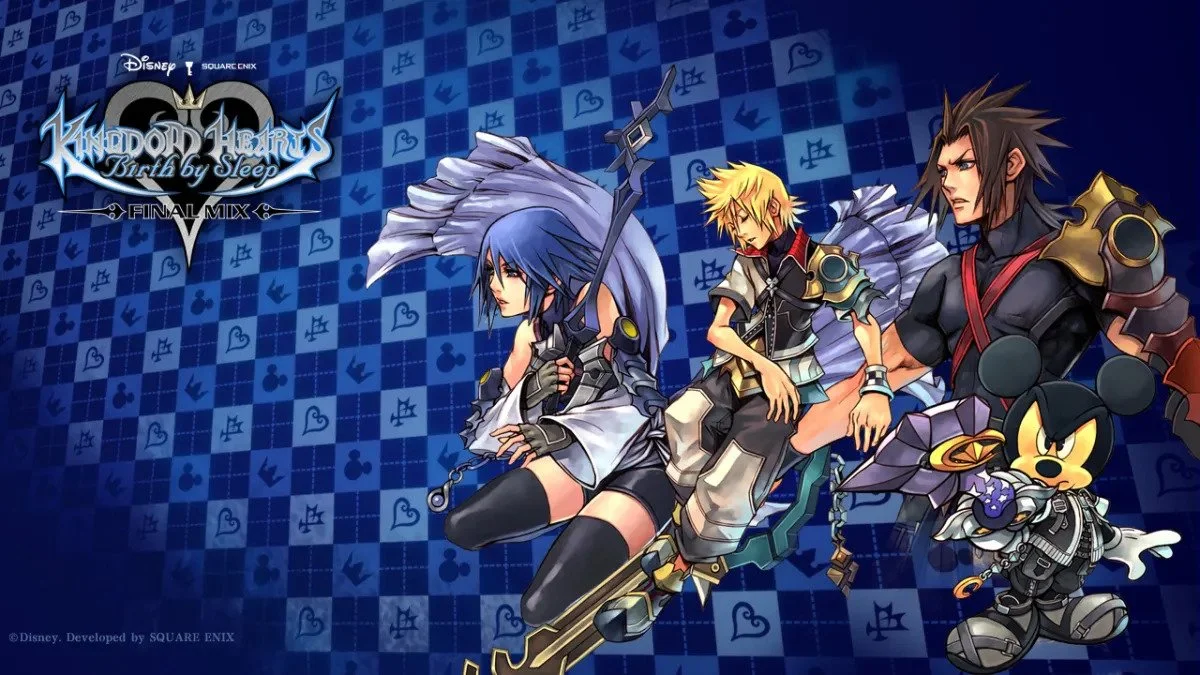
Don’t let its status as a prequel fool you, Birth by Sleep proves to be essential for understanding the events of later games, especially Kingdom Hearts III. While some of the retcons in Birth by Sleep show off some of the series’ sloppiest writing, there is a more compelling character tragedy here. Unfortunately, that is all marred by an uninteresting gameplay structure and some confounding progression systems that drag the game down. // Image: Square Enix, Disney
This series playthrough gave me the opportunity to play two games in the series for the first time ever: Birth by Sleep and KH III. Due to never owning a PSP, I wouldn’t have access to Birth by Sleep until it would get remastered years after its release - and by that point, I had officially checked out of the series. Despite that, I recall hearing positive buzz about Birth by Sleep, with the game even being one of the most fondly remembered games in the handheld’s history. More notably, the game garnered a ton of buzz within the KH community and features a story and characters that are vocal fan favorites. Even since I exited the KH fandom, I still regularly heard rumblings from how much people loved this game.
Now having finally played it…I just see a game ripe with issues. There are interesting ideas in Birth by Sleep for sure, but there are so many questionable design choices that balance it out to create a largely mediocre experience in my eyes. While I’d say its quality is on par with 358/2 Days, I concede that there’s a lot more meat on this game’s bones that at least makes it more interesting to talk about.
Following in the footsteps of Chain of Memories, Birth by Sleep offers multiple campaigns featuring different playable characters. After a brief prologue that shows the bond between Aqua, Terra, and Ventus, the player is given an option to play through each of the three character’s stories. Each of these characters exhibit relatively different playstyles. Aqua is primarily magic-focused, Terra, is about going all-in on physical attacks, and Ventus is a speed-oriented hybrid between the two. Each character feels different enough to play - and each character’s story can be completed at about 6 hours apiece.
That is, the playtime will be short if the player navigates through the game the same way they would in the previous numbered Kingdom Hearts games. Each character still levels up and gain Bonus Levels a la Kingdom Hearts II after major encounters, but new to Birth by Sleep is the Command Board, an additional layer of expanding each character’s capabilities, primarily in the form of learning new abilities. The Command Board is not essential for getting strong enough to comfortably roll credits in this game - and thank goodness for that. Put simply, the Command Board may very well be the most convoluted, unnecessary progression system that I’ve ever encountered. And that’s saying a lot considering this is coming from Square Enix - whose history if full of games with experimental progression systems.
My main problem with the Command Board is that it’s far too involved and too time-consuming to see meaningful rewards in. The Command Board is essentially a minigame where players have to defeat AI opponents in a Fortune Street-esque format. There are Cards, Effects, Panels, and more to keep track of - and engaging with this is what’s needed to unlock many of the game’s commands. For players that don’t engage with this system, they’re objectively going to have access to less options - and I think any game that locks content or progression behind a minigame plays a dangerous game of making its minigame become a key ingredient in making the game fun to play at all.
Does Birth by Sleep go over the edge with the Command Boards? Is it a step too far? I don’t quite think so, but it comes dangerously close. While I was willing to put time into Command Boards on my first playthrough with Terra, I quickly realized that I didn’t have the patience to dedicate so much time to building my character instead of just playing the main bulk of the game: getting stronger through leveling up while exploring Disney worlds. When played like a conventional Kingdom Hearts game, Birth by Sleep is serviceable but rarely feels like more than that.
I would perhaps be more open to allowing myself to engage with the Command Boards if Birth by Sleep was a broader, more in-depth experience. However, each character’s campaign in Birth by Sleep doesn’t take too long to complete, meaning that all the effort needed to meaningfully develop characters through Command Boards doesn’t feel like it’s worth the dedication. So, why bother with it? Why spend so much time with an optional progression system if the standard progression system facilitates the overall experience in a quicker, more streamlined way?
This reeks of experimentation and doing something different for the sake of it, rather than a feature that was born out of a breakthrough idea conceived to make getting stronger more satisfying for the player. This idea of weird progression systems made its debut in 358/2 Days, but it rears its ugly head the most here - so much so that I think the rest of the game could have been more polished and interesting if this system wasn’t put in place at all.
With that said, how’s the rest of Birth by Sleep? Was it worth finally playing after the anticipation of not having gotten to experience if for so long? Truthfully…it’s okay. Worlds here are incredibly short, and a lot of them are navigated in loosely the same way. Each character gains access to worlds in slightly different orders, but the worlds themselves are largely the same. The primary difference in each character’s campaign in Birth by Sleep is the individual stories that dictate what characters do while visiting each world.
An interesting nugget about Birth by Sleep is that it smartly determines its Disney worlds due to its status as a prequel to the first game. Many of the Princesses of Heart - a key narrative detail from the first game - are captured off-screen in that game. Characters like Cinderella and Aurora unceremoniously show up as they get rescued while Sora visits Hollow Bastion. In Birth by Sleep, we get to see these characters in their native worlds prior to being captured and having their worlds get lost to darkness. It’s a good attention-to-detail that helps make this feel better as a prequel.
Even though it features some visual and mechanical limitations as a PSP game, Birth by Sleep largely holds up as being a worthy follow-up to the PS2 lineage of games. Characters look good and the overall presentation is a massive upgrade from what’s on offer with the DS games. The biggest mechanical inclusion to Birth by Sleep is the inclusion of Shotlock and Command Styles. Neither of these mechanics entirely transform combat, but they help diversify whacking the Unversed (this game’s primordial version of Heartless) throughout the journey.
Where Birth by Sleep suffers is that its hand gets dealt fairly quickly. While all three characters have their own playstyle and play through slightly different versions of each Disney world with different minigames or bosses to fight, a feeling of repetition sets in as soon as the player begins their second character’s playthrough. By the time I ended my third and final character’s playthrough, the monotony of going through variations of the same core structure wore me down to the point where I felt like I was going through the motions.
There aren’t too many exceptionally difficult fights in Birth by Sleep nor are there particularly memorable moments that occur throughout the Disney worlds. The best moments in Birth by Sleep come from its epilogue that’s made available after completing each character’s playthrough - but by that point, players will likely be exhausted by the monotony of going through very similar adventures three times in a row.
This epilogue culminates in a few of the game’s most mechanically interesting fights, but I’d hesitate to call them anything close to the best of what Kingdom Hearts has to offer. Indeed, I thought most of Birth by Sleep was fine, but it doesn’t leave any particular impact one way or that other.
To add on to this feeling of monotony, Birth by Sleep carries on the Command system introduced in 358/2 Days - one that’s built on creating a deck of commands, each of which having a cooldown before they can be used again. This style of combat is fine, but it isn’t nearly as interesting as selecting abilities in the numbered games or Chain of Memories.
Another one of Birth by Sleep’s weaknesses that is emblematic of this era of the series is that the narrative has a good core about connections and friendship, but gets lost in the details it introduces. And this issue arguably reaches a far greater level here because of how many details get retroactively injected into older entries. So many details get added in this game, but I’d be okay with that if it meant that such details made the story on display here interesting to take in.
But it isn’t.
While some of the characters featured in Birth by Sleep are fan-favorites, they truthfully come off as wooden, unremarkable characters from a writing perspective. The game starts great with establishing their friendships with another because it serves as a driving force that makes players want to see these tragically separated characters reunite with one another. Unfortunately, the journey to see these characters get to that point isn’t particularly interesting. There’s a solid Point A and Point B in this story premise, but the line connecting the two is far from engaging. In lieu of that line, Birth by Sleep opts to add details that explain things that happen in Kingdom Hearts that arguably didn’t really need to be explained.
All of this makes me feel conflicted about Birth by Sleep. This game has some solid ideas, but it’s full of ideas that, in my eyes, don’t improve the experience in a significant way. This makes it a hard game for me to admire.
Playing Birth by Sleep became an affirmation of my jaded feelings towards Kingdom Hearts earlier in my life. Despite being a theoretically better game than 358/2 Days, Birth by Sleep feels more representative of the issues that I feel that Kingdom Hearts became burdened with. The storytelling, in particular, feels like a step away from what made people like what had come before. The gameplay, meanwhile, doesn’t take a meaningful direction in any way aside from having an unnecessarily involved yet optional form of character progression.
Overall, Birth by Sleep is just messy and made me start to question if my distance from the series was warranted. Indeed, at this point in my series playthrough, I could feel my broader opinion of the series begin to sour, mainly due to not feeling compelled by the direction of the story and Birth by Sleep’s particularly mediocre gameplay.
Then, something surprising happened. Before, I get to that, though…
Kingdom Hearts: Coded and the Mobile Games
Kingdom Hearts: Re:coded is a remake of a pre-smartphone mobile game. While it is canon and is a follow-up to the events of Kingdom Hearts II…does anyone really care about this game? In retrospect, this is the most skippable, unnecessary chapter in this entire series. // Image: Square Enix, Disney
I don’t care about Kingdom Hearts: Re:coded.
You don’t care about Kingdom Hearts: Re:coded.
So…why don’t we just move on?
…
While I really have next to nothing to say beyond that, I do think Coded and its DS remake are representative of a growing issue that this series began having at this time. Not only were there continuing to be a wider variety of games on different platforms, but the commitment to having every game be canon started to rear its ugly head around this era. While this game would go on to be preserved through its cutscenes being accessible in later collections, future mobile games would not be so lucky.
There’s a broader conversation to be had about preservation, especially as it relates to media that’s part of a broader multimedia narrative. While Coded tells a relatively meager slice of story that takes place between KH II and Dream Drop Distance, the stories told in Union Cross and Dark Road are far more substantial parts of the greater Kingdom Hearts canon. They even directly connect to a large moment in Kingdom Hearts III’s finale. Unfortunately, the only way to see what happens in the stories of Union Cross and Dark Road is to watch cutscene compilations on YouTube. These games have been delisted and, as of writing, there is no way to access them. A lot of mobile games and/or live-service titles are experiencing this phenomenon - years of game development effectively being flushed down the drain the second the servers for an online-only experience go down.
Depending on how Square Enix feels, they can take down those cutscene compilation videos on YouTube at any point. What then? Do the stories of Union Cross and Dark Road effectively become lost media? The decision to commit to having mobile games (most of which have expiration date) being canon unfortunately makes this story nearly impossible to keep track of.
This is already a series that risks losing people with the many details that it injects with each new installment. Having more details be injected into the greater plot by games that aren’t accessible anymore only further muddy the waters and certainly don’t do this series’ storytelling reputation any favors. I truthfully couldn’t be bothered to watch the Union Cross / Dark Road cutscenes for this piece, nor even finish Re:coded’s compilation of cutscenes, because, at a certain point, the narrative in these games just don’t really do anything. Unless you’re incredibly invested in everything to do with the broader Kingdom Hearts narrative, there’s nothing profound or new with these stories.
To put it another way, Kingdom Hearts loses itself by committing too much to making everything be an important part of the plot. By making prequel and side stories have as many details as whatever constitutes as a mainline game in this series, every story told in this series is more interested in making things happen in order to contribute to the greater plot rather than to create meaningful stories in their own right. The best games in this series are the ones that understand that their stories and scopes can stand on their own terms.
These mobile games and other titles like Dream Drop Distance feel more concerned with building the Kingdom Hearts universe rather than being a compelling game and story that people can take meaning away from on their own.
As of writing, the series has never recovered from this phenomenon. With Kingdom Hearts IV seemingly the beginning of a new era and a new arc for this series, there comes an opportunity for the storytelling focus of this series to recalibrate. Instead of forcing every game to be an important chapter in a greater saga, the future of this series should remember what made people become attached to Kingdom Hearts in the first place: simple stories with lovable characters that don’t get lost in the details and convolution of their own making.
Kingdom Hearts: Dream Drop Distance
Kingdom Hearts: Dream Drop Distance represents the end of an era. It is the final game that features PS2-level graphical fidelity and is the final game to use the Command Deck system. More crucially, it was the last game I played before this series playthrough. Why exactly did this game make me quit the series originally? // Image: Square Enix, Disney
Dream Drop Distance is almost the solution to that. More so than the last few games that preceded this title originally released on Nintendo 3DS, Kingdom Hearts: Dream Drop Distance puts effort into telling a story on its own terms rather than contributing details to the broader lore. Was this a response to fans feeling like the series lore was getting bloated, or was it merely a reality that this series was inching towards the conclusion of this arc? Perhaps it’s a bit of both - but regardless, Dream Drop Distance’s story is relatively free of too many details being injected into the broader lore.
It’s still there, though, with the inclusion of Young Xehanort - an additional antagonist that feels like the most inconsequential of all the already vast number of villains in this series. Dream Drop Distance adds the concept of time travel to this story, but it’s implementation feels so haphazardly explained that it hardly matters in practice.
In retrospect, the details added by Dream Drop Distance are few in number, and yet it was enough to be a breaking point for me. Originally, this was my drop-off point for the series, pardon the pun. I had lost interest in the series largely due to feeling burnt out by the series by the time I played Dream Drop Distance shortly after its launch. Looking back, having done so feels bizarre, given that Dream Drop Distance is a solid game in its own right. At its core, this is simply a story about Sora and Riku completing the Mark of Mastery exam at the same time. There aren’t too many events that occur outside of that, making this a story and game easier to enjoy on its own terms compared to something like Birth by Sleep.
Moreover, the gameplay here is solid. For the first time in the series, navigation has been made much more fun due to an expansion of level design. Levels no longer feel incredibly flat as they have since Kingdom Hearts II, but rather, there’s an great level of verticality within levels that make them interesting and fun to navigate through. Of course, levels are designed to be bigger and more mechanically intricate in order to facilitate one of the game’s biggest new features: Flowmotion. In concept, Flowmotion allows players bounce off walls, spin around poles, and fling themselves across level geometry to both navigate levels and gain access to different combat options.
Even outside of Flowmotion, Sora and Riku’s movement speeds are far faster than in any previous game. While using Flowmotion, however, there’s a true sense of liberation with how fast players can move through areas. The cost of this freedom, however, is that Flowmotion is completely busted in a gameplay balance context. Every Flowmotion move that Sora and Riku have access can lead into an attack - and these attacks are far and away some of the best tools that players will have access to throughout the entire game. And players can use Flowmotion immediately when starting the game, meaning that players can immediately use some of the best combat options in the game right off the bat.
This creates issues, as much of Dream Drop Distance’s enemies (and even boss fights) can easily be bested by spamming Flowmotion attacks. There’s no particular drawback for repeatedly using Flowmotion attacks, making the feature something of a dominant strategy for players that want to get through encounters more efficiently. That’s not to say that Dream Drop Distance is lacking in combat options - in fact, it continues Kingdom Hearts II’s tradition of injecting option inflation into the series. Beyond using regular attacks and Flowmotion abilities, players have access to Commands via the returning Command Deck, Reality Shifts, and Linking with Dream Eaters.
Reality Shifts are effectively minigames specific to each world - some of which are more involved than others. While Traverse Town simply asks the player to fling an enemy towards another enemy to deal massive damage, Melody of Memory’s Reality Shift is a quick rhythm game that rewards the player the better they do at matching the rhythm to a song featured in Fantasia. Meanwhile, Linking with Dream Eaters grants access to different combat options for Sora and Riku. Sora uses the Dream Eaters themselves to deal attacks, such as bouncing on the ground with a certain Dream Eater. Meanwhile, Riku transforms with a Dream Eater to gain access to a new form that deals devastating damage.
I feel the same way about this plethora of options that I did in Kingdom Hearts II. As cool as it is to have multiple options in combat, it causes players to place less value on each specific option as a result. I had multiple instances where it was difficult to justify linking with Dream Eaters because using regular attacks, Commands, and Flowmotion attacks more than sufficed for getting me through most encounters. On top of bestowing too many options for players to deal with enemies, there’s also a severe lack of balance in Dream Drop Distance. On top of the overpowered Flowmotion attacks, Dream Drop Distance features perhaps the most infamous lineage of spells in the series: Balloon. These projectiles deal massive damage, and when upgraded to Balloonga, they home in on enemies, making it an effective win button for players that have access to this option.
“Having access to this option” is a key part of that phrase. Unfortunately, gaining access to certain spells and abilities isn’t a matter of leveling up and judiciously equipping abilities. Learning new abilities and increasing Sora and Riku’s stats to even greater heights is locked behind progressing the Dream Eaters - effectively giving this game a monster-collecting-RPG tinge to it.
Like other games in this subgenre, players can fuse new monsters with materials they collect on their adventure, with stats and levels being determined by the quality and quantity of the resources used to make them. The primary issue with the Dream Eater system is that they’re tied to character progression more than they ought to be. In order for Sora and Riku to gain access to many of the game’s best active and passive abilities, they need to level up Dream Eaters - each of which have a Skill Tree that uses Link Points to progress.
Players can either gain Link Points through combat or through engaging in minigames that involve the Dream Eaters. Like with the Command Boards in Birth by Sleep, this progression system feels different and convoluted for the sake of it rather than as something that genuinely enhances the experience. To optimize leveling up multiple Dream Eaters, the player is going to have to put the game’s pacing to a screeching halt in order to play minigames for a couple minutes. The issue comes into play when players want to do this with multiple sets of Dream Eaters throughout their playthrough.
Because gaining LP takes commitment, either through combat or through minigames, that means that investing in a Dream Eater takes time. And so, there comes two options: either spend a lot of time developing multiple Dream Eaters at the expense of the pace of the overall game, or only develop a few Dream Eaters and have less combat options in order to keep the game moving forward at a good pace.
The player won’t know what abilities they can learn from a Dream Eater until after they’ve crafted it, potentially costing the player resources for Dream Eaters that can’t give the player the abilities they’re looking for. The Dream Eater system is a solid idea in theory, but its execution is poorly designed and comes with inevitable compromises that the player has to make. If you create a progression system where the player has to decide between getting a move-on with the game or putting everything else on pause in order to make an effective build, then you’ve created a weak form of character progression.
If you can get past the oversupply of options given to the player and the messy progression system, there’s a fair bit to enjoy with Dream Drop Distance. The level design alone makes these Disney worlds some of the best in the series - though, that’s also in thanks to the inspired choices on display here. Levels like The Grid and La Cité des Cloches have great verticality to them and feature a wide variety of ways to get around them. Their source material are arguably more deep cuts in Disney’s broader pantheon of IP, but that’s what makes them interesting picks.
Of course, I need to specifically call out Melody of Memory as being a contender for the best Disney world in the entire series - largely because of the neat ways it tweaks the game’s presentation. While most Kingdom Hearts games alter the clothing of Sora and co. when they explore certain worlds (such as giving the heroes a spooky skin when going through Halloween Town), Melody of Memory completely rids the game of voice grunts and traditional sound effects. In their place is an instrument sound that plays when hitting an enemy and an increased volume given to the songs of each area. This is a remarkable homage to Fantasia and serves as one of the best examples of Kingdom Hearts creatively representing a Disney property.
The visits to every Disney world haven’t evolved much since Kingdom Hearts II, as the bulk of them include retellings of their source material with the occasional injection of original Kingdom Hearts characters causing mayhem. This was the first game that felt like it was adding something new to the formula of visiting Disney worlds, mostly because of the game’s structure.
Dream Drop Distance features two playable characters, but unlike Chain of Memories and Birth by Sleep, these aren’t two campaigns that take place one after the other. Rather, these are two playthroughs that occur simultaneously. Throughout the game, the player will switch perspectives between Sora and Riku. While both characters go through the same levels in the same recommended order, they get to experience different stories within each Disney world, providing two different flavors for each Disney world. This often takes the form of each character roaming through completely different parts of the level, preventing the player from feeling like they’re retreading through levels a second time.
The drawback of this, however, is the manner in which switching between these characters is handled. Players can switch between the two characters freely, but the game highly encourages switching between characters a different way: when the Drop Meter reaches zero. Once that happens, the player is forced to switch to the other character and pass on certain buffs and passive abilities to the next character. This can be particularly annoying when this happens during boss fights, as it will cause the encounter to start over when switching back to the character that Dropped mid-fight.
Outside of those instances, I don’t find this mechanic to be annoying - I’d say it’s more baffling than anything else. Players can drop between characters whenever they want via a menu, making me question why the mechanic is locked behind a meter in the first place. Why not just force the player to switch characters after completing each world? While the perks that players can pass on to the next character between each Dive is a neat idea, these buffs are negligible in the grand scheme of things. This is yet another strange mechanic that feels different for the sake of it instead of adding to the overall experience.
Do you see a pattern here? There have been tons of instances throughout Kingdom Hearts that feel like inclusions that don’t truly add anything of value, but are there anyway. That’s what makes progressing through this series carry a feeling of frustration. These games are at their best when they embrace their innate simplicity and core fun ideas, but the extra ideas that bubble up to the surface, be they narrative or mechanical ones, make the series bite off more than it needs to chew.
I think Dream Drop Distance would be a better game if it had less combat options. It would be a better game if it didn’t have a needless Dream Eater progression system. It would be a better game if it didn’t have a Dream Meter and just committed to trusting the player to switch characters whenever they wanted. But it doesn’t, and the game is worse for it.
That said, I found myself surprised by how much I enjoyed my time with Dream Drop Distance in spite of these issues. I found the pacing of each Disney world to be relatively quick. Each major combat encounter is fun (save for one of Riku’s final encounters that’s a bizarre spike in difficulty the immediately winds down after). Even the game’s climax, with its injection of unnecessary details, doesn’t feel as narratively busy as other finales.
During this playthrough, I acquired a newfound admiration for Dream Drop Distance in spite of its ostensible flaws. I see a game that’s trying to put the series back on the path that made people like it so much in the first place, but it still insists on going forward with some unnecessary and flawed ideas anyway. I found myself able to look past this game’s flaws more so than with 358/2 Days and Birth by Sleep, and that gave me optimism for the last full game of this series playthrough: Kingdom Hearts III.
While Birth by Sleep suggested that I was perhaps right to have walked away from this series when I did, Dream Drop Distance managed to drag me back in just a bit. I just needed a game that rid itself of unnecessary progression systems and mechanics to really sell me back. And to some extent, Kingdom Hearts III did just that.
Kingdom Hearts III
Kingdom Hearts III is infamous - and how could it not be? It’s a game that had nearly 14 years of anticipation attached to it - it was never going to make everyone happy. It makes some baffling decisions, but it ultimately made this second chance all feel worth it in the end. // Image: Square Enix, Disney
An unfortunate Kingdom Hearts tradition is its tendency to announce games far before they’re anywhere near coming out. Kingdom Hearts II was announced in 2003 alongside Chain of Memories, over two years out from its Japanese release. Most recently, we’ve seen Kingdom Hearts IV be announced in 2022, with an unknown release date as of writing. At present, though, Kingdom Hearts III has the longest gap between announcement and release in the series thus far.
Announced at E3 2013, Kingdom Hearts III was already long overdue by the time it was unveiled. Fans wanted to finally see the series evolve with a game developed for an HD console in mind. While many anticipated a series continuation on PS3, it became clear that the next numbered game would instead opt to release on the then-upcoming hardware of the PlayStation 4. This reveal didn’t show too much of the game, but did provide a tease of what to expect with a few seconds of gameplay at the end of the trailer.
…Except for the fact that said gameplay was fake. Kingdom Hearts III’s reveal trailer was actually entirely CGI, featuring UI to make it look like what gameplay in KH III was expected to look like. In truth, the game was very early in development and wouldn’t release for a couple more years. It wouldn’t be until January of 2019, six and a half years after its announcement, that Kingdom Hearts III would release. With this long gap between announcement and release, an overwhelming aura of anticipation naturally built for the game. More so than any other title in the franchise, Kingdom Hearts III had a massive burden of expectations placed upon it - and that, I feel, is an integral part of the game’s legacy.
Kingdom Hearts III is a polarizing game for a lot of reasons. Depending on who you ask, Kingdom Hearts III is a colossal disappointment that fumbles concluding this arc of the series and is a significant downgrade in depth and difficulty compared to Kingdom Hearts II. Others will praise how polished Kingdom Hearts III and how smoothly it plays, largely feeling that the game’s few issues were promptly addressed in the Re:Mind DLC released about a year after the base game.
This polarized legacy is a natural byproduct of the very burden of expectations placed upon this game. While part of that expectation is due to the fact that multiple games were building up to a payoff that was presumably going to be here, but also because of Square Enix’s arguably irresponsible decision to reveal when and in the manner that they did. I’m not so sure that there’s a timeline where Kingdom Hearts III would be universally beloved by everyone that played it. Too much was riding on this game. So many people had different expectations and hopes for what this game could be. It couldn’t appeal to everyone and still be a cohesive video game.
So what did Kingdom Hearts III do? In some ways, Kingdom Hearts III is a return to form for the series. This is primarily a game that acknowledges the simplicity that makes the core of these games work so well. While the details of the Organization members occasionally influence the events in each Disney world, the bulk of the game is relatively straightforward: Sora needs to learn the Power of Waking by traveling through multiple Disney worlds.
On one hand, this objective is a bit nebulous, especially compared to previous games’ goal of having Sora reunite with his friends. The Power of Waking isn’t a gameplay ability - it’s simply a Thing that Sora obtains whenever the plot decides to give it to him. Nevertheless, this setup does its job: it creates a framework for the formulaic structure of the adventure. Sora, Donald, and Goofy visit multiple worlds to acquire Sora’s Power of Waking so that they can take on Xehanort once and for all.
This objective is simple. Perhaps too simple, given the stakes and complexity of details that have led to this game, but I’ll gladly take a primary structure light on unnecessary details. In fact, Kingdom Hearts III doesn’t really add many new plot elements at all. This is a game that mostly understands that adding more narrative details doesn’t make sense for what’s supposed to be a concluding chapter for this arc. Kingdom Hearts III understands all it needs to do is create a simple adventure that also features enough narrative weight to make for a satisfying conclusion for what’s been built up over the course of the series.
The issue for Kingdom Hearts III comes in the form of narrative pacing. It could be argued that Kingdom Hearts III is divided into two narrative segments. Segment 1 focuses on Sora gaining the Power of Waking, while Segment 2 focuses on reuniting with other characters and the final confrontation against Xehanort. Segment 1 takes up the vast majority of Kingdom Hearts III’s runtime, with Segment 2 constituting roughly the last 3-5 hours of this 30-hour-long game. Due to its narrative structure, it feels like Segment 1, the majority of Kingdom Hearts III’s story, is a mostly self-contained adventure, while the much shorter Segment 2 is the point where the game suddenly realizes that it has to conclude multiple character and story arcs. It causes the last few hours of the game to have a significantly different pace and feel compared to the rest of the experience, making for a narrative with jarring momentum and focus.
By virtue of Segment 2 being a relatively small portion of the game, the game’s way of concluding both its own story and this entire arc of the series thus far feels simultaneously rushed and stretched out. So much has to happen so quickly in order for this series conclusion to work, so certain resolutions or character moments don’t get the time to breath that they perhaps need to truly work. Likewise, the pacing of some scenes, particularly when dialogue is involved, still has the stiffness of the PS2-era games, which leads to cutscenes that can feel bloated. And yes, that does unfortunately mean that the cutscenes of Organization members talking to each other about their Evil Plans are still here and just as uninteresting to watch.
The biggest disappointment with Kingdom Hearts III’s narrative is that there’s an unfortunate amount of bullshit. The greatest sin that this series commits rears its ugly head here: characters coming back from the dead. Nearly every Organization XIII member, including Xion, come back from the dead here, making supposed deaths in previous games retroactively lose all narrative value. Moreover, it also creates a narrative point-of-no-return. If any characters die at any point in this series moving forward, why should players care? It is now established that returning from death is possible and seemingly easy for characters in this series.
The worst part of this is that it’s done largely to give characters what I call “moments in the sun” during the game’s conclusion at the Keyblade Graveyard. Characters get to have confrontations with characters that allow each character arc to have a seemingly nice bow put on it, but it comes at the cost of pure narrative messiness. The sequence at the Keyblade Graveyard simply has too much going on, with too many things getting narratively wrapped up around the same time. Because character moments and narrative beats have so little room to breathe, it’s genuinely difficult to care about everything that’s going on.
This is on top of the fact that Kingdom Hearts III truly reveals that Xehabort, the big bad of the entire series that’s been the mastermind behind everything that’s happened in this series, is kind of a lame villain. He doesn’t have an interesting backstory, he doesn’t have a compelling motivation, and he doesn’t have a particularly interesting relationship with Sora or other characters. He’s mainly just an Evil Guy, which only makes the events at the end of the game have even less narrative weight.
Story-wise, I agree with the sentiment that Kingdom Hearts III is a letdown. Square Enix have themselves to blame for writing themselves into a corner with Kingdom Hearts III. On one hand, I see a game that tries to return to the narrative simplicity that made this series work in the first place. When it’s a fun adventure where Sora and co. get to travel through Disney worlds and make friends along the way, Kingdom Hearts III accomplishes most of what it does quite well. When it bears the responsibility of providing payoff to narrative buildup from other games, Kingdom Hearts III crumbles under the pressure.
There are many criticisms of KH III’s narrative that I can address, such as with Sora bizarrely being portrayed as a dumber, more gullible character in this game compared to any previous game or the game’s NieR:Automata-esque moment involving characters from Union Cross / Dark Road that doesn’t really feel earned or satisfying. There are a lot of narrative problems that I could spend time picking apart here. However, I think the most telling instance of Kingdom Hearts III’s narrative shortcomings is the sheer fact that its story DLC, Re:Mind, is effectively an extended ending that tries to “fix” the game’s ending.
Re:Mind is bad DLC, plain and simple. It’s a three-hour episode that is mostly made up of playing through the final portion of the game at the Keyblade Graveyard again. Many of the cutscenes are the same, many of the boss fights are the same. The only difference is that some events play out differently, and the player gets the opportunity to control other characters for a few fights. As an expansion of the game’s story, Re:Mind is mind-boggling, as the changes it makes to the game’s ending feel minor at best until the very end, with a final confrontation that feels genuinely much more satisfying than the base game’s last encounter.
As a piece of DLC that sought to improve the overall story, Re:Mind is a mess and it makes this arc end on a really clunky note. Episode Limit Cut, the remainder of the game’s DLC, is a far better offering of DLC as it offers Data Battles that provide the challenge that’s sorely lacking in the base game. While this offering is cool, it only exacerbates one of the series’ greatest issues with its superbosses.
The gap in difficulty between that of the main game and that of the superbosses in Kingdom Hearts II was vast, but the gap in difficulty in Kingdom Hearts III dwarfs all gaps that have come before it and then some. This is largely due to the fact that Kingdom Hearts III is, in fact, a far easier game than anything else in this series. Sora’s aerial mobility has been massively buffed, to the point where aerial combos can be done nearly infinitely. On top of being able to attack enemies in the air nearly endlessly, Sora has experienced yet another round of option inflation.
There are Links, Disney ride attacks, the ability to transform weapons, and the return of Flowmotion attacks in Kingdom Hearts III. Though, Flowmotion has been nerfed from Dream Drop Distance so much, both in terms of movement and combat efficacy, that it hardly feels like the same mechanic anymore. Magic, meanwhile, has seen a significant buff, and Sora now has more dynamic, flashy attacks with every party member, including the guest party members that arrive in each Disney world. Sora has more options than ever afforded before in this series. While this provides a flashy power fantasy, it comes at the cost of making the game rarely ever put up a challenge.
Sora is capable of so much in Kingdom Hearts III. The player has access to so many options at any point in combat that they can navigate any encounter in multiple ways depending on what options the player feels like taking advantage of. Unfortunately, encounters aren’t designed with this plethora of options in mind. Kingdom Hearts III would have really benefitted from creating encounters that directly counter, challenge, or limit the player’s options made available to them, but instead, most boss fights can be trivialized - even on harder difficulties - thanks to Sora’s powerful aerial combos and other abilities that he has access to.
With all this said, I found myself accepting Kingdom Hearts III’s identity as a flashy power fantasy. Combat is fun and bombastic, so if challenge is decidedly not the priority, then I can accept the game’s pivot to this kind of flavor to its combat. However, that flies out the window with the Data Battles, which are ultra-challenging fights that provide some of the hardest fights in the entire series. Because the rest of the game’s encounters are so trivial, the player has to effectively relearn the game’s combat in order to see success with these superbosses. While it can be argued that every game with superbosses asks players to reassess combat to some degree, Kingdom Hearts III practically asks players to start playing a completely different game. The main game does not sufficiently prepare players for taking on tacitcal fights, which only makes the colossal gap between the challenge of the main game and the Data Battles to be that much more jarring.
Kingdom Hearts III fails with regard to being a satisfying narrative conclusion, but manages to create a fun adventure when it focuses on doing its own thing. Kingdom Hearts III is fun when the player accepts the game’s focus on making players feel flashy and overpowered, but insufficiently makes players become better at the game and sets them up for failure come the DLC’s postgame. In many ways, Kingdom Hearts III is a mixed bag, and that extends to other aspects of the game as well.
I want to say that Kingdom Hearts III has, by far, the best Disney worlds in the series. When they’re good, they’re good. The biggest reason for this is the massive upgrade in level design on display here. Mount Olympus is an incredible first level because it truly showcases just how much more players can do while moving through levels. From running on walls, to having occasional minigames relating to level navigation, to the sheer scale and verticality of these levels, Kingdom Hearts III creates level design that blows levels in previous games out of the water. Levels also feel incredibly different from one another, and stand apart from each other both in terms of aesthetics and mechanics.
The absolute standout here is the Caribbean, which gives Sora access to a ship that can sail across a small ocean, complete with ship combat and islands to explore. In many ways, it feels like a miniature realization of the unique vibe of The Legend of Zelda: The Wind Waker within the context of a single Kingdom Hearts level. Other levels like the Toy Box and Monstropolis are interesting in that they don’t directly adapt their source material movies, but instead tell original stories that canonically take place between or after movies. For example, Toy Box takes place between the events of Toy Story 1 and 2, whereas the events of Monstropolis take place after Monsters, Inc. has already concluded. There’s more diversity in the context through which Sora and co. inhabit these worlds, and I think that makes the Disney world component of this game a lot more interesting than in any previous Kingdom Hearts game.
The mixed bag part of this, though, is that some Disney worlds lose the plot with how closely they want to adapt the source material movies. Levels like the Kingdom of Corona and Arendelle levels feature cutscenes that verbatim recreate scenes from Tangled and Frozen, respectively. This is most infamously the case in Arendelle, which features the entirety of the “Let It Go” scene from Frozen, but now Sora, Donald, and Goofy are just kinda there sometimes.
What’s the point of this? Kingdom Hearts has primarily focused on telling abridged retellings of Disney stories for each Disney world, but the value of that largely comes down to how much that appeals to the player’s familiarity with that respective Disney property. Agrabah in Kingdom Hearts isn’t a perfect retelling of Aladdin, but if the player has familiarity with the 1992 animated film, then they can appreciate how the original game adapts and depicts certain elements of the film in a tighter window of time. When we’re getting to the point of recreating entire scenes from Disney films in Kingdom Hearts, it defeats the value and appeal of seeing these movies get adapted into video game levels in the first place. If I’m spending three minutes watching a part of Frozen just be remade in Unreal Engine in the context of being a video game cutscene, then I just don’t know what I’m supposed to get out of that.
It’s a “what are we doing here?” moment that unfortunately drags the quality of all of the Disney worlds down a peg in my eyes. There are some novel ideas in KH III’s Disney worlds, but there are also a lot of awful ideas that drag down the entire experience. Not unlike level designs in the original Kingdom Hearts, there’s still an imperfect structure to how some of these levels are laid out. While the bulk of the Kingdom of Corona is a linear jaunt from one end of the map to the other, revisiting the level reveals that there’s little of interest between only a few landmarks in a linear level. Monstropolis is perhaps the most linear level in the series, as there’s rarely much opportunity to go off the beaten path. On the opposite side of the spectrum, San Fransokyo is such a wide open space that it calls to attention just how little that space is actually used, making for a very empty-feeling level despite its size and vastness.
The presentation is, in my eyes, the most universally high-quality aspect of Kingdom Hearts III. While Kingdom Hearts 0.2: Birth By Sleep - A fragmentary passage, KH III’s effective demo included in Kingdom Hearts II.8: Final Chapter Prologue, had issues of certain character models looking remarkably plastic-y, Kingdom Hearts III refines its upgraded visual style to become one of Square Enix’s best looking games ever. Environments in particular look really good. Likewise, I find this game’s music, complete with arrangements of songs from previous games, to make for the best soundtrack in the entire series.
The Gummi Ship sections, while still taking up a decidedly small portion of the game’s overall runtime, are fantastic. Navigating between levels is now entirely free-form, but still contains encounters and sequences where players enter an on-rails shooter section. Traveling between worlds is the most fun it has ever been in the series, and yet it somehow still doesn’t fix the issue that the Gummi Ship sections have had since the very first game. While there are options to customize the Gummi Ship here yet again, putting the time into customization doesn’t feel worth it when it’s such an overall small part of the game that doesn’t directly tie in with other aspects of the game that heavily.
The last major addition to Kingdom Hearts III is its cooking system, complete with minigames starring Remy from Ratatouille. While these are cute, the utility of food, like many other games with similar systems, provides temporary buffs to Sora and co. Given the game’s overall easy difficulty, this system, as involved as it is, isn’t a necessary thing for players to think about. I can’t think of any situations where getting buffs from eating food would make a difficult situation more manageable for players. This makes for a cooking system that doesn’t feel entirely smartly integrated.
I can think of no better way of describing my playthrough of Kingdom Hearts III as jarring. I’ve seen so many different responses to this game from the outside looking in since its 2019 release. I didn’t know whether I’d ever get to experience this game, and if I did, I didn’t know if I’d fall in the camp of the many people that felt monumentally disappointed by this game or with the people that thought it was a fine enough conclusion. Now having played it, I find myself leaning towards the latter, but recognizing some of the merits of the former. Kingdom Hearts III is a difficult game to love, because there are a lot of problems with it. I take most issue with the narrative clunkiness evident in its final section of the Keyblade Graveyard and the chasm between the difficulty of the main game and its DLC.
But I also had some of the most fun I’ve had in this series with this game too. I can’t deny that the power fantasy afforded by option inflation of Kingdom Hearts III made for a fun time, even if it trivialized many encounters. I genuinely enjoyed roaming through most levels in this game, when I found such a thing to be little more than a means to get to combat encounters in previous games. I see in Kingdom Hearts III a game that is willing to address the gameplay and narrative shortcomings of its predecessors and really lean on what makes the series special. To that end, Kingdom Hearts III basks in making interesting Disney worlds that mostly succeed at capturing the imaginative, diverse worlds of Disney and infuses it with flashy combat that makes the player feel cool and powerful.
To that end, Kingdom Hearts III is perhaps the most Kingdom Hearts game of them all. Unfortunately, that also brings with it baggage of having to deal with the many details that made an ultimately simple story appear far more complicated than it actually is. I find myself grateful for giving this series a second shot, if for no other reason than that I was able to finally make up my own opinion on Kingdom Hearts III. This is a game that I find easy to point out flaws with, and yet I find it hard to hate. Even in the face of so many shortcomings, there’s a character within Kingdom Hearts III that’s evocative of the spirit of the entire franchise that makes it impossible to hate. It’s for that reason, that I’ve become incapable of being normal about Kingdom Hearts.
Kingdom Hearts is weird. It does a lot of things right and it does a lot of things wrong. But there’s merit and charm in that. This is a deeply flawed series that engenders a type of whimsical spirit that’s hard to resist. I don’t love Kingdom Hearts and likely never will again, but its spirit shines through to me despite having once walked away from it. // Image: Square Enix, Disney
I can’t help but think back to myself: why did I give Kingdom Hearts a second chance after all these years? I have so many games in my backlog to play and so many new releases that could have easily instead devoted time to. And yet, I instead chose to spend much of the last six months playing through a series I had once written off as being fed up with. What about this series prompted me to return to it after all this time? I’m still struggling to come up with a definitive answer, but I do think I’ve come with a vague, cryptic answer. I hope that suffices.
I returned to Kingdom Hearts because its innate joy called to me. Even though I had become annoyed by this franchise for its sometimes nonsensical approach to storytelling and found other JRPGs to have combat systems that appealed to me far more, there was something special that attracted me to the franchise when I was a young boy exploring his love of video games. Maybe I tried Kingdom Hearts for the first time out of convenience, just because a physical copy of the game owned by one of my neighbors found its way near my PS2 during my youth. Maybe it was fate, as I vividly recall watching that old commercial of the game on Disney Channel. Regardless of what made my path cross with Kingdom Hearts, there was a time in which I decided to stay. There was a time in which I considered myself a hardcore fan of this series. And I feel that was the case because there was a certain essence, a certain spirit inherent to this franchise that’s unique, intoxicating, and impossible to ignore.
Yes, I walked away from the series for over a decade. However, I still kept in touch with many peoples’ thoughts on the series and games. Whether through friends, content creators, people at conventions, or through message boards and social media, I was regularly tuned in to gaming and JRPG discourse - both of which naturally lead to at least some interaction with Kingdom Hearts and its community. And not all of those interactions are necessarily positive - and yet I felt compelled to give the series a second chance in spite of all of that. Why?
I think all pieces of media are worthy of being given a second chance. With Kingdom Hearts, specifically, there’s something deeply sentimental about this series to me that has kept it in my mind, even when I wasn’t directly engaged with this series. Maybe this is because of the fact that it was one of the first large non-Nintendo franchises I got really invested to at a young age. For a series that I spent so much of my youth playing and enjoying, there was a party of me that felt a sense of tragic guilt that I felt the way about the series that I did.
I’ve said over and over that I became “fed up” with the series’ clumsy storytelling, but is such an assessment enough to abandon an entire series, an entire fandom, an entire subsection of the JRPG community that I’ve entrenched myself into throughout my life? As this series playthrough has demonstrated, most of the games in this franchise are fun to play. Each game carries with it specific flaws, and I’ve made my feelings about each game’s shortcomings apparent throughout this piece, but are those problems enough to write off these games as worthy of getting “fed up” with? In retrospect, I don’t think so.
In hindsight, I think I was being a shithead about Kingdom Hearts - the kind of shithead that I hope not to be for any other work of art. We can all carry individual critiques and praises of any piece of media that we engage with. We can have personal red-flags that turn us off from specific stories and experiences and we can have certain aspects that attract or repel us from certain types of games, genres, and franchises.
On paper, I had always known that there was no hard reason for me to dislike Kingdom Hearts as much as I did. I like Action RPGs, I enjoy games that mash up different genres together, and I enjoy games that are willing to challenge players for those looking to have their skills tested. I’m a huge fan of Final Fantasy and am nostalgic for many Disney films as much as the next person. For all intents and purposes, I’m the primary demographic for Kingdom Hearts - especially considering my age at the time of the first game’s release.
And as a member of the first wave of the series’ core demographic, I found a lot to enjoy about Kingdom Hearts during my youth. And so, after years of crossing my arms and turning away from the series as a teenager and young adult, I now find myself returning to the series with a similar assessment to it that I had when I was a kid - that being a fun but flawed JRPG with a solid, simple core surrounded by needlessly convoluted layers that drag the series down from its true potential.
While writing this piece, I had a conversation with a friend of mine. This friend referred to themselves as being nerdy about incredibly obscure interests during their youth and feeling like they had to grow out of such interests by the time they were a teenager. This friend, now in their 30s, is finally starting to return to the obscure interests that defined their life as a child and they now feel more spiritually fulfilled as a result. They feel like they’re finally returning to the person they were as a child.
When we’re young, we unquestionably gravitate towards the things that interest us. We do not compromise on the things that bring us joy - until there comes a phase in our lives where we feel like that should not be the case. Whether it’s social pressure to conform while you’re a teenager, or wanting to have more relatable interests for the sake of having an easier capability to make more friends, we all go through an era in our lives where we lose a part of ourselves. It isn’t until our adulthood and when we have hindsight, experience, and wisdom that we’re able to have a renewed outlook on life that gives us permission to return to not compromising on the things that bring us joy.
Video games, JRPGs, and creative writing were massive aspects of my identity as a child - one I didn’t feel inclined to heavily advertise to others. While these were still a huge part of my life, I felt compelled to not make them a defining feature of who I am to others for the sake of fitting in. But as I write this to you, I now know that that’s disingenuous. Video games, JRPGs, and creative writing are integral to who I am - and I see no reason to deny such a thing.
Over the last decade or so of my life, I’ve fully embraced my love for games, have started attending conventions, and entrenched myself further into the writing, gaming, and JRPG communities that make me feel a greater sense of place in the world. The person I was in my youth was a pure manifestation of the kind of person I wanted to be, and I fell as though the last couple of years of my life have been a journey of returning to that pure representation, uncompromising version of myself and fully reclaiming it.
As I write this, I’m engaging with the video game, JRPG, and writing communities as much as I ever have in my life. I’m regularly interacting with this world in both a personal and professional capacity because doing so feels right to me. Being part of these communities and engaging in these hobbies feel right because they naturally appeal to what I enjoy doing with my life.
I’m not saying that Kingdom Hearts is a symbol of my uncompromised self, but it is certainly an aspect of it. Kingdom Hearts was a franchise that, even acknowledging its flaws, I could still find joy through. I enjoyed these games as much as I did during my youth simply because they accomplished certain things that I enjoyed seeing. I played these games as much as I did growing up because they were RPGs with satisfying progression systems and combat. I played these games because I found the universe and lore of Kingdom Hearts to be conceptually interesting enough to want to see whatever would happen next.
I enjoyed Kingdom Hearts because it brought me joy despite whatever flaws I could come up with it. That joy was enough to make these games worth playing. And that’s a lesson I’ve found myself relearning as an adult playing through the entire series over the last six months.
Joy is enough.
We can turn on our critic brains on whenever we engage with any piece of media and work of art. And we should do that. We should always intellectually engage with whatever we spend our limited time in this world with. We should do so so that we learn lessons from what works and what doesn’t, so that we can apply those lessons learned into the things we create. We should do so so that we can inform how future works, either created by ourselves or by others, can reach a greater level of quality in the future.
I’ve been as vocal as I have been about my issues with each Kingdom Hearts game in this piece because I truly think there are lessons that can be learned with these games’ shortcomings and be applied in the pursuit of making even better Action RPGs in the future.
At the same time, however, there’s value in acknowledging that experiencing the joy of the art itself is of just as much importance and value. Playing through Kingdom Hearts gave me instances of frustration and disappointment, yes, but it also gave me instances of joy. This was true during my youth and first experience with the series, and it is true now after having played each of these games as an adult. Even through the criticisms I’ve shared today, I still acknowledge that I continued playing each of these games because I simply found joy through doing so. I decided to keep spending a portion of the finite time I have in my life with these games because I found solace and joy through doing so. And that’s enough.
This is a journey that I implore everyone to go on. Maybe not specifically with Kingdom Hearts, but with any hobby or interest that you’ve had a falling out with as you’ve aged. I implore everyone reading this to reengage with something that they once found joy in and just see what happens. Maybe you’ll rediscover a part of yourself that you thought you had abandoned. Maybe you’re not so different from the version of yourself that was uncompromising in their interests and hobbies. The journey to find out is one worth taking.
Kingdom Hearts is nowhere near my favorite JRPG franchise, nor is it one I’d consider myself a diehard fan of now, even after all this time and investment. However, I’ve found myself returning to my old opinion of the series: that being one that I enjoy and am curious to see the future of. Playing through each of these games reminded me that these games succeed at bringing joy to me by way of being fun, mostly well-made Action RPGs. And that’s enough.
Joy is the key that casts off the apathy that we’re convinced that we have to spend much of our life exhibiting. Much like how Keyblade wielders are the light that fend off the forces of darkness throughout Kingdom Hearts, people that understand the power of joy are the ones that fend off the cold cynicism that pervades media criticism and discourse. That isn’t to say that we must be blindly joyous of whatever we engage with - but rather, that it’s essential to never forget that creating joy is the very reason we both create and consume art.
I played Kingdom Hearts because doing so gave me joy, and it reminds me that I want to write stories and make games to bring joy to others. There doesn’t have to be more to it than that.
It may not be possible to be normal about Kingdom Hearts, but I think remembering the value of finding joy during our limited time in this world is the most normal, natural thing that we can possibly strive for.
Thank you very much for reading! What are your thoughts on the Kingdom Hearts franchise? How do you feel about giving media that frustrates or loses you a second chance? As always, join the conversation and let me know your thoughts in the comments or on Bluesky @DerekExMachina.com!