Octopath Traveler 0 Review: Great Strides Despite Mechanical Retreads
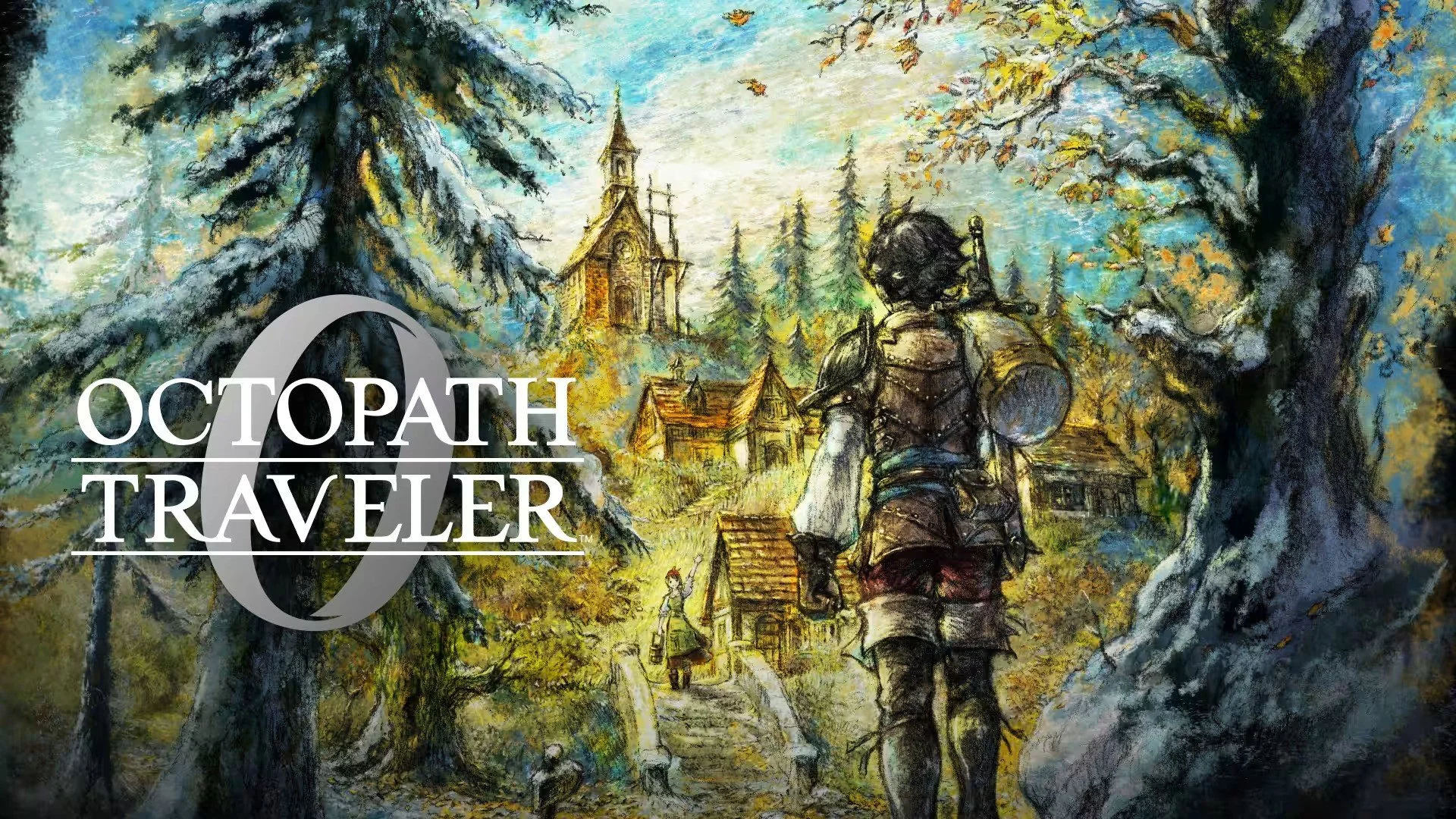
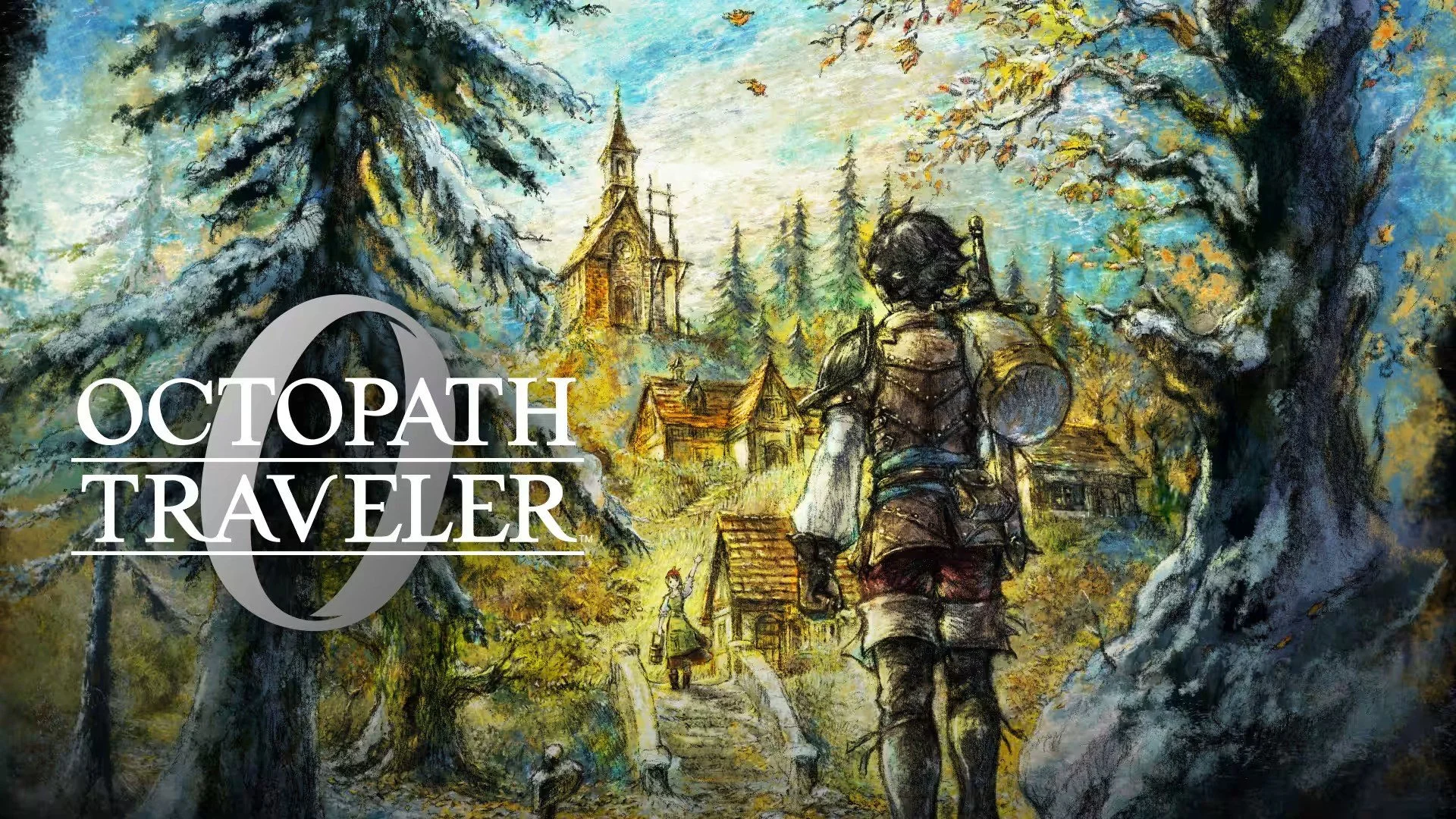
Octopath Traveler 0 makes the best of a conversion the games industry ought to see more of: a gacha game transformed into a full-length premium game. Despite its origins as a mobile game, 0 feels like a substantial addition to the Octopath series and even stands above previous entries in some ways. // Image: Square Enix
It’s no secret that the games industry is undergoing a preservation crisis. Most legacy titles aren’t available on modern hardware. Anti-consumer DRM policies threaten ownership of digital titles. Most crucially, we’re beginning to see the normalization of games being “delisted” and removed from sale and even playability. A game becoming unplayable is a frightening point of no return, as it prevents a game that may have made an impact on those who played it to tragically become lost media. If an online-only game has its servers shut off, then no future generations of players will ever get to experience it, dooming that game’s impact and legacy to obscurity.
This fate isn’t exclusive to online-only games, however. In fact, we see this most often in the mobile game space. The mobile side of the games industry is a lot more volatile for a variety of reasons. Free-to-play, microtransaction-heavy business models are both normal and the expectation for mobile games. Mobile games are inherently a high-risk, high-reward gamble that only a select few roll the dice on successfully. The curated amount of success stories for mobile games have revealed a few winning models. While many big-name developers and publishers tried various approaches to mobile game monetization throughout the 2010s, one of the most successful models became apparent: gacha.
Like the gachapon vending machines that inspired its namesake, gacha games entice players to spend money by giving them a chance to unlock characters and other content through effective slot machine spins. We all know the success stories of this genre. Genshin Impact, Fire Emblem Heroes, and so on. But the truth is - there are a lot of games that have tried this business model and failed to gain any significant traction, some of which use sizable IP to pull in an audience. Series like Atelier, Star Ocean, and Tales of, among others, have all had gacha games on mobile, and they still struggle to pull in and keep an audience because of just how uniquely ruthless and volatile this part of the industry is.
There’s no company that has struggled with making successful gacha games more than Square Enix, who have never been shy to throw some of their biggest IP to the mobile game market to see what they can get away with. From 2013’s infamous Final Fantasy All the Bravest to the ill-fated and unreleased Kingdom Hearts: Missing Link to 2026’s Dissidia Duellum, Square Enix has always tried to make their mobile games work. And…they regularly don’t. The vast majority of their mobile game portfolio is now a graveyard, with many of their games being delisted with official support ended - something that often means an eventual death when a skeleton crew’s support is no longer considered viable.
This is a shame, I feel, because some of Square Enix’s mobile games have a lot more effort put into them than you’d initially suspect. It’s easy to generalize mobile games as this low-stakes, high-reward cash cow that doesn’t require nearly as much developmental effort as big-boy/big-girl PC and console game development. But indeed, some mobile games have a lot of great effort put into them. One of the most apparent examples of this is Square Enix’s very own Octopath Traveler: Champions of the Continent.
While Champions of the Continent is still available as of writing, I don’t expect the game’s service to last much longer, as the game’s distribution was handed to NetEase and all significant developmental support for the game has effectively ended. Moreover, Octopath Traveler is nowhere near being one of Square Enix’s most recognizable IPs, so I can’t imagine that Champions of the Continent has ever been a significant money maker. In spite of its circumstances and status as a mobile game, though, Champions of the Continent features yet another fantastic soundtrack from Yasunori Nishiki and a sizable amount of narrative and gameplay content to make it a salvagable, worthwhile experience.
In 2025, Square Enix shocked the world when they announced in a Nintendo Direct that Champions of the Continent was effectively getting remade as a premium game with adjusted mechanics to make it more consistent with the two mainline games. Now dubbed Octopath Traveler 0, this remake would bring the mobile game’s immense amount of content to PC and consoles. It would even add voice acting to boot, as well as a town-building mechanic (which I’m a huge sucker for). All of this is at a $50 USD price tag, making this game a budget release, yet featuring the length of a typical mainline game (possibly even surpassing, depending on the amount of side content the player partakes in).
Now having finally played it, Octopath Traveler 0 feels so great to play that I don’t think anyone would suspect that the game is a facelifted mobile game unless you directly showed them evidence of that. Indeed, Octopath Traveler 0 feels like the full package and delivers a full, satisfying JRPG experience over its 70-hour-long campaign. Aside from it feeling like a visual downgrade from 2023’s Octopath Traveler II, 0 feels like a strong continuation of the series that stands on its own two feet as a premium game. Crucially, this preserves the content developed for Champions of the Continent. This ensures that, even when the mobile game almost certainly ends its service, CotC’s vast array of content is preserved in a stand-alone game that will last forever through 0.
Beyond that, Octopath Traveler 0 is a shockingly good prequel that helps recontextualize the events of the series’ first game in a meaningful way. Moreover, this title addresses one of Octopath’s greatest weaknesses by bringing together its small stories to create satisfying narrative payoffs that make every small-scale story feel relevant to the greater whole of 0’s story. While I don’t think Octopath Traveler 0 necessarily treads new ground for the Octopath Traveler series, I do think it crafts a compelling adventure that polishes the narrative weaknesses of the series to create an adventure that deserves its place as a mainline title along with the two titles that preceded it.
Octopath Traveler 0 is so good that it makes me hope that we see similar gacha-to-premium game conversions in the future.
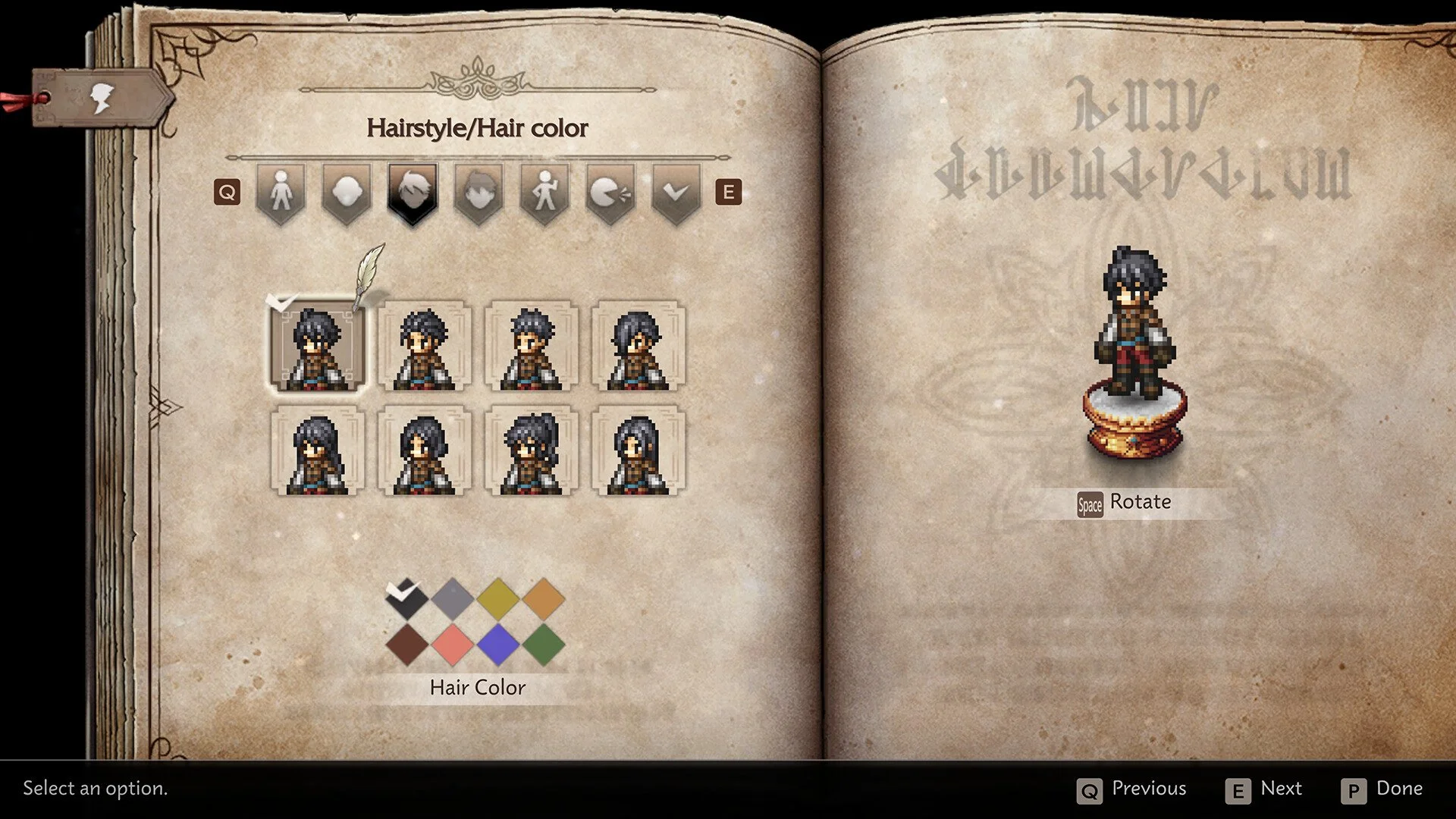
Instead of offering a collection of eight party members that each have a smaller-scale story that the player follows, Octopath Traveler 0 features an avatar protagonist that serves as the connective tissue for all of 0’s smaller stories. // Image: Square Enix
It truthfully feels like a full-circle moment to be talking about Octopath Traveler again. When I started this blog nearly eight years ago, Octopath Traveler was one of the very first games that I wrote about. In the eight years that have passed, I still find myself looking back on the original Octopath Traveler fondly. It was a fun JRPG with the innovative Boost and Break systems and a job system reminiscent of Final Fantasy VI’s take on the mechanic. Since I first wrote about the series on this blog, Octopath Traveler II released. This sequel greatly improved upon a lot of the original game’s shortcomings, feeling grander in scale and interconnecting its stories to a greater degree. (In those eight years, I’d like to also believe that my writing style on this blog has improved substantially. I’m far too afraid to actually read my old Octopath Traveler review.)
If anything, Octopath Traveler has become a franchise that deeply understands what it wants to be. This is a JRPG franchise that is more interested in telling smaller, more character-focused stories that each have antagonistic forces to overcome. This may come off as disjointed, but over time, it becomes clear that Octopath goes for an anthology approach for its storytelling. These games are more about creating a world for smaller stories to take place in, instead of telling a grand, epic tale that is usually the case for JRPGs. Each Octopath Traveler game is at its best when the player accepts these games’ terms. When the player accepts that Octopath Traveler has no interest in telling large stories in the same way as most other JRPGs, that’s when they’ll understand the unique narrative strengths of Octopath Traveler.
And indeed, 0 is in many ways a continuation of that. Like II before it, Octopath Traveler 0 is willing to play around with the narrative formula of the series and bring things together. Unlike previous games, the player now helms control of a created character that serves as the protagonist and connective tissue for all of Octopath Traveler 0’s smaller-scale stories. The game begins with a tragedy that will feel familiar to JRPG veterans: the protagonist’s peaceful, small village gets attacked by evil mercenaries and is destroyed. Some of the village’s residents die while others escape to other towns throughout the world.
Once the dust settles, the player is given two primary objectives: go after the three tyrants responsible for the destruction of Wishvale, and invest in the reconstruction of Wishvale by searching for the village’s survivors and gradually rebuild the town. From this point on, Octopath Traveler 0 will begin to feel familiar to previous Octopath games. Each of the three villains involved in the destruction of Wishvale have their own story told across various chapters, each of which have a rigid structure. For each chapter, the player will meet new characters, have them develop, explore a dungeon, maybe fight some minibosses along the way, then fight a climactic boss fight that concludes the chapter and sets up a narrative thread for the next chapter. It’s a structure that all previous Octopath Traveler games use, and it’s no different here.
Similar to its predecessors, this structure works as well as it does because of two things: the strong combat framework that makes progression feel consistently satisfying and the fun writing that often goes to shocking dark places, making story progression feel regularly intriguing. Fun combat and compelling serialized storytelling is enough to make each 45-to-60 minute chapter feel like a focused vertical slice of everything the game has to offer. In every chapter, there’s an opportunity to experience the story that features regularly dark subject matter, the excellent combat and customization systems, and the great presentation that’s become a series standard. In that sense, every chapter is remarkably Octopath Traveler, for better and for worse.
How good of a thing this is ultimately comes down to how much you vibe with this structure. If you like to consume stories and gameplay sequences in hour-or-so chunks, then Octopath Traveler 0 will regularly deliver a fun time. If you find such a thing to be limiting or even monotonous, then there isn’t much in this game that will ever deviate from that. As I said, Octopath Traveler is a series best enjoyed when you meet it on its terms. I found myself entertained by Octopath Traveler 0 the most when I embraced its admittedly rigid structural approach.
More so than previous games, however, Octopath Traveler 0 ultimately rewards players for sticking with the smaller-scale stories in this rigid structure. Once the three villains’ stories are concluded, a new, longer story begins and makes each of those smaller-scale stories feel larger in context. This happens yet again later on in the adventure - making the game’s structure become a way to illustrate just how much stuff happens in this narrative. The abundance of micro-stories creates a broader narrative that’s greater than the sum of its parts. By the end of Octopath Traveler 0, every small-scale story feels like an essential piece of the narrative puzzle that the game builds in front of the player. This culminates in a compelling finale that makes every small part of the journey feel essential in retrospect.
This is to say nothing of the quality of the writing itself (and the stellar localization that accompanies it). While I won’t pretend that Octopath Traveler 0 is a masterpiece with subversive, thought-provoking writing in any way, I do think that the writing on display is consistently entertaining and willing to go in unexpected directions. The game is wrought with JRPG tropes and ideas that we’ve seen before, but like previous games, Octopath Traveler 0 twists them is such a way that begets interest and curiosity from the player. Throw in a couple well-executed surprises and reveals, and you have a decisively fun narrative that plays out in Octopath Traveler 0.
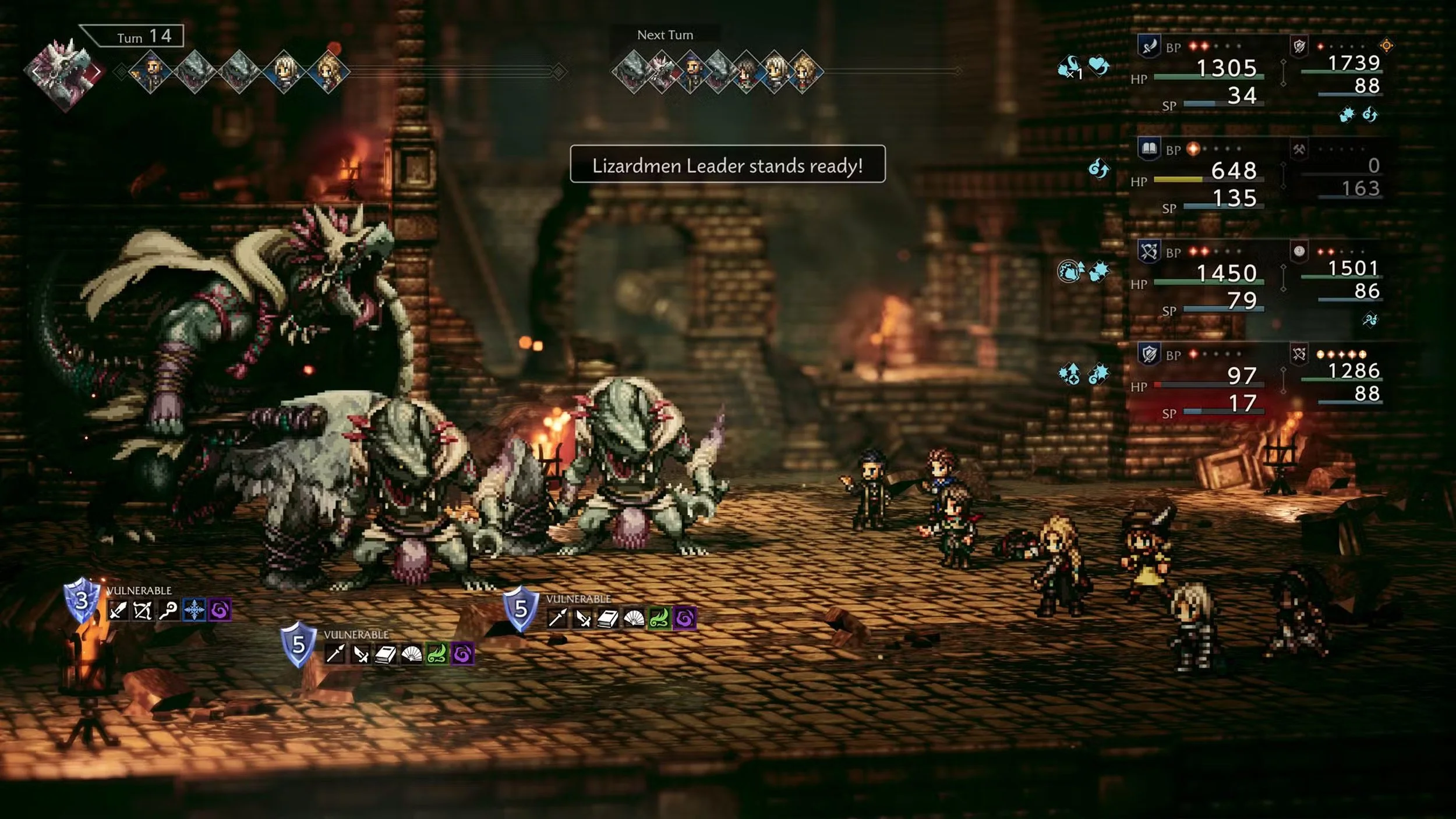
0’s unique spin on Octopath Traveler’s incredible combat system is its inclusion of eight party members, with a front and back row mechanic. This type of mechanic has been seen before, but its inclusion here injects yet another level of strategy in the already tactic-rich gameplay. // Image: Square Enix
The best part of Octopath Traveler 0 may also be the least interesting to talk about. The third iteration of a winning formula, Octopath Traveler 0 knows that it doesn’t need to reinvent the wheel for its combat system because Octopath’s combat system has always offered some of the best turn-based combat in JRPG history. And that remains the case here.
Like any previous Octopath title, the name of the game is using different weapon and spell types to chip away at an enemy’s weaknesses. Every enemy has a certain amount of times that their weaknesses need to be hit in order to be broken, represented by a shield icon. Every exploitation of an enemy’s weakness brings this number down. When it reaches zero, the shield shatters and puts the enemy in a Break state, where they take more damage, opening the door for the player to dish out major damage. Additionally, every turn, the player builds up additional BP that the player can cash in to attack multiple times in or turn, or power up a move to be stronger or deal additional effects.
This is all familiar territory for this series. Octopath Traveler 0 understands that it doesn’t need to revolutionize an already stellar framework for its combat system - as such, many of its additions are modular. On top of implementing Ultimate Techniques that debuted in Champions of the Continent and introduced to the main series in Octopath Traveler II, 0’s greatest addition to the combat model is the expansion from four active party members to eight.
Row systems are nothing new to RPGs, but Octopath Traveler 0’s spin on the concept feels novel. The typical implementation of a row system typically sees front row characters deal and take more damage, while back row character deal and receive less damage. This incentivizes physical attackers to be on the front lines, while the more fragile spellcasters and healers hang in the back. Octopath Traveler 0’s row system is far less committal than this, as 0 instead opts to have characters be able to freely move between rows during their turn. Characters in the back row see marginal healing take place between each turn. Additionally, they still see their BP increase each turn, letting them build up resources for powerful offensives while they’re on standby.
This creates a compelling layer of strategy on top of the typical Octopath combat depth. Characters that have taken a beating can simply go the back row for a few turns to recuperate, and thus saving the player from having to spend combat resources to heal them manually. Additionally, since enemies remain in the Break state for two turns, this means that, if players can strategize accordingly, they can burn through their BP for all characters in both rows in order to deal two full turns of up to eight character actions’ worth of damage onto enemies.
This row system is as great as it is because it implicitly invites more offensive and defensive strategies for the player to consider. However, this expansion of the strategic capabilities of Octopath Traveler 0’s combat model also brings a spotlight to the game’s greatest flaw with regard to its combat: the discrepancy between the quicker regular battles and the more strategically demanding boss fights. Regular encounters are often so quick and require relatively few resources that the player never has to consistently take advantage of resources across both rows.
This becomes especially apparent in the late game, when using a single spell that targets all enemies using the starting value of 2 BP becomes enough to end most encounters in a single action. Put simply, regular encounters don’t necessitate use of the strategic possibilities offered by the row system. Octopath Traveler has historically struggled to make regular encounters feel as exciting and satisfying as boss encounters. That issue rears its ugly head perhaps the most in 0, as the presence of additional mechanics only highlights how little the player has to lean on them during most fights.
It’s during boss fights, however, when this deep combat system gets to spread its wings and truly test the player in the best way possible. The boss fights that cap off each chapter in Octopath Traveler 0 are a genuine highlight of the entire experience. This is largely because of the fact that every mechanic in this deeply interconnected battle system needs to be made use of in order to see success. From having a diverse party composition in order to cover as many potential weaknesses as possible, to managing both the health and magic pools of both rows, to optimizing damage output across both rows once the enemy is broken all stacks on top of the typical Octopath Traveler combat fare to deliver a consistently magnificent combat experience.
In fact, this is where Octopath Traveler 0’s structure actually works to its benefit. Since each of the game’s many boss fights caps off a 45-60 minute section of gameplay, that means each demanding boss fight has roughly the same amount of time between one another. This prevents players from ever getting burnt out by an onslaught of challenging fights, while still being consistent enough to give the player something to regularly look forward to.
This is to say nothing of the music that accompanies these fights, which serve as some of the best tracks in the entire game. Octopath Traveler 0’s soundtrack offers a blend of tracks from the first game, the second game, and tracks originally composed for Champions of the Continent. While this game clearly benefits from being able to lean on the already-incredible soundtracks of previous games, the new tracks offered here are indistinguishably as brilliant as all tracks from previous games. Every battle track is brilliant, but the one that stands out the most to me is “Decisive Battle 0”, which, like the very best boss battle tracks, gets me pumped up to overcome even the most challenging fights this game has to offer. The incredible music in every fight is a reason in itself to look forward to each boss battle that awaits.
Like Octopath Traveler II before it, the challenge and flexibility of this combat model steadily builds throughout the game, climaxing at the final boss fight. As was the case in the series’ second full title, Octopath Traveler 0’s final boss is a genuine highlight of the entire experience, excellently serving as the ultimate test of everything that the player has learned throughout the game, with special emphasis placed on the player’s capability of taking full advantage of the row system.
Octopath Traveler 0 can admittedly feel samey during regular encounters still - and that’s an issue that I think seriously needs to be addressed if this series is to continue on. But when this combat system gets the opportunity to shine, it does so vividly and spectacularly. Part of what helps this game achieve that is its expansive, but decisively different approach to party composition.
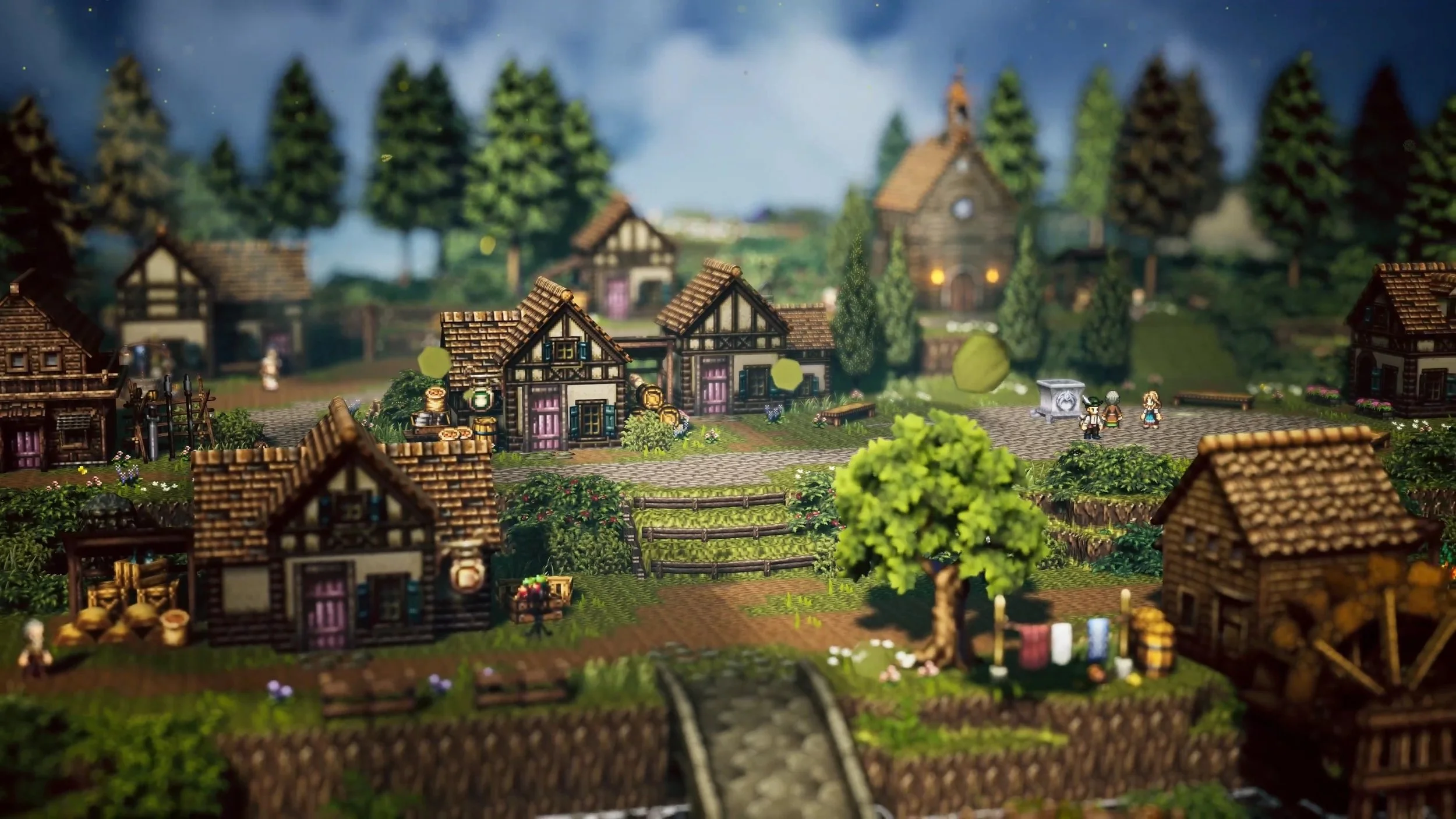
After the game’s inciting incident, Octopath Traveler 0 tasks the player with rebuilding the protagonist’s hometown. While this section of the game is promising, it is tragically bare bones compared to more involved city building modes in other RPGs, making its presence here feel like missed potential. // Image: Square Enix
Not only does Octopath Traveler 0 expand the amount of active party members per battle, but it also expands how many characters the player recruits throughout their journey. While previous Octopath games feature eight travelers that inspire the series’ namesake, 0 features over 30 playable characters, most of which fall into the eight jobs (Octopath’s version of classes) that are now series standard. Aside from having the freedom to choose the protagonist’s job, every character is locked into their assigned job. This creates a new dynamic of strategy and preparation for battle.
In previous Octopath Traveler games, the bulk of preparation came from determining what classes each of your four characters would have access to - with each character having the flexibility to change jobs and eventually multiclass. In 0, that layer of preparation has been replaced by sheer quantity of characters. Every character brings with them a job that they’re locked into, a unique collection of skills they can learn, and a unique Ultimate Technique that only they have access to.
This means that players will be thinking about how to synergize their jobs and abilities in a different, perhaps more restricted manner. Instead of the flexibility offered in previous games, Octopath Traveler 0’s customization and character progression is largely tied to what characters players want to bring into battle and how each character’s unique abilities synergize with other party members. That isn’t to say that there’s no customization to be found here - in fact, both characters can eventually learn and assign a combined total of six active and passive abilities. This gives characters just enough room to flex into different combat roles as needed. For example, I used Primrose in my party primarily for buffing party members. However, I taught her Armor Corrosive, a skill that debuffs the enemy’s defense, so that the primary damage dealers could spend the same turn buffing themselves in preparation for huge damage. Likewise, I gave Ophelia, my primary healer, access to spellcasting skills so that she could flex towards exploiting elemental weaknesses if needed.
The customization here is certainly more limited than in previous games, but that doesn’t necessarily make it bad. That said, once the player begins recruiting various characters into their party, it gradually becomes overwhelming just how many options that the player has access to - to the point that I feel most players will reach a point where they find an ideal party for their party and stick with it for the majority of the adventure. So long as you construct your party smartly in order to effectively cover enemy weaknesses and combat roles, there’s really no need to actively switch party members in and out outside of curiosity of how different abilities and Ultimate Techniques function in practice. It isn’t until the final boss when the game engages with having access so many different characters in an interesting way.
Previous Octopath Traveler games give every party member unique Path Actions - options to uniquely interact with NPCs. While Path Actions do return in 0, the options given to the player are instead determined by the specific NPC being interacted with, as well as the protagonist’s Power, Wealth, and Fame stats (which effectively serve as social stats that determine how likely a Path Action will succeed). This only gives less value to each party member. This is designed as best as possible given the circumstances, given that having to fumble through over 30 characters each with different Path Actions would become a needlessly annoying and monotonous chore, but it’s yet another aspect that makes each party member feel less of a special contributor to the party than in previous titles.
Having moments where the player needs to divvy up their party or to have more systems to encourage experimenting with different character would have gone a long way towards making the game’s large playable roster feel more justified. At the same time, it could be argued that this leads to a wide variety of possible party compositions and strategies throughout the game, thus encouraging multiple playthroughs that use different characters. However, I feel like such an argument begins to crumble when considering that some playable characters in Octopath Traveler 0 are just objectively better and more useful than others. Some characters’ collection of abilities and Ultimate Techniques feature blind spots or don’t synergize well with other party members as others - so the actual number of viable party members isn’t as grand as I feel the developers may have intended. This only exacerbates the issue of players effectively funneling the game’s playable roster into a smaller collection of characters.
While I understand that the game’s large roster is a carryover from the Octopath Traveler 0’s origins as a gacha game whose primary monetization is through giving players access to more characters, I don’t think this quantity-over-quality approach to party members benefits the strategic capabilities of this series too much. While it does enough to get the job done and elevate the tactical options of combat, I felt that previous Octopath games did a stronger job at encouraging and incentivizing experimentation.
Another major weakness of Octopath Traveler 0 comes from one if its main hooks as a standalone release: the town-building mechanic.
It’s hard to not fall in love with a good town-building side of a game, especially when doing so brings major rewards in other parts of the game. One of my favorite examples of the mechanic is the Evermore Kingdom Management in Ni no Kuni II: Revenant Kingdom. This instance of the mechanic is so mesmerizing not just because it’s easily accessible after a certain amount of story progress, but of how integrated it is across all the game’s different systems. Town-building is an essential part of Ni no Kuni II, as it gradually unlocks access to new equipment, new side quests to take on, new shops that open up, and more. This compounds with the fact that the actual scale of the city expands in both a physical and communal sense. Seeing the characters you recruit throughout your journey populate the town creates a satisfying degree of community in this civilization that you’re building.
When I think of a strong city-building mechanic, I think Ni no Kuni II sets a great gold standard to strive for. Even for games that have a somewhat streamlined implementation of the mechanic, such as Xenoblade Chronicles’ Colony 6 reconstruction, can still create the satisfying feeling of progression, even if it isn’t necessarily deeply integrated across the rest of the game. Octopath Traveler 0 has elements of a strong town-builder, but it largely loses steam fairly quickly. This leads to the town-building of the game making me feel disappointed and wanting more, especially since it gets off to a relatively strong start.
Throughout Octopath Traveler 0’s first half, one of the smaller-scale stories involves rebuilding Wishvale, including reuniting with the surviving residents of Wishvale and building new facilities. This culminates in building a tavern where the player can cook food, a farm where the player can grow materials to cook with, and a shop to buy unique equipment, items, and materials. There are a few more enticing additions to the town, such as a Training Ground to reward EXP and JP to party members not in the active party (which is essential to even stand a chance in the game’s final encounter) and an arena to hunt down optional bosses for worthwhile rewards. On top of all this, the player is able to recruit NPCs throughout the world to Wishvale, each of which have unique skills such as reducing the cost of items at Wishvale’s ship, increasing the frequency of resource yields, and more.
Writing this all down, it seems like Octopath Traveler 0 does just about everything you could ask for with a town-builder. But after reaching the roughly halfway point in the game, Wishvale becomes something of an afterthought in the narrative. There’s relatively little reason to go back to Wishvale in the game’s second half outside of taking advantage of a few of the town’s facilities. Moreover, every single NPC recruited to live in Wishvale is only present at the building or facility they’ve been assigned to - which makes the town feel weirdly isolated non-communal. There’s a degree of satisfaction that never quite comes when building Wishvale.
The town-building here is solid and does a lot of things right on paper, but the execution leaves me wanting. I can’t help but wish that the town-building was a more consistent presence throughout the game. While Wishvale’s destruction and reconstruction is certainly an integral part of the game’s narrative at its onset, it fades into the background as other narrative threads take hold. Wishvale taking a narrative backseat causes it to also take a mechanical backseat, in my mind, leading to a solid but tragically underwhelming utilization of the mechanic.

Like with the rest of the Octopath series, 0 is built on great moments, but never truly fantastic moments that stick with you forever. While the game lacks the sauce that elevates it to being a special game, Octopath Traveler 0 still features various memorable moments, plot twists, and encounters that make the overall adventure feel worth the 70+ hour investment.
While I wish that Wishvale remained a high priority for the broader narrative, I can’t argue that the direction that Octopath Traveler 0’s story does go in isn’t consistently intriguing. This narrative goes to various places, primarily investigating the ways and the extent to which power, wealth, and fame corrupt people. Each antagonist brought forth by the narrative are corrupted by one or multiple of these aspects in different ways. Moreover, their corruption has a deep impact that affects the lives of countless people around them. One thing that I appreciate about the Octopath Traveler series is that it’s willing to illustrate darkness and death to a greater extent than many other T-rated RPGs are willing to go.
There’s a massive body count in Octopath Traveler, with at least one character dying in nearly every chapter. But rather than just featuring a lot of death, Octopath Traveler 0 primarily explores how corruption makes one apathetic to the death and despair we see in the world. Corrupted souls are what allow suffering to permeate throughout the world - thus, corruption begets the normalization of suffering, pain, and loss. Through the darkness of this illustration and portrayal of corruption, Octopath Traveler 0 ultimately takes the archetypal JRPG idealism by featuring a cast of characters that battle this corruption and seek to create a world free of it. The blend of darkness and hope consistent throughout all of Octopath Traveler 0’s storytelling is what keeps it investing and what keeps players motivated to see what happens next in spite of all the death and hardship they see in each chapter.
Octopath Traveler 0 doesn’t have the special, unforgettable moments that stick with you long after you put the controller down - but it comes close. If anything, Octopath Traveler 0 represents the mastery of Octopath’s approach to storytelling. Despite this game representing the very apex of the anthology approach that the series has been known for, it builds into a cohesive whole in ways that previous Octopath games don’t. Octopath Traveler 0 inspires a hopeful future that future titles can further build upon by using shorter stories to gradually build up to a meaningful arc that smartly investigates how evil is allowed to permeate the world.
Octopath Traveler 0 is the antidote that the games industry needs more of. It takes a game that the gaming public has been trained to assume will be delisted and unplayable at some point, and preserves it as a standalone game that sits alongside its peers. While Octopath Traveler 0 has traces of its mobile game lineage, such as its reduced visual fidelity and plethora of playable characters, the entire game feels so cohesive and feature-rich that it can easily trick anyone that plays it that it was designed for consoles and PC from the start. For being a mobile game conversion, Octopath Traveler 0 punches above its weight and stands as having one of the most entertaining and engaging stories from Team Asano.
All this is done without compromising the stellar combat, visuals, voice acting, and music that the series has become known for. While Octopath Traveler 0 recycles content from both the original Octopath Traveler via settings and characters as well as Champions of the Continent via story and party members, it ultimately takes familiar elements to carve a new path forward. I think such an approach is deeply admirable, especially because it does so in the pursuit of ensuring that all the content produced in Champions of the Continent will now permanently live on.
Octopath Traveler 0 suggests that efforts to preserve these types of games prone to being delisted are well worth the full-game conversion effort. In fact, since 0’s release, Blue Reflection Sun, a delisted mobile game part of Gust’s Blue Reflection series, is now being preserved and remade as a full game in the upcoming collection, Blue Reflection Quartet.
Octopath Traveler 0 instills hope that seemingly doomed games can still have a future. The fact that it does this while also being a deeply entertaining and fun JRPG over 70 hours in length only confirms why Champions of the Continent deserved to be preserved in a full, premium game in the first place.
In that sense, Octopath Traveler 0 may be a trailblazer for what’s to come - of great games that were unfortunately developed in volatile environments or markets that get a shot to be the full, uncompromised games they originally couldn’t be. It such a trail is being blazed by this game, then I can think of nothing more appropriate than to travel upon it.
Final Grade: B+
Thank you very much for reading! What are your thoughts on Octopath Traveler 0? How do you think it stands a mobile game converted into a full game? How does it compare to the first two games? As always, join the conversation and let me know what you think in the comments or on Bluesky @DerekExMachina.com!