Xenosaga Episode I, II & III Review: The Growing Pains of Independent Ambition
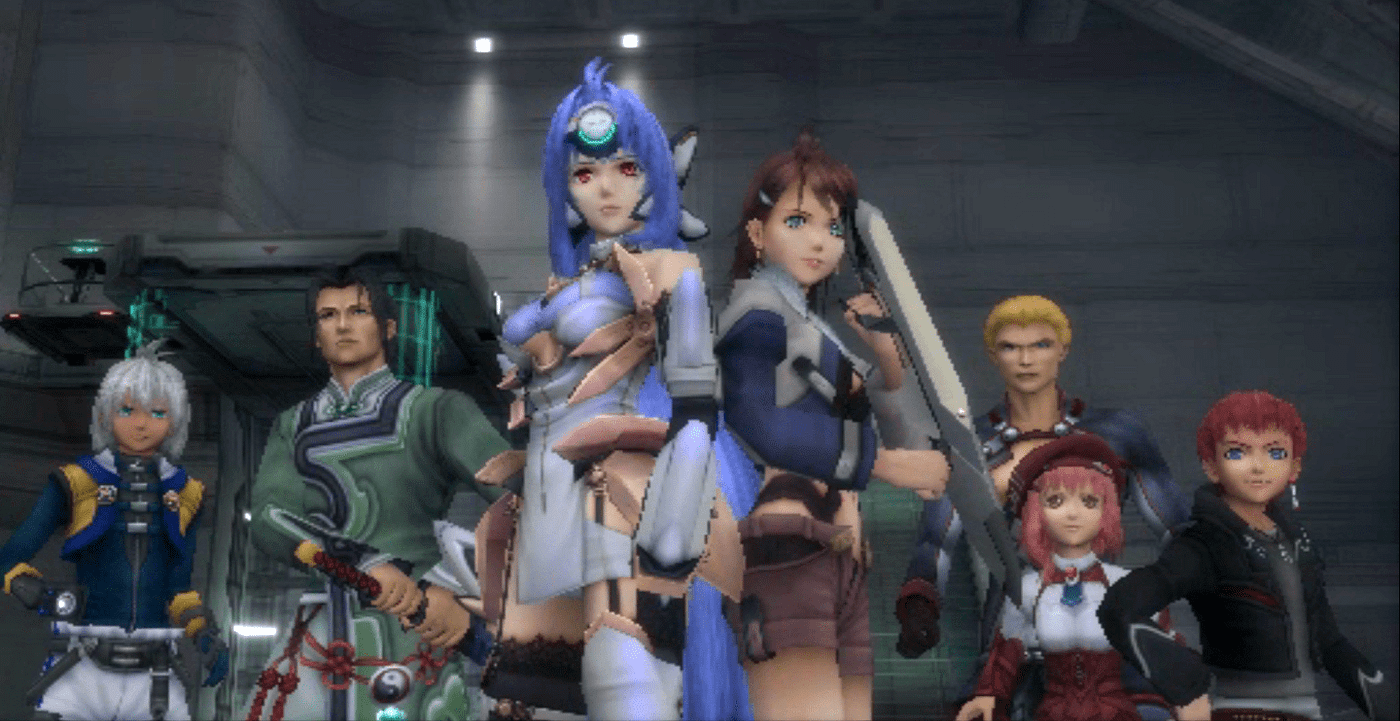
Xenosaga is a transitionary JRPG franchise that bridges the philosophical magnificence of Xenogears and the marriage of story and gameplay cohesion of Xenoblade Chronicles. While featuring moments of true greatness, Xenosaga elicits unmistakable growing pains from a team still trying to figure out their strengths as a developer. // Image: Monolith Soft, Bandai Namco
For better and for worse, Xenosaga hits different. It’s an unmistakably weird JRPG franchise that was born out of Tetsuya Takahashi and the team behind Xenogears’ wish to make something free of the creative and managerial restraints that marred that game’s potential. In many ways, Xenosaga carries on the ambitious soul of Xenogears by crafting a massive story and world that inherits a lot Xenogears’ ideas and lore, while injecting many new ideas that build upon the ideas seen in the golden era Squaresoft title.
Earlier this year, I wrote an essay about how Xenogears’ ambition is a large part of what escalates the game towards greatness. The team behind Xenogears more than proved that they were capable of creating a larger-than-life story within the JRPG framework to deliver an unforgettable game. Given that Xenogears didn’t get the greenlight for a sequel nor realize any of its starry-eyed, six-episode ambitions as outlined in Perfect Works, the development team’s ambition had to come out some other way. In 1999, the burning desire to never let go of this team’s ambition culminated in the formation of Monolith Soft, a new developer that was majority-owned by Namco (now Bandai Namco). This team would work on a spiritual successor to Xenogears in an attempt to actualize the vision that couldn’t be realized under Squaresoft. In addition to the Baten Kaitos duology in collaboration with Nintendo, Monolith Soft would mostly be known throughout the 2000s for their work on what would become the Xenosaga franchise.
Despite being born from similar ambitions and scale, I feel that Xenosaga has a very different legacy from Xenogears. Unlike Gears before it, Xenosaga actually got multiple installments to tell its large-scale story. Unfortunately, though, history began to repeat itself. Xenogears was a hugely compromised experience that had to condense much of its story to reach a shippable state on time, resulting in a story that felt unevenly paced and dense in its second half. Xenosaga had a somewhat similar fate - the series’ first episode ended up becoming a severely compromised slice of its original vision. However, the kind of compromises that Xenosaga Episode I had to make were very different from Xenogears in the sense that it became a significantly smaller end product.
Indeed, Xenosaga Episode I was severely compromised in that it featured less than half of the intended content that was planned for the first of six installments. This meant that the original draft of the six-episode story had to effectively get thrown out the window as the rest of the series tried to rearrange its own pieces and catch up to the original story. But by the time Episode II released, the damage had already been done. Part of Episode II tries to complete what was intended to be the second half of Episode I, while another part of it deviates from the originally planned vision altogether in attempt to tell a new story.
While Episode I sold modestly well, Episode II severely underperformed, leading to a decision that would ultimately seal the series’ fate: Xenosaga would only feature three games instead of six. Through that mindset, Xenosaga: Episode III seeks to wrap up the series with a satisfying conclusion to two games that felt narratively incomplete, inconsistent, and imperfect representations of what this JRPG franchise was originally intended to be.
All this is to say that Xenosaga is not the series it was originally planned as. And hey - that’s game development and, generally, the process of creating anything, right? Things don’t go as planned, and you have to adapt and create something good even if it doesn’t work out the way you want. Takahashi and his team succeeded at doing just that with Xenogears, but could they pull off the miracle again?
The answer is complicated. Xenosaga struggles a lot more with cohesively realizing its narrative and gameplay ideas. These games have a lot of rough edges and have big inconsistencies among one another. I have a hard time declaring Xenosaga as a masterpiece like I easily could with Xenogears. With that said, however, I can’t help but admire Xenosaga despite its flaws and struggles to be a cohesive and fun trilogy of JRPGs. Xenosaga is flawed, but it’s shockingly fun to talk about.
So let’s do just that! Let’s talk about my thoughts on Xenosaga after having played all three games on original hardware in 2026 and see how they’ve held up over twenty years after their original releases.
Xenosaga Episode I: Der Wille zur Macht

Xenosaga Episode I is the most transparent with its inherited DNA from Xenogears. Unlike that game, though, Der Wille zur Macht feels compromised in the sense that it feels like not that much happens throughout its runtime. // Image: Monolith Soft, Bandai Namco
Xenosaga’s first installment bares the subtitle, Der Wille zur Macht (or “The Will to Power”). As would be the case for all mainline Xenosaga installments, each game’s subtitle is in reference to a philosophical work by 19th century German philosopher, Frederich Nietzsche. As was the case in Xenogears, Xenosaga inherits a lot of ideas that were popularized by Nietzsche, particularly in relation to the philosopher’s views on nihilism and religion. Moreover, Xenosaga often borrows terminology popularized in the musings of Frederich Nietzsche, Carl Jung, Sigmund Freud, and others. It’s not uncommon for Xenosaga to also make references to the Bible and Kabbalah, with Bible verses sometimes even being directly quoted.
A consistent tragedy, though, is that many of these references throughout all of Xenosaga are largely surface-level. A good example of this is the Pleroma, an early dungeon in Xenosaga Episode I that introduces characters Ziggy and MOMO. “Pleroma” refers to the idea of spiritual completion or fullness. The term is specifically used in the New Testament as well as within Gnosticism, a theological interpretation that was particularly investigated within Xenogears. However, “Pleroma” in the context of Xenosaga is little more than a spaceship where prisoners are held captive. It’s merely a dungeon that the player spends not that much time in before moving on to the next narrative moment in the game. The name of the ship is little more than a surface level reference to what may be one of the themes of the game - and if that’s the case, what’s the point?
Xenosaga features a database where players can reference various nouns and terminology that liberally populate the entire series. There is a lot that players have to mentally keep track of and learn in order to fully understand Xenosaga’s story. There’s a lot of information to absorb, but the process of doing just that is a fun process in and of itself (and Episode I’s relaxing track that plays while in the database certainly helps too!). Xenosaga is filled to the brim with sci-fi jargon that practically begs the player to read database entries to get context. While some may find that an annoying aspect of Xenosaga’s storytelling, I think it’s thought-provoking and cool jargon. Truthfully, the extensive lore and database are some of my favorite aspects of the series.
I want to quickly focus on Episode I’s database entry for “Pleroma”. This entry simply describes the spaceship and contextualizes the uses of the Pleroma that helps frame why MOMO was being contained in this spaceship. After this flavor text, though, Episode I insists that the term “pleroma” is essential to the overall themes of Xenosaga, teasing that later episodes will fully unveil why this is the case.
While I do see the themes of wholeness come into play throughout Episode II and III, the mention of this very idea feels genuinely premature in Episode I. The story told in this first installment doesn’t deliver much payoff that makes any theme of fullness feel meaningful. That makes the reference of the term feel decidedly surface-level - and such a thing establishes an underwhelming precedent that Xenosaga never truly escapes from.
Xenosaga doubtlessly features many ideas, but many of those ideas don’t reach their potential because so many ideas appear either half-baked or surface-level in the final product. I have no issue understanding that there is a deeper intent behind many of Xenosaga’s creative storytelling decisions. I have no doubt in my mind that Xenosaga aims to plant seeds that lead to profound payoffs not unlike what this same team accomplished in Xenogears. However, Xenosaga consistently stumbles throughout this first episode with regard to creating intriguing, well-thought-out payoffs.
Perhaps much of the intended narrative setup feels as underwhelming and half-baked as it does because of the compromised state of the game’s final narrative. Perhaps the intention was to have so many of Xenosaga’s ideas and setup have bombastic and profound narrative payoff, but in the final product, that seldom happens. Ultimately, I have to judge these games for what they are and not what they could have been. And as it is in its final, released form, Xenosaga Episode I never presents satisfying payoffs in the way that Xenogears and the Xenoblade Chronicles games often do.
Let’s back up and contextualize what this game sets out to do in the first place, though. Xenosaga Episode I: Der Wille zur Macht begins in 2001 at Lake Turkana in Kenya, when the Zohar is discovered, forever altering the trajectory of human history and technology. We are then propelled thousands of years into the future, where humanity is living among the cosmos as the Zohar is rediscovered floating through space by the spaceship, the Woglinde. Onboard this vessel is a team of researchers working for Vector Industries who are working on a battle android named KOS-MOS. Shion Uzuki, the chief engineer of KOS-MOS and the protagonist* of Xenosaga, is collecting and delivering data for KOS-MOS while also supporting research and development on Realians, artificial humans primarily designed for combat. This is until the Gnosis, the effective monsters throughout Xenosaga that the player will fight throughout the series, appear and attack the Woglinde, seemingly targeting the Zohar.
The Woglinde section of the game is shockingly vast for what is effectively a tutorial area. While onboard the Woglinde, the player will get acquainted with combat, talk to various NPCs, learn about the game’s systems such as the Segment Files, and become introduced to Xenosaga’s deep lore - and this especially helps set up various questions that help build intrigue in ways that the first installment of a multi-part series ought to. What exactly are the Gnosis? What is the Zohar truly capable of? Are certain characters’ hatred of Realians justified? It’s impossible to not become intrigued and hungry for more throughout the lengthy opening Woglinde section of the game.
Most vitally, though, the Woglinde is a great opening video game section because it does a great job at setting expectations for the remainder of the series. Much of this section is calm - maybe even mundane and repetitive. Throughout this section, Shion will slowly run through long hallways with important rooms far apart from each other. Shion can talk to NPCs, buy items and equipment from shops, play the odd minigame or two, and generally move through the linear environment at an admittedly glacial pace.
During this time, no music will be playing. The hums of ventilation ducts are the only sound the player hears - which feels both eerie and empty, neither of which I’m guessing are intended feelings. Indeed, much of Episode I’s soundtrack is reserved for battles and cutscenes. Navigating through the game’s environments, however, is almost always silent, making navigating through most of the game’s settings to feel…off. What music is in Xenosaga Episode I is quite good - exceptional even in the cases of the game’s brilliant vocal tracks like Pain and Kokoro. It’s just really unfortunate that you don’t get to hear any of it while exploring the game’s world, something that takes up a major chunk of the game’s runtime.
Walking through the Woglinde gives the player a sense of cozy easiness. Indeed, many of Xenosaga’s NPC interactions have quirky, lighthearted tinges that help add brightness and color to the game’s atmosphere. The game admittedly has kind of a meandering, easygoing direction during this time (Shion literally gets distracted from reporting to the ship’s bridge during this sequence as she gets caught up helping the Realian lab for a while). This cozy vibe of the game gets sharply contrasted once the Gnosis finally arrive in pursuit of the Zohar stored onboard the ship. In what feels like a snap of the finger, Xenosaga quickly shows how dark it’s willing to get.
Once Gnosis enter the Woglinde, we see people get turned into stone, others have their bodies become pools of blood (complete with some gory imagery that’s genuinely shocking to see for a T-rated release). While there are certainly times where Xenosaga is willing to get silly and lighthearted, there are also moments of genuine tension and fear that naturally come about by the threat that the Gnosis and Xenosaga’s many antagonists instill into the game’s tone. Episode I sets this precedent of having long stretches where the player can explore and get immersed in the game’s world while at ease, only to take that comfy feeling away and instill deadly stakes that accelerate the pace of the game’s storytelling. After long stretches of no combat, the elevation in stakes lead to more battles, character deaths being on the table, and familiar environments becoming tarnished ruins that barely resemble what they once were.
Episode II and III will both go on to have sequences that mirror the pace of the Woglinde section, and for that, Episode I does a good job at preparing players for the general gameplay pace that should be expected throughout the series. However, this also lays the foundation for the series’ uneven blend of story and gameplay. While Xenosaga’s pacing remains roughly consistent throughout the series, that consistency is in the form of a very stop-and-go narrative structure. Xenosaga gets caught in a cycle where long stretches where nothing significant happens are followed by relatively short stretches where a lot happens to then be followed by long stretches where nothing significant happens.
It isn’t uncommon for JRPGs, especially circa the early 2000s, to have stories that effectively go on pause in order to have the player complete a longer dungeon complete with numerous encounters and boss fights. But Xenosaga, specifically Episode I and II, exhibit this issue throughout their entirety. Indeed, there are times when Xenosaga Episode I will feature a bombastic 40-minute stretch of cutscenes that lay on a lot of narrative information onto the player, only to have the next hour or two of gameplay feature almost no story progression as the player navigates through a dungeon. Once the dungeon is over, the game goes back to having TV show episode-length cutscenes that deliver the player to the next gameplay sequence and so on.
This stop-and-go nature of Xenosaga’s storytelling is at its very worst in Episode I. This causes Xenosaga Episode I’s story to have plenty of exciting moments, but they’re isolated far apart from each other and are separated by long stretches of gameplay content where events of little narrative significance take up hours of runtime. In a genre already notorious for being prone to having poor pacing, Xenosaga stands as having some of the worst pacing in a JRPG - particularly with how it balances its dense storytelling and long dungeons.
As the section on the Woglinde reaches its climax, Shion nearly gets killed by a Gnosis before being saved by KOS-MOS, who mysteriously exhibits a special directive to protect Shion at all costs - even if it means leaving others to die. Although she’s the chief engineer of her very savior, Shion has no idea why or how KOS-MOS has this directive. Indeed, Shion’s relationship with KOS-MOS and the former chief engineer, Kevin Winnicot, who was himself killed by a prototype of KOS-MOS, is at the very core of Xenosaga’s intrigue and is by far the most compelling aspect of Xenosaga’s story in my eyes.
It’s a shame, then, that this key aspect of the story never feels like it gets the exploration and depth that it deserves. Despite KOS-MOS being the mascot character of the entire series and being prominently featured on the box art for every installment, KOS-MOS often feels like a background character that rarely ever gets moments to shine. Throughout Episode I, KOS-MOS admittedly does have some badass moments, particularly when she activates the Hilbert Effect and destroys thousands of Gnosis in a single instance, but she never becomes the star of the show that the game’s marketing would lead you to believe. Monolith Soft really leans into KOS-MOS being an android in the sense that she hardly exhibits emotions at all, which sometimes makes her a scary, imposing figure. I can see this as part of the authorial intent, presenting KOS-MOS as an automaton that Shion needs to understand how to effectively communicate with and understand, but this dynamic is hardly ever the focus of Xenosaga. As a character, it’s hard to get too attached to KOS-MOS until her character is fully unveiled in Episode III.
I put an asterisk when describing Shion as the protagonist of Xenosaga because, while the beginning of Episode I certainly frames her like a protagonist, Xenosaga often feels unable to decide whether it wants to fully commit to having a central protagonist or take a “every party member is a protagonist” approach. While much of Episode I centers on Shion’s perspective, there are a few instances where we pull away and focus on a different character. Largely, though, Episode I focuses the most on Shion - something I want to bring attention to when we talk about Episode II.
While we start with Shion and KOS-MOS aboard the Woglinde, we gradually become introduced to other characters in separate sections. Ziggy, a part-human, part-machine cyborg that wishes to become entirely machine, gets tasked with rescuing MOMO from imprisonment onboard the Pleroma. After escaping the Woglinde, Shion, KOS-MOS, and fellow Vector Industries engineer, Allen stumble upon the Elsa, a vessel that effectively serves as a hub between major areas and dungeons throughout Episode I and the rest of the series. It’s here where the party meets chaos (yes, it physically pains me to write that character’s name in all-lower case, but alas, that’s how his name is written in-game), and cross paths with Ziggy and MOMO. Lastly, the party flies to a larger spacecraft, the Durandal, where they meet Jr., the game’s final party member.
From here on, Xenosaga Episode I becomes an adventure that takes players to various different spacecrafts. Despite being a space opera, Xenosaga Episode I never actually has the player touch down on any planet - which admittedly makes it stand out from any other sci-fi RPG that I’ve played. Although the back of the game’s box art boasts over 80 hours of playtime, Xenosaga Episode I can be comfortably beaten in less than a third of that time, as the player will primarily go through dungeons rife with turn-based battles between seeing lengthy gauntlets of exposition and narrative progression.
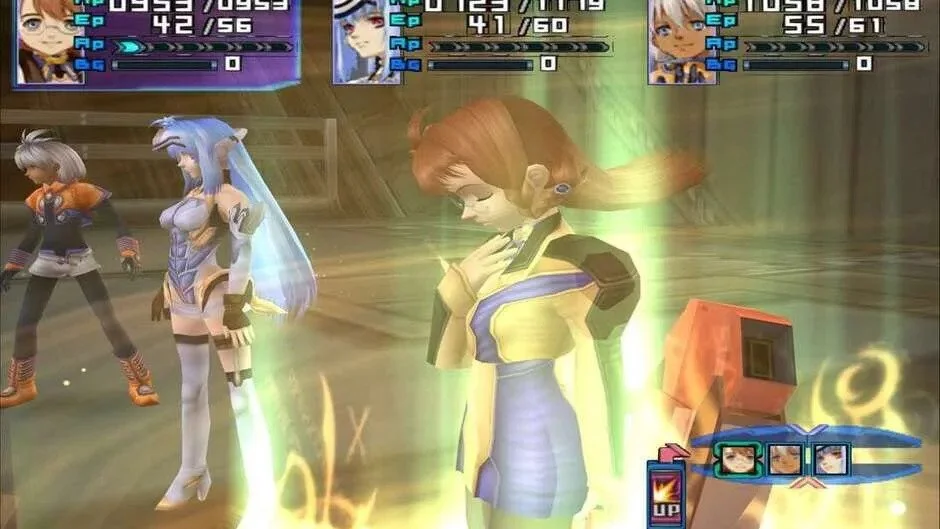
Xenosaga Episode I evolves Xenogears’ combat system while injecting a lot of new elements that later Xenosaga titles would further build upon. The Boost system that allows character to budge their way to the front of the turn order and Event Slots both make their debut here - and would both be iterated on throughout the series. // Image: Monolith Soft, Bandai Namco
I’ve done a lot of complaining so far while talking about Xenosaga Episode I. I find myself looking back on my time with Xenosaga Episode I as critically do because I genuinely see what it could be. This is a fun JRPG that features a lot of interesting combat mechanics, versatile systems that allow for deep customization, and a ton of unique mechanics that genuinely make playing through Xenosaga Episode I’s many battles feel unlike any other turn-based RPG.
There are glimpses of true brilliance in Xenosaga Episode I’s gameplay, but it never quite reaches its true potential, and a large part of that is due to battles’ often glacial pacing. Looking past how slow battles can be, though, Xenosaga Episode I regularly delivers a deeply customizable, flexible, and fun combat system that makes the slow pace of battle worth slogging through.
Xenosaga Episode I’s combat system works as well as it does because of three central mechanics: Boost, Events Slots, and the A.G.W.Ss. Each of these mechanics, while somewhat minimal on their own, come together to help transform a relatively straightforward combat system into a deeply complex and regularly satisfying one.
The core of Xenosaga Episode I’s combat is an expansion and evolution of Xenogears’ combat system. Instead of the low, medium, and heavy variants of attacks from its spiritual predecessor, Xenosaga implements near and far variants of attacks, with different combinations leading to different attacks. Each action that the player takes, including the multiple attacks that they can issue per turn, takes up Action Points (AP), with a maximum of 6 AP per turn. By strategically saving and using AP for each turn, players can end their attack combos with powerful Tech Attacks, which can be used for crowd control or focused damage on a single enemy.
The idea of allocating an amount of points to each action taken per turn isn’t a novel concept even for 2002, but it’s a common gameplay system for a reason: it works. Of course, the main bulk of seeing success in Xenosaga Episode I is strategically using each character’s different Tech Attacks - with new powerful Tech Attacks being learned through levelling up. Each Tech Attack can also be powered up in multiple ways with Tech Points. While the player can level up Tech Attacks to hit harder or have a quicker recovery after use, players can also spend Tech Points to make Tech Attacks available after only one attack instead of two. This makes the game’s powerful Tech Attacks become accessible even when the player doesn’t store 6 AP on a character, something that typically requires either guarding or only attacking a single time per turn in order to use. Having access to Tech Attacks makes players regularly feel the power fantasy of watching flashy attack animations tear through enemies.
Since Tech Attacks are so powerful and have so much utility in combat, that means that players are incentivized to use them as often as possible. However, every Tech Attack features long, often slow, and unskippable animations. Not only does this lead to repetition of seeing the same few animations play out multiple times over the course of every battle, but it also severely stretches out the runtime of each battle. Random encounters in Xenosaga Episode I take 45 seconds at the very least - and a lot of that time is attributed to the slow speed that animations play at. This isn’t limited to Tech Attacks, either. Using items, casting Ether spells, watching enemy attacks - just about everything that can happen during combat feels slow and can’t be sped up or skipped in any way.
This creates an unfortunate bloat that makes the trivial regular encounters still take anywhere from 45 seconds to two minutes. Boss fights that require more attacks, strategies, and adaptation take far longer - often going well past fifteen minutes. The overall pace of battles contributes to the broader slow feeling of Xenosaga Episode I. Inside and outside of combat, things just move at a relatively slow pace, and there are no settings to make things flow faster in any way. Much like 2001: A Space Odyssey, the film that inspired Monolith Soft’s namesake, Xenosaga Episode I is a game that isn’t afraid to take its time, and that very much extends to every aspect of its gameplay systems. With that said, being slow doesn’t necessarily make Xenosaga Episode I’s combat unenjoyable. Along with the fun inclusion of attack combinations and Tech Attacks that evolve the Deathblow system of Xenogears, Xenosaga Episode I gives players a lot to consider during its tactical fights.
The most integral part of Xenosaga Episode I’s combat system is the Boost system, in that it’s one of the few mechanics that sees use in all three games. Upon building a meter for each character that fills after attacking or taking damage, characters can Boost in order to budge to the front of the attack order. This mechanic synergizes beautifully with another of Xenosaga Episode I’s primary mechanics, the Event Slot system. Next to the turn order display, players can see the event present for each turn. Events alter what happens on each specific turn. For example, during the Boost event, characters’ Boost gauges will fill significantly faster upon attacking. The Critical event will increase the odds of critical hits landing during that turn. The Points event will multiply the amount of Tech Points, Ether Points, and Skill Points received from an enemy upon death. Lastly, there’s a Nothing event where nothing happens.
These events happen in a cycling order that never changes throughout the game. This lets players get familiar with how to take advantage of each Event and strategize according to their static order. For example, in order to secure killing an enemy during a Boost event, players can Boost with a character so that their turn takes place during a Points event. Likewise, the player may Boost multiple times to ensure that an enemy doesn’t attack during the Critical event in order to avoid taking extra damage. It’s a smart system that feels consistently fun to engage with.
Of course, these systems are ones that enemies can take advantage of as well - and this leads to mixed results. Enemies can Boost as well - however, enemies are able to bend the rules in their favor in a way that makes combat a bit less fun. Enemies can Boost at any time - including when one of the player’s characters already has a Boost reserved for the next turn. When this happens, the enemy’s Boost overrides the character’s Boost, meaning that the player has effectively wasted the Boost Gauge that they used for the Boost. This would be engaging and lead to fun strategy if the player could override enemies’ Boosts as well - but this is unfortunately not the case.
Put another way, the enemies effectively get to cheat against the player with their Boosts. This can often lead to frustrating and inherently unfair situations where the player is strategizing a way to set up characters’ turns during specific Events in order to deal optimal damage, only for that strategy to get shattered by an enemy overriding one of the players’ Boosts. There is no counterplay to this or way to work around enemies Boosting - the player just has to accept that the enemy has Boosted and must revise their strategy to adapt with whatever the enemy will throw at them. This thankfully doesn’t happen too often throughout Xenosaga Episode I, but it’s doubtlessly disheartening when it does. Even with that imperfection, the Boost and Event Slot systems work together beautifully to create a combat system that carries an otherwise basic, often slow battle system.
Beyond that, players have additional options available to them. While each character can perform attacks, Tech Attacks, and guard, they can also perform move between the front and back rows, cast Ether spells, and summon A.G.W.Ss. Switching rows is hardly ever essential, as it merely makes characters in the back take less damage as is typical for JRPGs with row mechanics. However, rows also determine whether characters can physically attack at all, as only characters in the front row can directly attack enemies. While there are some instances where certain Ether spells are available depending on the row its cast from, such as when a spell is cast from behind another character, being in the back row isn’t that advantageous for the player.
Seasoned players of classic Final Fantasy games may posit that being in the back row may be optimal for characters that focus on spellcasting - and they’d be right for assuming that characters specializing on casting spells are more valuable to have in the back row in Xenosaga Episode I in theory. However, the fatal flaw of Xenosaga Episode I’s practice of this theory is that spellcasting in this game is quite weak. Ether (Xenosaga and the broader Xeno series’ stand-in for magic) has much of the usual suspects for spellcasting in JRPGs. You have your buff and debuff spells, healing spells, and a few attacking spells to deal damage. Unfortunately, I found many of the offensive spells to have very, very limited power and utility. Using physical attacks and their accompanying Tech Attacks are far more efficient and effective means of dealing damage throughout Xenosaga Episode I. This tragically causes many spellcasting-focused characters like MOMO to be far less effective than tankier powerhouses like Ziggy and KOS-MOS.
This is especially tragic because Xenosaga Episode I’s means of learning new Ether spells is genuinely cool and innovative. Every character in Xenosaga Episode I has a different skill tree with different Ether spells that can be learned with Ether Points - all of which are unique to them. However, characters can also learn Ether spells exclusive to other characters by expending Ether Points. So, do you use Ether Points to learn new Ether spells on the character’s skill tree? Or do you use Ether Points to learn another character’s Ether spells? Early on in my playthrough, I had multiple characters learn Shion’s healing abilities in order to give every character access to healing options - something that came in handy during the late game’s more challenging boss fights.
I’ve already touched on how Tech Points are used to power up Tech Attacks, but they also serve another purpose - raising characters’ stats. Beyond just leveling up with experience points, each one of every character’s stats can be manually raised by expending Tech Points. This gives the players the freedom to customize their characters’ builds to their liking. This dual use admittedly makes Tech Points a very valuable resource - which only makes killing enemies during Points events that much more enticing.
The last of the three types of points awarded from enemies is Skill Points, which simply turn the abilities of accessories into passive, equippable abilities for each character. The more Skills that the player unlocks, the higher their Skill Level becomes, which grants them access to converting Skills from the more overpowered accessories.
Each of these systems create a deeply customizable combat and buildcrafting systems - yet the most customizable system is that of the summonable Anti-Gnosis Weapon Systems or A.G.W.Ss. The spiritual successor of the pilotable Gears in Xenogears, A.G.W.Ss are large mechs that can be summoned during combat and have separate health bars. While they can’t boost nor heal by conventional means, they can have multiple weapon systems that deal devastating damage. This system is cool - but is somewhat undercut by how expensive many A.G.W.S weapons are. Unlike Xenogears, players aren’t necessarily showered in money to the point where they can comfortably buy most pieces of equipment for the game’s mechs. Players will either have to grind for money to gain access to the stronger A.G.W.S weapons (and even purchasable A.G.W.Ss that have exceptional stats) or rely on Xenosaga Episode I’s side minigames to get cash.
As cool as A.G.W.Ss are, the money-sink that’s required to make them exceptional tools in combat goes too deep to make them a go-to for each combat encounter. Likewise, the previous criticism of slow, unskippable combat animations very much applies to A.G.W.Ss. Given that piloting these mechs during combat is almost entirely optional throughout Xenosaga Episode I, I often only resorted to using A.G.W.Ss as a way to buy time or prevent a character from dying if I was low on healing resources.
A.G.W.Ss are doubtlessly customizable and offer strong alternative strategies for combat in theory, but their execution in combat makes them often feel like an afterthought. While I appreciate giving the player more agency over whether they want to fight on-foot or in a mech after Xenogears often decided for the player how they would be fighting enemies, I don’t think Xenosaga Episode I nails the landing for making A.G.W.Ss feel like an essential part of its overall combat model.
In fact, failing to nail the landing is a common thread that unfortunately dominates Xenosaga Episode I. The game features various strong ideas, has fascinating lore, has a promising combat system, and has moments of narrative brilliance. But nothing ever truly clicks and feels exceptional, and that’s largely where I feel the compromise of the game’s development comes into play. By the time more characters and antagonistic forces come into play and it feels like the game’s plot is truly going somewhere, it suddenly beelines towards a conclusion that sets up the next episode. There are a few fun dungeons to explore, particularly with the last two dungeons that introduce a lot more puzzle mechanics, but the game ends just as it feels like the dungeons feel like they get proper momentum.
The game’s sci-fi aesthetic is often cool and cohesive, but it leads to many environments feeling similar to each other, and even coming off as dull at times. There are so many cool characters in Xenosaga Episode I and many of them have cool moments, such as the terrifying yet badass KOS-MOS and the love-to-hate villain of Albedo. But at the same time, there are also many characters that are hard to get attached to because they don’t have much if any development. chaos, a party member introduced a few hours into this game and one that’s present in all three titles, is a character that has almost no development here and has little presence beyond being the mysterious character that no one truly knows. That makes for an interesting backdrop for a character, but it doesn’t go anywhere within the context of this single title. If chaos was only introduced in this first title to be a more important character in later entries, maybe he shouldn’t have been a party member or had as large of a presence here.
I could go on, but you likely get it at this point - Xenosaga Episode I has so many cool, ambitious intentions, but very few of them reach their full potential. I feel that many of this game’s shortcomings come down to how little payoff there truly is within this single title. Even if you’re telling a story across multiple installments, I strongly feel that every installment should feel like a complete narrative in and of itself. That’s a challenge that any multi-part story has to grapple with, and unfortunately, I don’t think Xenosaga Episode I steps up to the challenge well enough.
That’s a difficult criticism for me to give, because I genuinely see effort in Xenosaga Episode I. When I play this game, I see a game that tries. There’s a genuine attempt to build a larger-than-life story with a deep, customizable battle system. In some ways, the game succeeds at realizing its ambitions, but in most ways, it doesn’t. Xenosaga Episode I often stumbles in pursuit of setting up something far larger than it can handle the weight of - and that leads to a game that rolls credits just as it feels like its starting to find its footing.
I had fun with Xenosaga Episode I, but I was doubtlessly left wanting more. I wanted to see more story, more dungeons, more puzzles, more challenging encounters, but the game gets cut short - largely because of development struggles that made Episode I a far smaller game than what was originally intended. Unlike Xenogears before it, Episode I doesn’t cram its originally intended story into the game - it just leaves a setup into a sequel - one that would itself be far more compromised and flawed than Xenosaga’s first episode.
I only find myself as critical of this game as I am because when Xenosaga Episode I is fun and immersive, it’s fun and immersive. The heights of this game regularly convinced me of the merits of Xenosaga’s ambition. Unfortunately, the growing pains of realizing that ambition as a young development studio prevented Monolith Soft from making Xenosaga Episode I the game it needed to be in order to prop up a successful, multigenerational story. That would become especially evident as Episode II entered the picture.
Xenosaga Episode II: Jensuits von Gut und Böse
Xenosaga Episode II: Jensuits von Gut und Böse is a complicated video game. Having the played the game with fresh eyes, I find the game to have some brilliant ideas and an innovative spin on the turn-based formula. But the clunky narrative, lack of tonal cohesion, and radical departures from Episode I make Episode II a hard game to recommend. // Image: Monolith Soft, Bandai Namco
I owe Xenosaga Episode II: Jensuits von Gut und Böse an apology. The first time I played through all of Xenosaga was in early 2013. I had become a fan of Xenoblade Chronicles after playing an imported PAL copy of the game. The then-untitled successor, Xenoblade Chronicles X, was announced early that year, leading me down the hyper-fixation rabbit hole of getting into the broader Xeno series. I got Xenogears as a PS1 Classic on PlayStation 3 and ordered physical copies of all three Xenosaga games while they were still reasonably priced. My excitement-fueled intention was to play through all three games of Xenosaga and gain a deeper appreciation for Xenoblade and anticipation for the future of the Xeno series. While I completed Xenosaga Episode I and enjoyed the game despite its flaws in early 2013, I couldn’t do the same for Xenosaga Episode II.
I had made it roughly halfway through Episode II and struggled to find joy with the game’s combat system. I found the game’s deviation from Episode I’s competent combat unnecessary and robbing the series of a chance to iterate and improve upon the promising capabilities of Episode I’s combat model. I enjoyed the cutscenes but didn’t find the dungeons or combat to be satisfying enough to keep going. In a move that’s very unlike me, I gave up on Episode II and resorted to watching the remainder of the game’s cutscenes on YouTube before proceeding to the next game. For the following thirteen years, I would regularly think of Xenosaga Episode II as one of my least favorite JRPGs that I’ve ever played. The game was a massive letdown for me and made me less interested in Xenosaga as a whole.
The inspiration of this project of replaying and reviewing Xenosaga was born out of a desire to replay Xenosaga Episode II specifically. Prior to this most recent visit of the game, I hadn’t played Xenosaga Episode II since I was a teenager. In that time, I’ve gotten more experience with JRPGs, have played and gotten used to many more combat systems, and now have a fully developed frontal cortex. That probably helps.
Moreover, I am a firm believer in giving everything a fair chance. I wanted to give Xenosaga Episode II a fair chance with no expectations to see if I could properly enjoy the game as an adult now that I have more knowledge and experience under my belt. And indeed, upon this replay, I see something in Xenosaga Episode II that I didn’t see when I was a teenager. I’m not quite sure how I didn’t understand Episode II’s combat system when I was younger given how well I clicked with it on this playthrough. I’m not sure how I didn’t find any joy in the game’s combat or dungeons given how consistently of a good time I had throughout Episode II.
All around, I gave Episode II a fair shot and a second chance after all these years - and I’m glad I did. While I still find Xenosaga Episode II to be an ostensibly flawed game and the weakest of the three games, I do think that it does some stuff well enough to be considered a fun, if imperfect JRPG. Like with Episode I, I have a lot of criticisms of Episode II - but those criticisms are largely born out of a frustration that, behind the many flaws inherent in these games, there is a strong foundation here. The ideas on display here could have led to an exceptional collection of JRPGs had the series’ direction been more cohesive and congruent with the originally intended vision.
With all that said, how does Xenosaga Episode II hold up after my first playthrough of it as an adult?
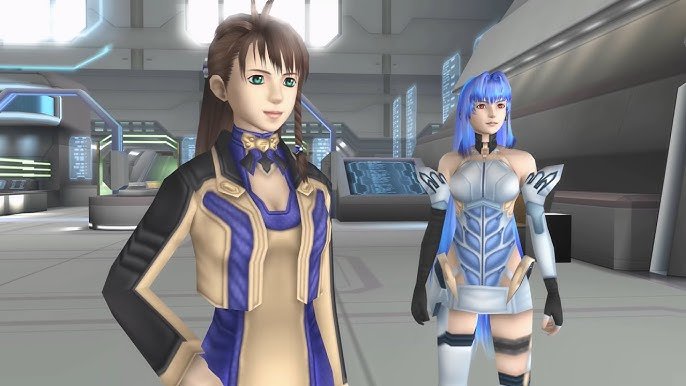
Xenosaga Episode II changes the series’ art style, opting for stylized realism instead of Episode I’s anime aesthetic. This awkwardly makes some characters like Shion and KOS-MOS in their Episode I costumes look like people cosplaying as these characters instead of the characters themselves. // Image: Monolith Soft, Bandai Namco
Xenosaga Episode II is largely a very enjoyable game that has immense baggage. In many ways, Episode II addresses a lot of the shortcomings of the first game. The overall pace of gameplay, be it the speed of animations that play out during combat to how quickly menus connect from one another, is consistently snappier. Episode I featured very little side content to invest time into, and so, Episode II has a fairly robust collection of side quests to complete, some of which even include optional minigames.
At the same time, though Xenosaga Episode II feels like so much of a departure from much of what Episode I set out to do, that it can often feel a bit head-scratching as to why these games were titled as episodes. The term “episode” implicitly suggests a consistency between installments. To look at one of Xenosaga’s contemporaries as an example, the .hack and .hack//G.U. games are multi-volume series of games that tell distinct stories but have consistent gameplay, user interface, and art style between them in order to make each installment feel like they’re contributing to a cohesive whole while still being individual games in their own right. Xenosaga Episode II makes it clear that it isn’t interested in doing that as soon as the player lays eyes on the title screen.
What is arguably Xenosaga Episode II’s biggest departure from Episode I is its aesthetics. The title screen features music from the incredibly talented composer, Yuki Kajiura, who is now most known for her work on .hack, Sword Art Online, and Demon Slayer / Kimetsu no Yaiba. Despite her supplying the first song the player hears, Kajiura only actually contributes to the music of the game’s cutscenes. The captivating, often melodramatic style of her music helps make some of Xenosaga Episode II’s most emotional cutscenes hit that much harder. The issue, however, is that the tone of Kajiura’s music clashes with the music heard in battles and environments. The songs heard in these parts of the games, composed by Shinji Hosoe and Ayako Saso, while by no means being bad music, genuinely feel like they belong to a different game than what’s offered in the cutscenes.
Xenosaga Episode I lacked music in almost all of its areas, but what music is present throughout Yasunori Mitsuda’s soundtrack in that game feels cohesive and has a consistent style that gives Xenosaga its sound distinct sound. Episode II, on the other hand, exhibits an unclear identity because of the vastly different styles of its multiple composers. There’s a striking, often jarring divide between the tone of Episode II’s music between its piano and vocal-heavy cutscene music from Kajiura and the bouncy synths present in Hosoe and Saso’s music. Songs like Kajiura’s Sweet Song unfortunately clash with the jubilant synths for songs that play in the Elsa and Second Miltia, for example. While I’m okay with later episodes having a different sound from Mitsuda’s work in Episode I, I think the lack of aesthetic cohesion makes Episode II’s style feel messier.
Of course, Episode II clashes even more with Episode I through its visual aesthetics. Episode I opted for an anime art style for its characters, as well as lower fidelity graphics compared to its higher budget peers. As such, the use of an anime art style helps make the game feature more expressive and vivid characters. The use of an anime art style perhaps wasn’t essential for Xenosaga, but it nevertheless gave Episode I a specific look. Episode II immediately deviates from Episode I’s art style by going for stylized realism with its art style. This approach makes characters appear more realistically proportioned, with women and children characters, in particular, having eyes and faces that are shaped completely differently from how they looked in Episode I.
When Episode II begins and we see the cast of Xenosaga clad in their Episode I costumes, everything about many of these characters looks off. Shion and KOS-MOS are the most egregious, in that their Episode I costumes were clearly not designed to be presented in an art style akin to Episode II’s. The way in which characters like Shion and KOS-MOS look in this new art style looks immediately awkward and stiff. Once these characters adorn new outfits that feature designs that are clearly more catered to look better in this more realistic art style, the change in art style becomes an easier pill to swallow. In time, it’s clear to see that Xenosaga Episode II is an overall solid looking game - but the switch between art styles in each game is going to inevitably jarring for any player going from game to game.
Another change that can be jarring when progressing between games is the change of voices for certain characters - the most notable being, once again, Shion and KOS-MOS. While I noticed Shion’s new voice immediately, she sounds roughly close enough to Shion’s voice in Episode I and III to not feel too distracting. KOS-MOS’ new voice, on the other hand, feels the most jarring because of the change in direction. In Episode I, KOS-MOS’ voice direction had a balance of roboticism and humanity that made her feel within arm’s length of coming off as human, but never fully so. Through Episode I’s direction, it was clear to take away from KOS-MOS that there’s a deeper, human connection that KOS-MOS shares with Shion and other humans and Realians despite her robotic nature. In Episode II, however, KOS-MOS’ voice direction goes all-in on making her sound as robotic as possible - to a point where all her dialogue feels inherently cold and lifeless.
There are other aspects of lifelessness in Xenosaga Episode II’s English dub. chaos and newcomer Canaan both heavily feature in the game’s opening sequence, and both characters have brutally monotone voices that barely emote in any way, taking the player out of the experience. At the same time, some characters have stellar voice direction. Crispin Freeman as Albedo, in particular, is an absolute standout throughout all of Xenosaga, but in Episode II, specifically, Freeman gives a great performance as Albedo in some of the game’s strongest narrative moments. Voice direction varies wildly in Xenosaga Episode II and feels by far the least polished out of the three games.
Other aspects of Episode II’s aesthetical identity, while different from Episode I, do a better job at making the transition to a new style while still feeling like Xenosaga. Namely, the menus feature an aesthetically pleasing animated background, complete with an overall snappier menu interface. As much as I feel the environment music tracks clash with the cutscenes’ music, at least there’s music playing in environments at all this time around!
While there are a few jarring irregularities with Xenosaga Episode II’s presentation, obviously the most important thing for Episode II to accomplish as the second installment of a multi-part franchise is to continue the story in a satisfying way while also evolving the gameplay to take greater advantage of Episode I’s mechanical ideas. Episode II takes one step forward and two steps backwards in both of these instances, making for a game that evolves what has come before in some ways while regressing and underperforming in other ways.
At the game’s onset, though, Episode II puts its best foot forward. In a massive improvement over its predecessor, Episode II starts with action by showing a flashback to the Miltian Conflict - a key event that sets many of the events of Xenosaga into action. It’s here that we finally get a slice of characterization for chaos (whose personality gets undercut by the aforementioned wooden voice direction of the English dub). Accompanied by Canaan, chaos navigates through a war-torn city onboard an E.S., which are the replacement for Episode I’s A.G.W.Ss.
E.S.s behave more akin to how Gears functioned in Xenogears, in that they replace on-foot combat and exploration altogether. Brand new to E.S.s, however, is that they level up from characters and never require new equipment in order to become stronger - largely because equipment (and currency to buy equipment) doesn’t exist at all in Episode II. The Miltian Conflict flashback serves as a great cold open for Episode II to introduce new characters and information that will become critical for the remainder of Xenosaga. Specifically, we get to see a proper introduction of Jin during this sequence, Shion’s older brother who we only briefly hear the voice of during Episode I. Not only does he pass on essential, top-secret information to Canaan, but he has a cool-as-hell sword fight with Margulis shortly after.
Believe it or not, though, this cool-as-hell sword fight is indicative of yet another problem inherent to a lot of Episode II: it just kinda happens. The sword fight doesn’t necessarily add anything beyond being a cool set piece that the player gets to watch during a cutscene. This isn’t the only time something like this happens in Episode II. In fact, the most infamous instance of this happening in Episode II occurs not long after we return to the main party shortly after the end of Episode I.
While Episode I entirely took place onboard spacecrafts, Episode II finally sees the main party land on a planet - Second Miltia -, as they finally are able to analyze the Y-Data stored in MOMO. Given that the Y-Data was the very reason that MOMO was imprisoned in the Pleroma at the beginning of Episode I, we finally can prepare to see the payoff to a narrative seed that was planted at the beginning of the previous game. Before that, though, the party’s first adventure while on Second Miltia is an effectively meaningless car chase sequence that maybe looks cool in the moment but doesn’t actually progress anything. It doesn’t lead to anything narratively meaningful - it just contextualizes a short dungeon where the party roams through the back streets of Second Miltia’s capital. This dungeon concludes with a boss fight against Richard, a character so inconsequential that he doesn’t get a portrait in Xenosaga Episode III’s database, which gives portraits to characters that don’t even have lines.
Put another way, Episode II has a lot of filler scenes - instances where things happen because they seem cool in the moment but don’t actually build that much in the grand scheme of things. That unfortunately leads to lot of instances where many inconsequential things happen in the plot - leading once again to the feeling of stop-and-go with the game’s pacing that impacted Episode I so much. I would argue that such a thing is even worse here, since there are now the addition of side quests with NPCs that give even more opportunities to have longer instances of little plot happening for long stretches of time.
When Xenosaga Episode II’s plot gets going, it gets going. Much of Episode II is concerned with MOMO’s Y-Data getting intercepted by Albedo, which leads to pieces falling into place for many of Xenosaga’s antagonists to find ways to Miltia and Lost Jerusalem. I find Xenosaga Episode II at its best when it takes the time to slow down and focus on the backgrounds of its characters. The genuine highlight of the entire game is when the party is exploring the Yuriev Institute where the U.R.T.V.s are raised. This section of the game gives players an opportunity to learn more about Jr., Gaignun, Albedo, and their relationship with one another. One particular cutscene involving Albedo hugging Gaignun’s leg gave me shivers on my most recent playthrough despite being familiar with this cutscene for fifteen years. That speaks to the power of some of Xenosaga Episode II’s best narrative moments.
It’s just a shame that there aren’t too many of them. A lot of that, I feel, comes down to the fact that Xenosaga Episode II has inconsistent focus with which characters it wants Xenosaga to center on. Despite Shion being framed as the protagonist throughout the majority of Episode I, she largely gets put on the sidelines throughout Episode II in favor of Jr. In fact, Shion’s behavior throughout Episode II is truthfully irritating a lot of the time, thanks to how she treats her brother and coworkers. Shion is certainly a flawed character and her strained relationship with her brother is clearly a large part of her character arc, but she’s frequently an unfun character to spend time with in Episode II. Jr. is effectively the protagonist of Episode II, and he has lots of great moments, but his time in the spotlight only further highlights how comparatively little screen time other party members get. Ziggy, chaos, KOS-MOS and MOMO get shockingly few moments to step forward into the limelight.
Xenosaga Episode II’s story is doubtlessly as messy as it is because of the game’s messy development history. Despite directing the first episode, Tetsuya Takahashi is only credited in Episode II as the “Original Author”, making it clear that Xenosaga was not going in the direction it was intended to go in. While I can see the sequence where the party lands on Second Miltia and extracting the Y-Data from MOMO as being originally intended for Episode I, the latter half of Episode II’s story tangibly feels like it’s going in a different direction from the original vision of the series, as showcased by the pivot to focusing heavily on Jr.’s perspective. Heck, there isn’t even a database in Episode II, making it the only game of the three where the player can reference the many nouns that they have to keep track of.
In spite of its narrative shortcomings, though, Episode II never quite feels narratively incohesive. While I find the pacing and attention given to characters to be uneven, it never reaches a point where everything falls apart. While Episode II is largely responsible for halving the expected length of the Xenosaga series, it still manages to set up a third installment in a somewhat satisfying way.
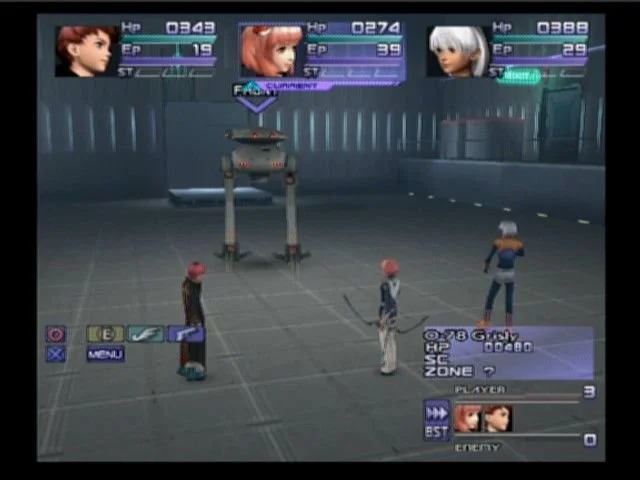
Xenosaga Episode II serves as the origin of the Break system that would be expanded upon in Episode III and each of the Xenoblade Chronicles games. Episode II’s combat can be hard to get to grips with, but when understood, it’s deeply satisfying to deal massive damage to enemies by Boosting multiple times to keep them in the air. // Image: Monolith Soft, Bandai Namco
Since my first playthrough all those years ago, I had always known that Xenosaga Episode II’s story was flawed but enjoyable. After all, I did have enough interest to watch all of the cutscenes on YouTube when I bailed on the game. But what really stuck out to me on my recent playthrough of Episode II was how good the combat feels in Episode II. Like with Episode I, I have a lot of criticisms to share with Episode II’s overall gameplay, but that criticism comes from a place of recognizing that there are genuinely brilliant ideas inherent to this gameplay model underneath the flaws largely tied to its progression systems.
So, yes - Episode II strays from Episode I’s combat system, making the broader Xenosaga series feel inconsistent between each entry on a gameplay level. Progression and many aspects of the gameplay have changed, but what has stayed the same? On-foot combat still holds on to two of the three core innovative ideas introduced in Episode I: the Boost system and the Event Slot system. While Boosting has gotten nerfed in the sense that there is now a single pool of Boost charges that are shared across the entire party, Boosting has been given far more utility in Episode II’s combat that makes it far more of an essential piece of Episode II’s combat puzzle.
Boosting is now more meaningful than just getting more turns in before an enemy or taking advantage of a certain Event Slot - Boosting is a key ingredient to set up Break combos. Every enemy in Episode II features some kind of weakness with a certain combination of A, B, and C attacks that, once exploited, puts them into a Break state. For example, an enemy’s weakness may necessitate the player to attack them with a B attack, then a C attack - in that specific order. Once this is done, that enemy enters a Break state, which makes them susceptible to special attacks that trigger the Down and Air statuses. Both of these special statuses cause damage multipliers, making this the ideal position for the player to be in order to dish out massive damage.
The core gameplay loop inherent to Xenosaga Episode II’s combat is to exploit weaknesses to set up a Break state, then use Boost and new Stock mechanics to deal massive damage during enemies when they’re in the Down or Air statuses. Stocking effectively replaces Episode I’s Guard command. In its place, players can stock additional attacks for future turns. While the player can get away with ignoring Stocking during the early game, this becomes an essential component of maximizing damage output during the challenging boss fights that populate the mid-to-late game. Each character can stock up to three attacks, which can be used to deal as many as five attacks in a single turn. This, when used in conjunction with the returning Event Slot system, can lead to long combos that either do massive damage thanks to an event’s increased critical hit rate or greatly increase the gain of Boost meter charges during a Boost Slot.
There are a lot of moving parts in Episode II’s combat system, but the true fun to be had with this game is the process of learning and mastering how to interconnect every combat mechanic to optimize damage. It’s certainly different from and more complicated than Episode I’s combat system, but I think it reaches significantly greater heights once fully understood by the player. Effectively stunlocking opponents with smart, judicious uses of Stocking, Boosting, and taking advantage of Event Slots in order to keep them in the Down or Air state for as long as possible makes for regularly exciting, strategic battles.
Part of why I feel I love this battle system is how much it stands as a clear predecessor to combat systems seen throughout the Xenoblade Chronicles series. The lineage of Xenoblade’s Break -> Topple -> Daze or Break -> Topple -> Launch -> Smash can be traced back to Episode II’s debut of the Break system here. Part of what makes me love Xenoblade’s combat so much is that it throws so many complicated mechanics to the player and asks them to figure out how to not only master each individual mechanic but decipher how to best connect each separate mechanic together. It causes seemingly separate, independent mechanics to come together and be part of a cohesive whole. Xenosaga Episode II accomplishes just this, but in a turn-based context, and I think it does a masterful job at that.
While I thought the combat in Xenosaga Episode I was solid, serviceable, but a bit basic and slow, I truly find Episode II’s combat system to be an objective improvement in almost every way. Combat animations are far snappier, making quick battles take as little as 15-20 seconds. Longer battles with the game’s bosses and more challenging enemies never feel like gauntlets of patience for long animations as was what it felt like with Episode I. Rather, each one of Episode II’s more challenging encounters asks the player to use their acquired knowledge of the capabilities of this combat system and try to trivialize it through smartly constructed Air or Down combos. Taking down half of a boss’ health in a single Down combo feels deeply satisfying largely because it’s a result of smart setup and payoff on the players’ end. Stocking attacks, building up Boost meter charges, then letting loose on a combo never fails to be a fun time.
Combat is truly the shining beacon of Xenosaga Episode II as a whole. While I found the game’s battles themselves to be an excellent time, Episode II unfortunately struggles to make everything surrounding the combat feel as polished and fun. The dungeon design comes closest to replicating the polish seen in the combat. While Episode I featured a couple puzzles that ramped up in challenge by the game’s last two dungeons, Episode II regularly throws in puzzles throughout each of its dungeons from the onset, and most of them help make dungeon navigation a more enjoyable time. There are a few finnicky dungeon puzzles, specifically ones relating to destroying blocks while in an E.S. to make an on-foot path in the late game, that take more time to get through than they should. But overall, I found the dungeon design and puzzles on display to be an improvement over what has come before. They’re nowhere near what I would consider to be exceptional dungeons, but they’re a clear step in a good direction for the dungeon-focused design of the series.
Xenosaga Episode II’s greatest flaw, I feel, is in its poor itemization and progression. In a baffling move that I don’t quite understand, Episode II entirely forgoes having an economy, which causes ripple effects throughout the game’s design. Episode II features no currency, which naturally causes there to be no shops to buy new equipment and items at. In fact, there’s no equipment at all in the game. Whatever items that the player acquires throughout the game, be they healing, support, or offense-focused, are entirely given to the player at the mercy of enemy drops, treasures hidden throughout dungeons, and the odd side quest reward.
This inevitably means that items will be on relatively thin supply for the player throughout the entire game, leading me to be quite conservative on my use of items throughout Xenosaga Episode II. I already lean towards being an item-hoarder in JRPGs (to save them just in case I need them later, only to have a surplus in reserve for the game’s final encounters, etc.), but Xenosaga Episode II asks players to be like this by design. Items are deeply valuable - even more so thanks to the way character progression is handled here.
Episode II streamlines the multiple points given to each character in Episode I and instead only supplies Tech Points that can be used to learn skills. Some skills are active abilities, some are passive buffs, and some behave like equippable accessories. Skills are grouped together in bunches of four in what are called Classes. Each Class’ four Skills can only be accessed and learned when dispensing Class Points - which are usually only acquirable by using certain items or learning all Skills in a specific Class.
This system isn’t bad on its surface. Unlike Episode I’s direction by giving every character their own pool of moves that could eventually be transferred to other characters, Episode II’s progression system allows every character to acquire the same skills from the jump. You may choose certain characters to be more offense-focused, while others specialize in healing or getting stat buffs. The way players can build characters is freeform - but it ultimately doesn’t make too big of a difference when healing and support skills are far more essential since items aren’t a reliable commodity in Episode II.
This is where Episode II’s lack of economy’s ripple effects rear their ugly head. Episode II regularly features enemies that hit hard, nearly requiring every character to have access to healing skills. Revival items, specifically, are quite limited throughout all of Episode II, meaning that the skill that allows characters to revive fallen party members is effectively a requirement for most of the game’s cast to have. But because getting this requires a certain use of Skill Points and Class Points, this effectively means that characters are given far fewer options to branch out and be different from each other.
While Episode II offers the promise of build variety in theory, many characters feel interchangeable from one another in practice, largely because the player can’t diversify the skills each character learns too much. A lot of this is also due to the relatively slow rate at which Skill Points are given to the player. Even when taking advantage of the Points event to get more Skill Points from enemies, the rate at which the player receives Skill Points only means that characters get enough resources to learn new Skills once or twice in a given dungeon - further causing a rift in making Episode II’s progression just not feel great.
Episode II delivers a theoretically more expansive, open-ended progression system than Episode I, but because of the limited amount of resources given to the player throughout the journey, the player is never truly afforded the freedom to build characters however they please. This is on top of the fact that not all characters in Episode II are created equal. Certain characters are more optimal to bring into battle than others. Characters like Jr., KOS-MOS, and chaos have more utility and strengths in combat thanks to their access to Air and Down attacks that act as combo starters, while characters like Shion and MOMO have less attacks available to them and are thus more situational. Bafflingly, Shion and MOMO are also the only characters capable of escaping from battle, making this game the first and only time I’ve seen a JRPG make running from battles a character-specific ability.
All this is to say that Xenosaga Episode II features a lot of oddities within it. The story features uneven pacing and has limited focus on many of its characters. While there’s a lot of side content is offered to the player, most of it is only made available during specific parts of the story, forcing the player to have to effectively gauntlet a lot of the side content (much of which amounts to unimpressive, mediocre quest design anyway. Episode II loves its fetch quests). The progression system, while having some interesting ideas, doesn’t entirely work in execution and ends up offering a more limited version of character progression than what was seen in Episode I. There are even some lame instances where the player doesn’t get to experience much new in certain stretches of gameplay, such as at the end of the game’s first disc where the player has to effectively complete the same dungeon twice in a row. The jarring nature of the game’s visual style and inconsistent tone of its soundtrack and voice acting also lead to a presentation that just feels all over the place.
In spite of all of those issues and all of the obvious problems that proliferated this game’s development cycle…there’s something here. Underneath all the imperfections and all the misguided direction of various facets of the game, there’s something special about Xenosaga Episode II, just as there was in Episode I. After disliking it for well over a decade, I grew an admiration for Episode II upon my most recent playthrough and much of that comes from the game’s je ne sais quois. Call it spunk, call it charm - there’s something underneath Xenosaga Episode II’s surface that makes it an interesting and fun game to play through, flaws and all.
The excellent combat model certainly holds the game up - I’d struggle to think I’d feel this way had I not clicked with the mechanic-heavy combat system of Episode II so much. Like with the other installments of Xenosaga, there’s something about this game that makes it unlike so many other JRPGs. The lore and worldbuilding here is still so deep and otherworldly, even if it doesn’t take the greatest advantage of the world that it and its predecessor have built up.
Xenosaga Episode II is a complicated game to enjoy, and yet I find myself doing just that. Episode II has almost as much, if not more flaws than strengths, and yet it’s a game that’s impossible to forget. From the deeply satisfying Air and Down combos that result in massive damage to some of the game’s goosebump-inducing cutscenes, there are various memorable moments in Xenosaga Episode II, and that’s enough to make the game a worthwhile play in my mind.
I hold Episode I and Episode II to similar levels of praise. I think that Xenosaga Episode I is the more consistent experience across the board despite feeling consistently sluggish and that it ends just as it starts gaining momentum. Meanwhile, Episode II feels a lot more disjointed and uneven, but has higher highs and lower lows that ultimately make a game that balances out to about the same quality level of Episode I.
Both of these games, as flawed as they are, hold up as solid JRPGs of the 2000s. I’d struggle to say they’re worth modern audiences playing right now, given that none of these games are accessible on modern hardware, but my opinion of the broader Xenosaga series would change for the better after I concluded my series playthrough with Episode III.
Xenosaga Episode III is so incredible that it elevated how much I think all three of these games are worth playing despite the hoops players will have to jump through to make any playthrough happen.
Xenosaga Episode III: Also sprach Zarathustra
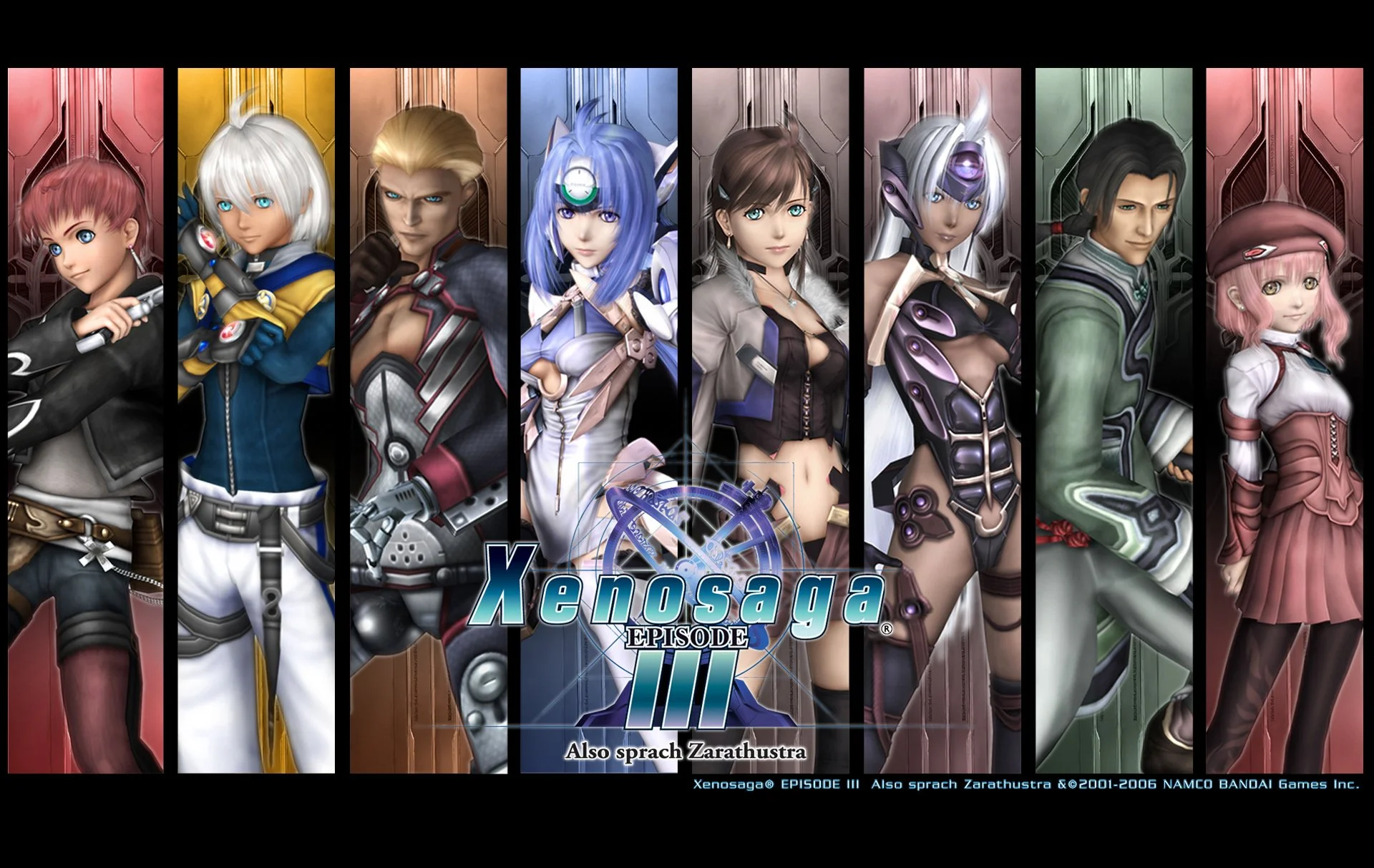
Xenosaga Episode III is a turning point in the history of Monolith Soft. It is the point where they become the legendary developer that have put out some of the most highly regarded JRPGs of recent memory. // Image: Monolith Soft, Bandai Namco
When making anything, whether it’s a video game, a novel, a presentation - you’ll often be advised to start strong and finish strong. Xenosaga Episode I did a great job at setting up the intrigue and density of Xenosaga’s world and lore. Given that the direction of Xenosaga didn’t go as planned, especially with Episode II going off the rails of what was originally envisioned for the series, Episode III found itself in a particularly challenging situation. It had to pick up the pieces from the compromised state of the series up to this point in conjunction with the fact that this series was denied its original vision of being a six-part saga and satisfyingly conclude the events of multiple games.
This was an impossible task with immense pressure that most games and developments teams would crumble under the weight of. And yet, against all odds, Xenosaga Episode III finishes the series strong - remarkably so. This isn’t a game without flaws, but my overall experience with Xenosaga Episode III reminded me a lot of my assessment of Xenogears. In my Xenogears piece, I concluded that Xenogears wasn’t a perfect video game because there was no universe where it could have been. There was no possibility that Xenogears could ever realize its originally intended vision considering the technical, managerial, and logistical restrictions that were placed against it. Xenogears is a remarkable game, in my eyes, because it reaches a great level of quality in spite of the odds placed against it. I find myself viewing Xenosaga Episode III very much the same way.
Episode III had to confront the fact that it had to cut a six-episode series short while still being an enjoyable, complete video game in its own right. With authorship returning to Tetsuya Takahashi, Episode III’s overall direction feels much more in line with Xenogears and Xenosaga Episode I. The story feels a lot more focused and confident in what kind of story that it wants to tell while still making the events of the first two games still feel meaningful, despite not aligning with the original plan for the series. There is no universe where Xenosaga Episode III is equipped to be the most optimal finale of a multi-part video game franchise. The trajectory and behind-the-scenes story of Xenosaga is too troubled and imperfect for it to be the perfectly satisfying game that it needed to be. And indeed, Episode III isn’t that perfectly satisfying finale for Xenosaga - but what it does do is turn a messy situation into a meaningful evolution and conclusion of what Xenosaga has strived to be up to this point.
Xenosaga Episode III is otherworldly, ambitious, and filled to the brim with heartful narrative moments. But more than that, it’s a game that feels precisely like how Xenosaga should have always been. Episode III doesn’t shy away from being the third child of a troubled franchise - rather, it doubles down on the unique traits and strengths of Xenosaga’s identity and strives to tell a story and create a gameplay experience that only Xenosaga truly could. That is one of the two reasons why I find Xenosaga Episode III to be a deeply admirable piece of art.
The other reason is that it happens to be a damn good video game.
In many ways, Xenosaga Episode III dilutes Xenosaga to its purest essence. It trims the fat and bloat of previous entries and tries to focus exclusively on what makes the series unique. Episode III doubles down on the complexity of the series’ lore by offering a far more detailed and comprehensive Database. It features more dungeons filled with more puzzles. It features far more narrative sequences and high-production-value cutscenes. It features devastating narrative reveals backed by a gorgeous soundtrack now fully composed by Yuki Kajiura. Episode III is a Xenosaga game through and through. It streamlines certain elements, such as having a more conventional combat system to be more in line with its JRPG peers and cuts back on the plentiful but monotonous side content seen in Episode II. This causes Episode III to feel, by far, the most cohesive game in the series - one that makes it a clear transitionary piece for Monolith Soft as a whole.
Indeed, I find Xenosaga Episode III to be the point in Monolith Soft’s history where they ascended to being a developer that not only strived to make ambitious games, but fully delivered on it. I would ascribe Xenosaga Episode III as the very game that marked the beginning of Monolith Soft’s track record of making groundbreaking JRPGs that lift up the entire genre. That isn’t to say that it’s a perfect game - but it’s a game that does an admirable job being the best it can be with the cards that it was dealt.
With all that said, let’s talk about what makes Xenosaga Episode III reach such exceptional heights and accomplish the seemingly impossible task of making everything that led up to this game feel worth it in the end.
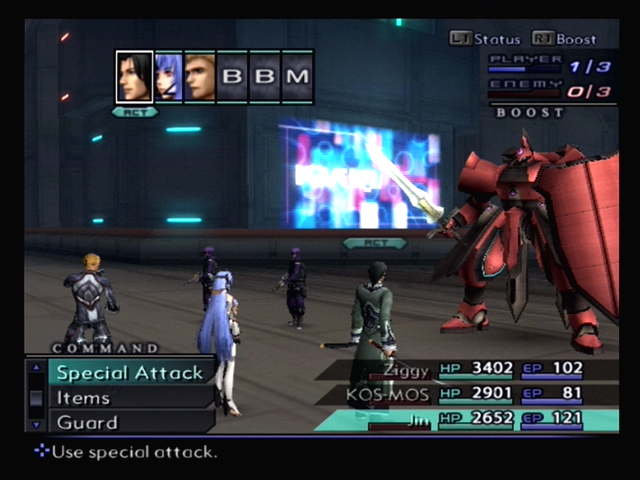
Xenosaga Episode III foregoes continuing to evolve the combat styles seen in Xenogears and the first two episodes of Xenosaga in favor of presenting a more streamlined, conventional battle system. Episode III has the least ambitious but most accessible and snappy combat system in the series. // Image: Monolith Soft, Bandai Namco
Unlike its predecessor, Xenosaga Episode III features a time skip that separates the events between it and the previous installment. This is the part of the review where it makes the most sense to mention that the three episodes of Xenosaga do not make up the entirety of the Xenosaga franchise. Indeed, there are other games within the Xenosaga IP, some of which have unfortunately teetered on being lost media, such as the Japan-only mobile game, Xenosaga: Pied Piper (which was only recently recovered and preserved). Another Japan-only game, Xenosaga Freaks is largely an inconsequential spin-off.
The only Xenosaga spin-off piece of media that is actively relevant to the main trilogy of games is that of the bizarre Xenosaga: A Missing Year, which bridges the gap between Episode II and III. The story told in this Japan-only series of flash animations helps set up the context for Xenosaga Episode III. Given how niche this side-story’s release was, though, the vast majority of players, especially outside of Japan, are just going to have to do more digging through Episode III’s database to understand the gaps that A Missing Year covers. It’s a clunky instance of transmedia storytelling.
Thankfully, this isn’t a massive detriment to the story of Episode III - it’s just yet another bizarre footnote in Xenosaga’s history and legacy. Once the game actually begins, Xenosaga Episode III immediately sets itself apart from previous Xenosaga games by being a massive improvement in production value and graphical fidelity. I truly find Xenosaga Episode III to be one of the best looking games on PlayStation 2, and a lot of that assessment specifically comes from the consistently impressive cutscenes. They’re shot well, feature dynamic camera movement, and frame action in often interesting and exciting ways. The sheer graphical fidelity and direction of Episode III highlights just how comfortable Monolith Soft had gotten with the PlayStation 2’s architecture at this point. This game consistently feels like a showcase of their mastery of working with the PS2 hardware throughout this multi-episode project of theirs.
Another aspect of Episode III that becomes immediately clear is that the odd inconsistencies from Episode II are now nowhere to be seen. The voice actors for Shion and KOS-MOS from Episode I reprise their roles here, and the overall voice direction is a substantial improvement from anything done in this series prior. A lot of that is in thanks to the excellent localization courtesy 8-4, in one of the Tokyo-based localization firm’s very first projects. Episode III features a lot of voice acting - notably more than the previous games, and yet the polish for the acting, translation, and localization remains consistently high throughout the game. While Episode I and II had a few instances of strong voice acting, Episode III’s increased production quality and direction gives its voice actors the material and environment to deliver some of the best character moments in the entire series.
Episode III changes art direction again, but the stylistic display here feels far less jarring than the shift when transitioning from Episode I to II, largely because Episode III’s art direction leans more heavily into the “stylized” part of stylized realism. In fact, the art direction here just feels…right, for lack of a better term. Episode III’s look feels like the most appropriate given the overall vibe and tone of Xenosaga. Characters, cutscenes, and environments all look fantastic thanks to how well this art style blends the expressive characters with the detailed environments they populate. Xenosaga Episode III is a consistent joy to look at.
Consistency really goes a long way at making the overall experience better. That’s illustrated nowhere better than the game’s soundtrack. Since Yuki Kajiura is now fully in charge of the soundtrack, there is more cohesion across all of the game’s music. While Kajiura channels different energy for tracks that play in cutscenes versus battles versus dungeons, there’s a through line present in this soundtrack that was never present in the previous games. Not only does Episode III consistently look great, it regularly sounds fantastic. Episode III features some of my favorite tracks in the series, including Fatal Fight, Maybe Tomorrow, Rolling Down the U.M.N, Fifth Jerusalem, and the underrated minor boss theme.
Another improvement to Episode III’s consistency is that of its pacing. Xenosaga Episode III regularly carries forward momentum throughout its runtime, with relatively few instances where the story slows down. Out of the three games in the series, Episode III is doubtlessly the game where the most stuff happens. Perhaps part of that is due to the fact this game had the pressure of trying to build its narrative to satisfyingly close out the series, but it’s ultimately a net gain for the game itself. Practically everything that has happened throughout the previous two games (even the inconsequential conflicts with Richard) feel like they have some kind of payoff in Episode III, even though such payoffs are clearly not what was originally intended during the series’ inception.
In between the impressively constructed cutscenes that often push the PS2 to its limits, Xenosaga Episode III conveys a large chunk of its narrative through dialogue exchanges complete with character portraits using parts of character models. This is a clear instance of trying to tell more story while keeping the clearly limited budget in check. A lot of these sequences are admittedly visually stiff and can have a few awkward character portraits due to using character models instead of character art (as was done in Xenogears). However, these are a necessary inclusion given just how much narrative content is in Episode III. Indeed, Episode III is the longest game in the series not only due to having more boss fights and dungeons to tackle, but largely due to just how many cutscenes and events make up the overall runtime.
And thankfully, the story told in Xenosaga Episode III is consistently engaging. Episode III’s plot grapples with the true identity and intentions of Vector Industries and its mysterious CEO, Wilhelm. The majority of this installment sees Shion reunite with the party in order to recover the Elsa’s crew, who have ended up in an anomaly near where Old Miltia used to be. Upon embarking on a rescue mission, the party discovers that the anomaly appears to transport everyone back in time to the days leading up to the Miltian Conflict - the key inciting incident of the entire series. In Episode I and Episode II, the player has gotten to play through certain sequences of the Miltian Conflict during flashback or dream-like sequences, but Episode III finally gives players the full context for what truly happened during the Miltian Conflict and the context that led up to it.
In that sense, Episode III finds ways to answer ongoing questions and open plot threads with this sequence. Moreover, the Miltian Conflict gives the game various opportunities to focus far more on Shion, Jin, KOS-MOS, Kevin, and their relationships with one another. While each of these characters get very strong character moments throughout Episode III, a lingering issue pervades Xenosaga yet again: the unequal attention given to its party members.
Nearly half of Episode III’s cast have shockingly little going on in this installment. Characters like MOMO, Ziggy, and Jr. have each effectively finished their arcs in the series, and are now kind of…just present. These characters have a few neat moments and look and sound better than they ever have, but these characters don’t get fleshed out any further than they already have. I find this the most disappointing with Ziggy, who had an interesting character setup in Episode I, being a cyborg that wishes to be completely machine. Through his bond that develops with MOMO over Episode I and II, Ziggy’s rough exterior begins to lighten, but this character arc still lacks the depth and finality needed to make it feel like a meaningful aspect of Xenosaga’s broader story.
At the end of Episode II, we get introduced to Voyager, a character that Ziggy has a past with, specifically as it relates to the end of his life as a human. This naturally draws intrigue going into Episode III. While Ziggy and Voyager’s relationship is elaborated upon in this final episode, the execution and connection to the broader narrative falls flat, in my eyes. Tragically, some characters don’t even get that. Jr., who served as Episode II’s effective protagonist in its second half, doesn’t get much to do outside of a few key scenes. chaos, a character whose relevance has been teased and alluded to throughout the series up to this point, still doesn’t feel like an integral part of the broader narrative once his true identity and purpose is revealed in Episode III.
As has been the case with other points of criticism throughout this review, I mention this criticism because I see the potential of Xenosaga’s unique, oddball cast. Indeed, Xenosaga features one of the strangest collection of characters to make up its party in any JRPG. Every character in Xenosaga’s party has such different backgrounds and are different levels of biological and artificial - and yet, they all share pasts filled with tragedy and pain. In the face of that, they still work together to bring hope and peace to the universe in the face of the threats brought forth by the Gnosis. The shared thread of tragedy brings these characters together in a rather beautiful way, but Xenosaga, even in its final, most refined chapter, struggles to take full advantage of each one of its characters.
What makes this flaw with Xenosaga so frustrating is that, when it commits to exploring these characters, it’s really good at it. Jr. received a heavy spotlight throughout Episode II, and in so doing, he transformed from a character I felt lukewarm about to one I deeply sympathized with and wanted to see overcome his struggles. In Episode III, the spotlight switches focus to Shion and KOS-MOS, with Shion’s childhood and early relationship with Kevin being explored and showing just how flawed of a character she truly is. KOS-MOS, while being as cool as ever in Episode III, is finally revealed to have a deeper purpose in Episode III. This leads to KOS-MOS having genuinely powerful character moments that justify her presence as the series’ mascot tenfold - and yet, it’s a reminder that KOS-MOS has not had this type of strong characterization earlier in the series.
Xenosaga’s storytelling is at its best when it allows its characters to have moments where we both get to see what has formed who they are as characters and see the fruits of their resolve. Out of the series’ main three titles, Episode III comes the closest to consistently delivering on that - but it’s still not to the level seen in Xenogears or Monolith Soft’s later work with the Xenoblade Chronicles games. There’s clearly an increased level of effort and intentionality with character writing here, but it’s not quite where it needs to be to create character journeys that feel both profound and complete.
Xenosaga Episode III improves a lot on its storytelling, visual and audio presentation and cohesion, and overall direction, but I would argue that what makes Episode III the best game in the series is its strong gameplay and structure. Xenogears and the first two installments of Xenosaga particularly struggled with balancing narrative to gameplay content. Truthfully, this is a tricky thing for any RPG to strike a perfect balance for. If you feature too much narrative and not enough gameplay, you risk players feeling that they lack agency in the movement of the story - instilling a feeling in the player that they are watching/reading the game rather than playing it. If you feature too much gameplay and not enough narrative, then that can cause players to get antsy and impatient while they drag their feet to get through long stretches of gameplay just to see what happens next in the story.
RPGs often have to tackle the unique challenge of striking a balance where gameplay and narrative move forward at similar paces to keep the overall momentum of the adventure feel engaging as a video game and entertaining and insightful as a story. Xenosaga Episode I and II specifically featured long stretches of cutscenes, followed by long dungeons (and in the case of Episode I, very slow battles) that stood in the way of the player seeing what happens next.
Episode III is by no means perfect with its balancing act in story and gameplay, but it’s clearly the best of the three in this regard. There are still long stretches of cutscenes here (at this point, it’s just a trademark feature of the series, so I can’t blame Monolith Soft for just running with it at this point). However, there are more dungeons to run through, more involved puzzles to consistently engage with, more boss fights to overcome, and more secrets to uncover throughout the game’s world. Having played all three of these games back-to-back, I found Episode III to be a significant improvement in overall momentum.
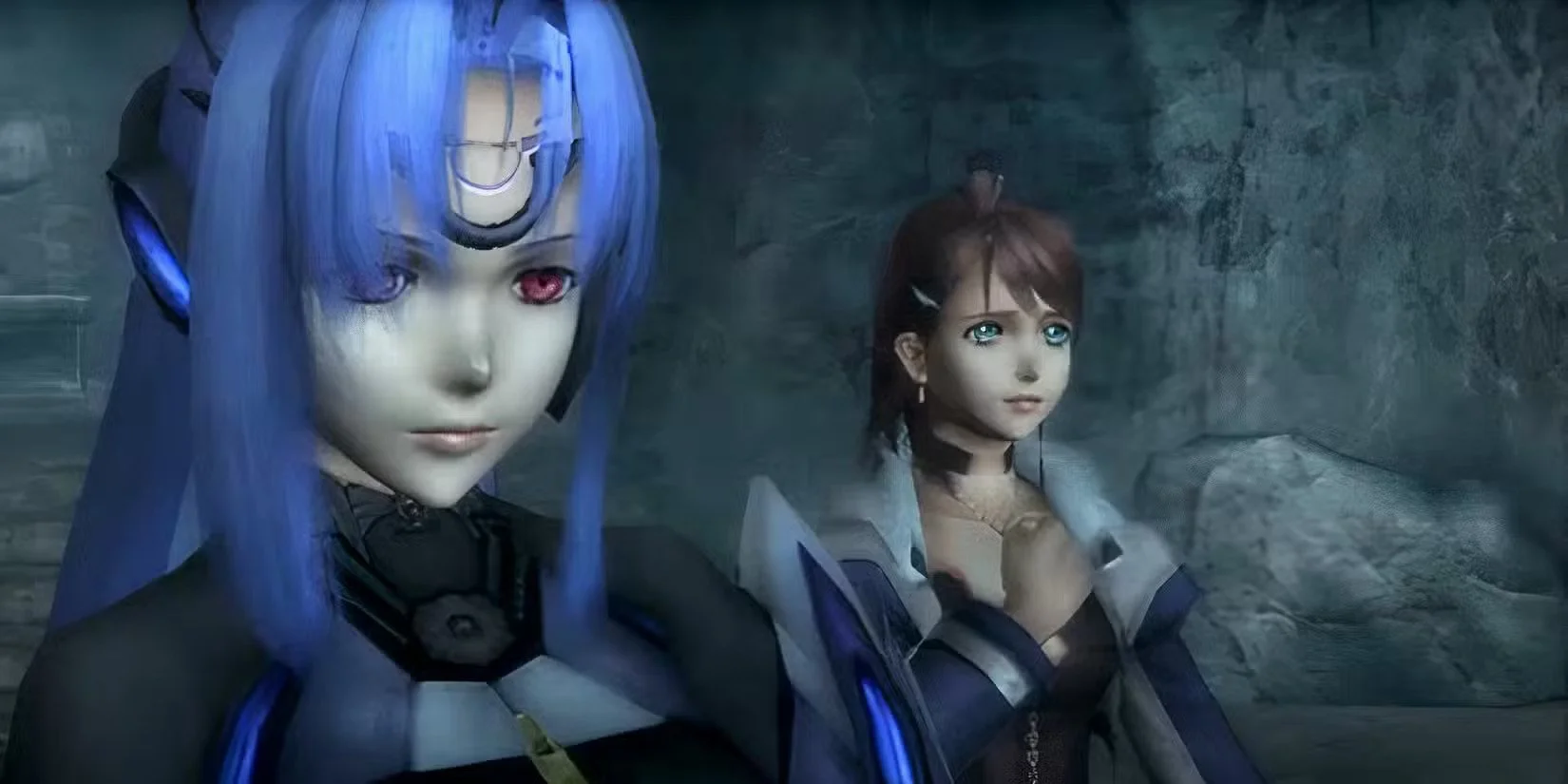
Xenosaga Episode III takes bold swings with its narrative, particularly in its final act that finally unveils the true identity and background of characters like chaos and KOS-MOS. Although a doubtlessly flawed collection of characters, Xenosaga has a cast unlike any other JRPG. // Image: Monolith Soft, Bandai Namco
Each Xenosaga game is remarkably linear. Instead of being sprawling JRPGs with world maps and optional areas to explore, Xenosaga has historically been more interested in offering linear areas that gradually ramp up in challenge, both through encounters and puzzles. Indeed, Episode III continues this trend by delivering linear dungeons and the occasional multi-area city to roam through. Like Xenogears before it, Xenosaga depicts the scale of its gigantic cities through abstraction. Players control a large version of their character as they navigate the city streets that connect the areas that the player can enter and directly explore.
Each episode of Xenosaga has seen a steady improvement in the quality of puzzles on display within dungeons, and I find Episode III’s collection of dungeons and puzzles to easily be the best in the series. They’re often engaging and challenging without ever being intrusive. In fact, if there’s any adjective I can use to describe Episode III’s dungeons entirely, it’s fast. Dungeons have a quick rhythm to them that makes navigating them feel consistently more fun than the previous two games, and a large part of that, I feel, is in thanks to the quantity and quality of puzzles throughout dungeons, as well as the phenomenal battle system on display in Episode III.
It’s easy to be a cynical snob and critique Episode III for abandoning the odd-but-unique flavor of Xenosaga’s combat by opting to feature a more conventional battle system. The system of performing near and far attacks to perform Tech Attacks or start Down and Air combos has been almost entirely discarded in favor of a streamlined system that will be more immediately familiar to JRPG veterans. In fact, Xenosaga Episode III clearly takes the most notes from Final Fantasy X’s battle system. In my eyes, if you’re going to make a derivative battle system, you might as well borrow from the best.
I suppose the use of the word derivative implies that I don’t admire or enjoy Xenosaga Episode III’s combat, but that couldn’t actually be further from the case. While I do lament the absence of Episode II’s addictive Down and Air combos, Episode III’s combat is to-the-point and polished, leading to combat that feels the fastest and most refined in the series.
Episode III’s similarities to Final Fantasy X’s combat system largely derive from the way information is presented to the player. From the Command menu, to the placement of character’s health and ether information, to the turn order display, there’s a very obvious inspiration from Square’s 2001 JRPG hit. But, of course, there is still some Xenosaga DNA embedded into Episode III’s combat system - primarily in the form of the ever-solid Boost mechanic.
Players (and enemies) can still expend Boost charges that are shared across the party in order to budge to the front of the turn order. However, an additional utility given to Boost charges relates to the brand-new Special Attacks. If the player saves up enough Boost charges, they can use them to perform powerful moves, most of which are devastating offensive options (though, some provide support and healing). Defeating an enemy with a Special Attack causes the enemy to give more Tech Points for the player, effectively replacing the Points event from previous games.
In fact, the Event Slot has been removed altogether, which I’m admittedly a bit sad about. The Event Slot was an interesting way to diversify gameplay and provide additional strategy for how and when to Boost during combat. The greatest consequence of this, though, is that the very Special Attacks that consume Boost charges become more valuable than Boosts themselves.
Since Special Attacks are as good as they are and the game rewards the player for finishing off enemies with Special Attacks, they are generally the most optimal use of Boost charges. This means that Boosting itself becomes more of a situational necessity rather than a mechanic that the entire combat system revolves around. On one hand, this makes the combat system more straightforward and simplistic, but on the other, it removes a lot of the unique identity that Xenosaga’s combat has had up to this point.
That said, simplicity isn’t inherently bad. Another instance of this is Episode III’s reinterpretation of the Break mechanic from Episode II. Now instead of being a reward for striking an enemy’s weaknesses in the correct order, Break effectively serves as a secondary health bar for both enemies and party members. Certain attacks deal more Break damage onto enemies. Once broken, that enemy or party member’s defenses are significantly reduced and they can’t act for two turns - opening the door to deal massive damage. This also opens the door for strategizing during Episode III’s more challenging fights. During the game’s final boss, specifically, I had to tactically trigger a Break in order to give my party enough time to heal and get reoriented before the fight progressed any further.
If I can describe Episode III’s combat in a nutshell, it’s simple but effective. There is certainly less Xenosaga identity present here compared to previous games, but fights being more conventional and familiar means that there’s less of a learning curve. This means that players can more quickly jump into what makes this combat system work, and sometimes, that’s the optimal approach if you just want to give players an ideal, comfortable, and fairly challenging gameplay experience.
E.S. combat returns from Episode II and it plays significantly differently than that game. Episode II’s E.S. combat was effectively an extension of the on-foot combat, with E.S.s having different but similar combat options as on-foot combatants. Episode III decides to make E.S. combat feel inherently more cinematic. While still having the previously mentioned Special Attacks, E.S. combat revolves far more on managing energy consumption from different weapons. Each weapon has higher accuracy and greater strength during longer combos, so it’s generally best to attack with E.S.s in a way that starts with a weaker, multi-hit attack and ends with a stronger, single-hit attack.
E.S. combat is inherently more repetitive than on-foot combat, but thankfully, it never overstays its welcome. While E.S.s are used to explore some dungeons, they’re primarily front-and-center for some of the game’s more climactic boss fights. These E.S. fights serve as a solid palette cleanser from the typical on-foot combat throughout the rest of the game. Truthfully, E.S. combat actually serves as the basis for some of the most difficult and rewarding fights in the game. The fight against Margulis’ E.S. during the game’s final act serves as a fantastic test of everything that the player has learned for E.S. combat, and genuinely sticks out as being one of the most fun yet challenging fights in the entire series.
Of course, E.S. combat is as enjoyable as it is because of its customizability. After Episode II’s lack of economy and customization, Episode III returns with weapons and armor shops and upgrades for on-foot and E.S. combat. It’s simple and perhaps a repeat of Xenogears’ instance of “just buy the most recently available equipment and you’ll be well-equipped for the oncoming boss fights”, but having at least a little room for character gear customization feels nice to have after a game without it.
The best instance of Xenosaga Episode III’s customization comes in the form of the Skill Line. This effectively serves as a Skill Tree that features unique progression for every character. From new moves to stat increases, each Skill Line offers two primary directions for each character to specialize in. This system is fairly straightforward as far as skill tree progression systems go, but as I stated earlier, simplicity isn’t inherently bad. Here, it keeps the gameplay progression moving forward at a snappy, consistent pace without having to ask the player to slowly tab between multiple menus (as was the case in Episode I’s decentralized means of progressing characters) or opening the door to having most characters develop in the exact same way (as was the case in Episode II). Episode III may have the most straightforward progression system, but that may actually be what causes it to have the best progression system in all of Xenosaga.
As a franchise, Xenosaga is primarily interested in taking its players on a narrative journey. Gameplay, while doubtlessly an important means of stringing together narrative moments, isn’t the essential focus of these games. Maybe that limits their overall potential as video games, but that’s the lane that Xenosaga has opted to go in since the very beginning. With that direction in mind, I think Xenosaga Episode III navigates this mindset the best out of the three games. The combat and progression systems are straightforward, simple, and take inspiration from other, more popular JRPGs to make learning its systems easier. This makes the combat and gameplay get in the way of the story as little as possible.
If Xenosaga is fated to be a series where the story matters most, then it makes sense for the gameplay to be constructed in a way where it’s serviceable and doesn’t detract from the primary interest in telling a story through the unique capabilities of the video game medium. And Episode III succeeds the most at doing that by far. Unlike the first game, Episode III doesn’t feature glacial pacing that elongates gameplay sequences that connect story progression. Unlike the second game, Episode III doesn’t feature a high learning curve that can potentially turn off players not willing to invest the time into mastering Air and Down Combos for the sake of seeing the game’s story play out.
Episode III features strong gameplay and story cohesion and pacing because, out of the all the Xenosaga installments, it is the game that most understands the role that gameplay plays in its own context. Episode III’s gameplay helps service the story by not being too slow or complicated to get in the way - and that ultimately allows Xenosaga Episode III to be the best game that it can be. Through being a simple but fun JRPG on a gameplay front, Xenosaga Episode III is allowed to be a deeply engaging, fascinating, and compelling JRPG on a story front. It took three games to find that balance, but Episode III strikes a competent if imperfect compromise between large-scale storytelling and gameplay cohesion to make for a deeply fun, entertaining JRPG with a story featuring the franchise and studio’s signature ambition.
Xenosaga encapsulates just how difficult it is to create a large-scale story. Even when you have a grand vision for a multi-part franchise filled with multiple story arcs told across various games and even console generations, things outside of your control can and often will go wrong. Xenosaga was born as an incredibly ambitious idea, and its short-lived life was rife with development struggles, unexpected problems, and significant compromise. Because of its starry-eyed ambitions of being a multi-part epic, the likes of which have never truly been executed in the history of video games, Xenosaga was destined to struggle to live up to its vision. Not only was Xenosaga intended to tell a massive story in a way that was unprecedented for video games, but the franchise was also intended to feature incredible JRPGs in their own right.
The ambition for Xenosaga derived from a desire to realize what Xenogears could have been had Takahashi and his team had full creative and financial control of the IP. Now free from Square’s grip, Tetsuya Takahashi and Monolith Soft were uniquely positioned to now realize what Xenogears could have been under a more creatively independent direction. But even in such a position, Monolith Soft couldn’t pull off the project born from their independent ambition.
I think a lot of that comes down to the fact that it’s hard to truly follow-up on what you aspire to put out into the world and fully nail the landing. The truth is, things change when you’re creating art. Unexpected factors come into play - some of which are in your control and some are not. Xenosaga struggled so much to find its footing as a JRPG epic because it experienced the growing pains of a developer realizing that achieving what they wanted to do wasn’t as viable or easy as they thought it would be.
There’s a common saying in the games industry: never work on your dream game. Or at the very least, don’t work on your dream game first. Instead, build up to it. Learn the skills and lessons that you’ll naturally learn by working on other projects. By the time you’re ready to tackle the game that you truly want to put out into the world more than anything else, you’ll have acquired the skills, experience, knowledge, and lessons learned from your previous games and projects that will help set you up for success for making your dream game reach its best possible quality.
I think Xenosaga would have greatly benefited had Monolith Soft waited on putting it out into the world. Xenosaga was simply too much for a relatively young development team to tackle. Because this project featured so many grand ambitions, it was fated to have severe growing pains as a team that was still in the process of figuring out their own strengths and talents as a developer. This is most obviously seen by Episode I and II having inconsistent aesthetics and messy direction. Although the bones of the games had promise and still featured solid gameplay and storytelling, they were both ostensibly products of a developer still deciphering its own capabilities.
By the time Episode III released, Monolith Soft’s growing pains had come to an end. They had finally realized their own identity as a developer and catered to their accumulated strengths as a developer. They specialized in making detailed worlds, masterful and cinematic cutscenes, dense narratives, and designing multilayered but accessible gameplay systems.
If Episode I and II of Xenosaga are the adolescent version Monolith Soft still going through puberty and figuring out its own identity and strengths, then Episode III is the fully grown adult version confident of what it is and trying to rectify the mistakes and imperfections of its past as best it can. Sure, the growing pains were there in Episode I and II, and they certainly inhibited Xenosaga from living up to what it could have ideally been, but Episode III grapples with that and, with the growing pains having finally subsided, it does its best to ensure that Xenosaga left the world with an admirable legacy.
And I truly think it succeeded at that.
Xenosaga hits different. It’s a franchise that I can criticize a lot and discuss its many, many flaws in detail, but I can’t help but have an affection for it. This series tries to be so much and it truly tries to be something that no video game before or since has attempted. Its ambition and scope are infectiously charming. Its story and gameplay systems, while both ripe with issues, have a strong core to them that help lift the series just enough to leave an impact on any player that embarks on the journey these games provide.
Xenosaga is as interesting of a series to talk about as it is because it’s impossible to blanket hate or love the series. Anyone that plays Xenosaga is going to have a complicated relationship with it because, well, Xenosaga itself is complicated. It’s development history is complicated. The discrepancy between its original vision and the final product is complicated. The story, world, and lore of Xenosaga are complicated. But the complication, the inherent complexity to everything about the series is what makes it so fascinating to play, to discuss, and to remember.
I don’t love Xenosaga in the way I love Xenogears or the Xenoblade Chronicles series, and that’s okay. Although I don’t love this series in the way I love other JRPGs, I still find immense inspiration from Xenosaga because of what it tries to be. Even if they don’t accomplish their originally intended vision, every episode of Xenosaga has fantastic worldbuilding and distinct characters and gameplay that have unforgettable qualities to them. As I’ve been writing and developing my own game, I’ve oddly found a lot of inspiration from Xenosaga thanks to how it constructed its lore, story, gameplay, and characters, and I think there’s immense value in that.
The final time that we see KOS-MOS in Xenosaga, she’s drifting towards Ancient Jerusalem - her fate and future unknown. This is emblematic of Xenosaga’s status as a whole - a JRPG franchise in limbo with an unclear future. I don’t know what will come from that future. Maybe Xenosaga will have some kind of follow-up. Maybe it will have a remastered collection release. Maybe nothing will happen and Xenosaga will drift on forever. But no matter what happens, Xenosaga will always have the capacity to inspire anyone that plays it thanks to its sheer ambition and heart.
Xenosaga hits different, and that’s what makes its impact stay like no other.
Xenosaga Episode I: Der Wille zur Macht Final Score: C+
Xenosaga Episode II: Jensuits von Gut und Böse Final Score: C
Xenosaga Episode III: Also sprach Zarathustra Final Score: B+
Thank you very much for reading! What are your thoughts on Xenosaga? Do you think this series deserves to come back with a remaster to fix its issues? As always, join the conversation and let me know what you think in the comments or on Bluesky @DerekExMachina.com!