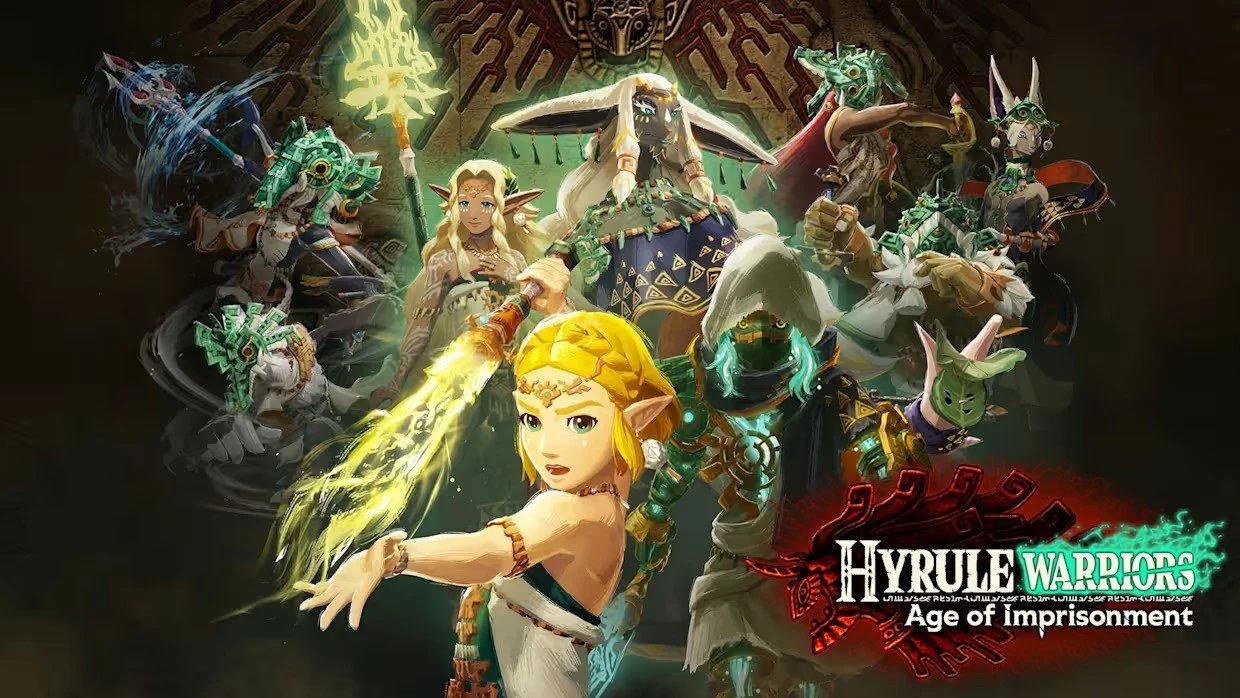
Hyrule Warriors: Age of Imprisonment Review: Musou Action Without Fan Service is Still Good Fun
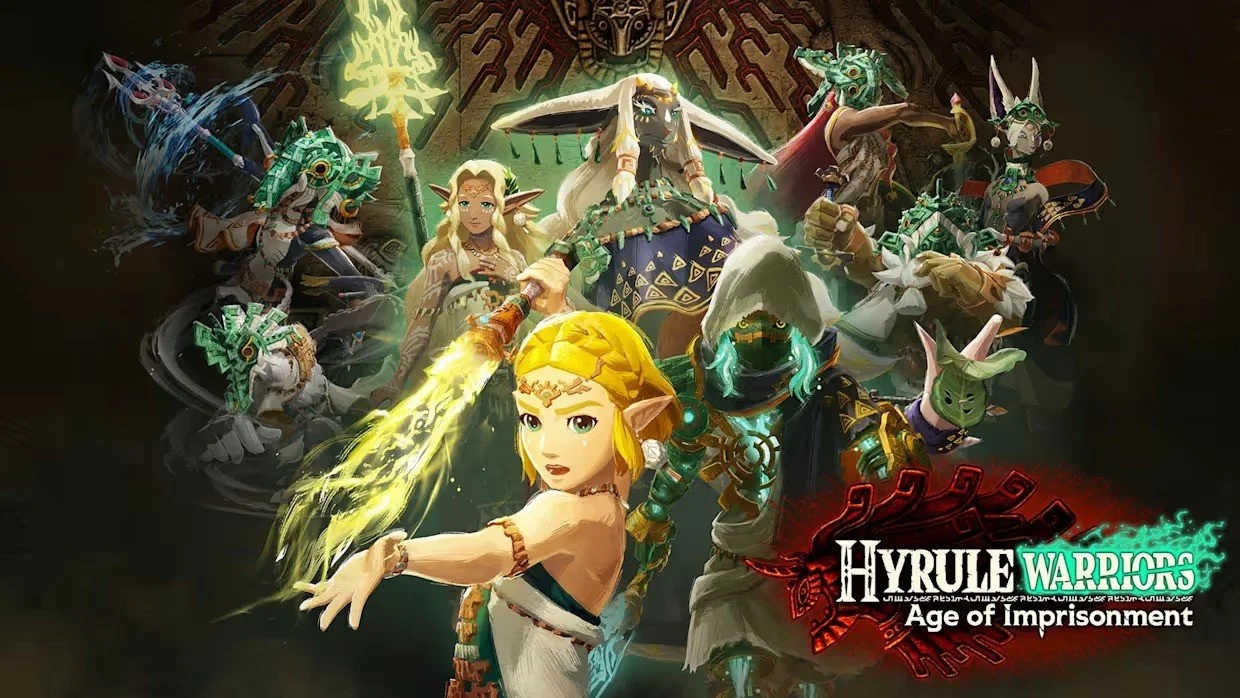
Hyrule Warriors: Age of Imprisonment stands out from its predecessor, Age of Calamity, by being a canon story focusing on Zelda’s perspective during the events of The Legend of Zelda: Tears of the Kingdom. Age of Imprisonment brings little new to the formula, but what is here still offers good fun from a tried-and-true formula. // Image: Nintendo, Koei Tecmo
What has made the Warriors / Musou subgenre of action RPG prevail for over two decades is its unrelenting promise: the power fantasy. Video games can serve multiple functions for people in their day-to-day lives. Some view games as a way to keep their minds active while they’re killing time. Others view games as a means of engaging with a story in a way that isn’t replicated by books or movies. Arguably the most popular source of attraction to games, though, is that of the escape they bring. Taking on the role of video game characters that perform superhuman actions and overcome all kinds of adversity provides an escape that few other forms of art can truly replicate. Video games are uniquely positioned to provide pure escapism through power fantasy, and no gameplay formula provides a power fantasy quite like the Warriors formula. Some Warriors games offer varying elements of strategy, and many have unique mechanics and structures that help diversify the presentation for each game, but the core formula of overpowering thousands of enemies has been enough to keep the Warriors experience alive for so long.
The core power fantasy that Warriors games uniquely provide is so effective at releasing endorphins and making the player feel powerful in a way that helps them escape from their everyday stresses. Of course, this power fantasy often comes at the cost of the series’ biggest weakness: repetition. By their nature, Warriors / Musou inevitably become repetitive adventures where the player is mostly doing similar actions, missions, and combat encounters. To counter this issue, Warriors leans on the appeal, spectacle, and fan service of its collaborations.
2014’s Hyrule Warriors was rough around its edges and is a poster-child for content bloat with its massive and exhausting Adventure Mode, but the mission of the game was clear: offer the power fantasy with the added buff of the fan service of seeing various Legend of Zelda characters fight alongside each other. In a series with alternate timelines, self-contained stories, and multiple incarnations of various characters, Zelda has a plethora of characters that have never interacted with each other. Because of that, there’s genuine appeal in seeing Midna from Twilight Princess and Ghirahim from Skyward Sword fighting alongside each other, because…well, when else are you going to see those two characters stand next to each other?
The fan service assists the power fantasy, elevating the experience into being a game that, while perhaps not for everyone, is a fun time that longtime Zelda fans will have a hard time not smiling at. And for many Warriors crossovers, that’s enough. 2017’s Fire Emblem Warriors did much the same, bringing in various characters from multiple Fire Emblem games, but the game’s roster highlighted just how much fan service matters to consumers of these games. Fire Emblem Warriors’ greatest criticism is that the game’s cast of playable characters are mostly pulled from a small fraction of Fire Emblem’s total games. This meant that fan-favorite characters from some of the series’ more obscure titles had no chance of showing up, causing some disappointment to series fans.
I remember being intrigued when this criticism came to light at the time of the game’s release. Fire Emblem Warriors was being critiqued because it didn’t provide enough fan service. People wanted more diversity from the game’s roster in order to represent the series in a wider capacity, which would therefore increase the fan service value of the game. This brings to light just how much people care about fan service in these Warriors crossovers. Seeing this made me realize just how much fan service helps elevate these experiences to mattering to fans of the series crossing over with the Dynasty Warriors formula.
Later Warriors crossovers doubled down on fan service, with a clearly increased effort in making these crossovers feel like narrative extensions of their source material, tonal consistency and all. Persona 5 Strikers greatly adapted the turn-based combat of Persona with the real-time action in Warriors games and created something that felt like a genuine sequel to the beloved JRPG. The appeal of the fan service in this game was the very opportunity to play with the various Phantom Thieves in a 3D space for the first time and seeing them engage in combat in completely new ways. The cast of Persona 5 was so good that seeing more of them and controlling them in a new way was enough to satiate fans of the source material.
Hyrule Warriors: Age of Calamity did much the same through being a supposed prequel to The Legend of Zelda: Breath of the Wild. Not only did the game appear to fill in the gaps of the conflict against Calamity Ganon, but it offered an opportunity to see characters that players only got glimpses of during Breath of the Wild. This feeling of being an extension in its source material applies to Age of Calamity’s UI, cutscenes, and overall presentation. Age of Calamity features a consistency with its source material that paves the way to see Breath of the Wild’s beloved characters in an entirely new light, and getting to see characters like Impa, Zelda, and Sidon fight alongside each other still gave fans the fan service that Musou crossovers uniquely provide.
I greatly enjoyed Age of Calamity when it came out, but this game sparked something of a controversy among its players. I referred to Age of Calamity as a “supposed” prequel because, in truth, it actually takes place in an alternate timeline. Despite the game’s marketing, Age of Calamity isn’t an actual reflection of the events that transpire before the events of Breath of the Wild, but rather, the game’s story features time travel where characters from the past and characters from the present fight alongside each other to fight Calamity Ganon - something that obviously doesn’t happen in the canon of Breath of the Wild.
Put another way, Age of Calamity is a non-canon crossover, which…upset people, for some reason. I found people’s frustration with this reveal a bit silly. I had long considered Warriors crossovers to be an excuse to have Dynasty Warriors gameplay with the aesthetic and style of whatever IP it was crossing over with. In that context, there’s no reason to care about whether the stories of these games are canon, because they’re just means to have fun and feature stories that prioritize spectacle and style over substance. The original Hyrule Warriors saw characters travelling to different parts of the convoluted Zelda timeline to tell an original story with original incarnations of Link, Zelda, and Ganondorf. That game’s story is obviously non-canon because its mission is simply to have fun by letting as many characters from as many Zelda titles as possible cross paths and fight alongside each other. Was it a really big deal that Age of Calamity did something similar?
I see no reason to be upset by a crossover Warriors game being non-canon. Though, perhaps people were disappointed by Age of Calamity being non-canon because it appeared to contradict the game’s marketing. People expected this to be a genuine prequel to Breath of the Wild due to the game’s marketing and initial presentation, and so that set up disappointment when that expectation was ultimately shattered. I still find this unimportant in the grand scheme of things, as Age of Calamity greatly succeeds in the department of offering compelling Warriors-style action and fan service, as well as featuring a particularly strong gameplay structure. Still, seeing all these elements in addition to a story that “matters” in the canon of Breath of the Wild clearly matters to people.
This is where Age of Imprisonment comes in and feels like a genuine response to fan criticism. Unlike its predecessor, Age of Imprisonment commits to telling a canon story that acts as a prequel to the events of The Legend of Zelda: Tears of the Kingdom. There’s no surprise time travel; there are no twists that turn this supposedly canon story into an alternate universe interpretation of Tears of the Kingdom’s events. This is a genuine, canon prequel to Tears of the Kingdom, Breath of the Wild’s 2023 follow-up.
While it’s neat to say that, what does it really unlock for this game? What does this story being canon truly add to the experience? In my eyes - very little.
Although it features some charming original narrative elements, Hyrule Warriors: Age of Imprisonment doesn’t offer a particularly compelling narrative that enhances the story it leads up to. But because this game makes a commitment to being a canon game, that brings with it the burden of having to feature characters that players have no relationship with. Most of Age of Imprisonment’s cast of playable characters make their introduction in this game, acting as a kind of antithesis of the typical appeal of Musou crossovers. There are limits that prevent the game from reaching heights greater than its predecessors, but that doesn’t take away from the fact that Age of Imprisonment is still a fun-as-hell game that still delivers on the power fantasy that only a Warriors game can specifically provide.
Age of Imprisonment is a solid game, but it gives itself unnecessary handicaps that prevent it from being a great game. Let’s talk about it.
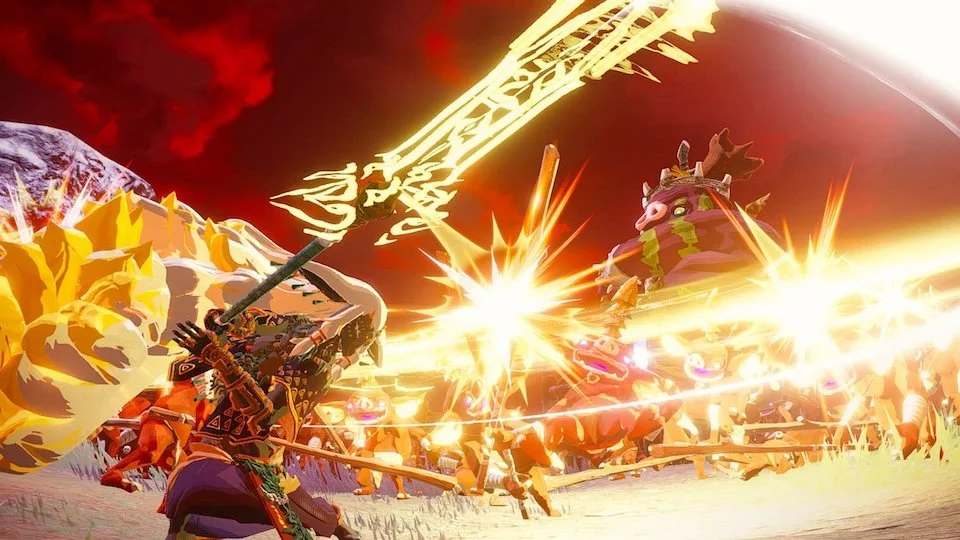
Age of Imprisonment continues the gameplay formula established in Age of Calamity. The power fantasy of battling against hundreds of enemies is now mixed with Tears of the Kingdom’s reactive mechanics such as the Zonai Devices and Fuse Items. // Image: Nintendo, Koei Tecmo
The trajectory of the Hyrule Warriors series is a beautiful illustration of how mechanics can become more complex over time while still retaining a simple feel to gameplay. The original Hyrule Warriors is primarily concerned with giving players a finite amount of tools across the entire cast to use for dishing out damage against enemies. Every character has a meter for Special Attacks and another meter for magic that creates a more powerful and temporarily passive Special. Players gradually gain access to staple Zelda items like the bow, hookshot, and bombs to deal with certain hazards and enemies. Using certain items or Specials at certain times helps reduce enemy shield gauges that, when destroyed, leave the enemy open to massive damage.
And…that’s pretty much as deep as Hyrule Warriors ever gets. There aren’t any character specific mechanics nor are there a vast array of objectives for players to accomplish. Story Mode battles simply task the player with defeating enemies and claiming bases throughout a map to gain morale, which passively buff the player’s army. Adventure Mode battles add a few more tasks, namely through defeating a certain number of enemies or completing a win condition under a time limit, but there is never much gameplay depth with the core combat experience. Some of Adventure Mode’s maps do have unique mechanics that require players to consider how they navigate through maps, but I’d refrain from referring to map gimmicks as mechanical complexity that enhances the overall gameplay.
The original Hyrule Warriors is as fun as it is because it is an ultimately simple game, but that simplicity comes at a cost. By being mechanically simple, the repetitive nature of the gameplay becomes all the more apparent.
All games are, by nature, repetitive. The goal of a game’s design is to prevent the player from becoming aware of the game’s repetition by introducing gameplay variety - whether through different levels, styles of play, different activities in a game, or by featuring numerous mechanics and factors to consider during normal gameplay. Hyrule Warriors falters in the illusion it sets up for players. Because the game is so simple and doesn’t offer too many mechanics to consider, players can grasp the repetition inherent to the game quite quickly and easily. This doesn’t make Hyrule Warriors a bad game, but it does make it a game that players can easily get exhausted from.
This is what makes Age of Calamity a great follow-up to Hyrule Warriors: it directly addresses this issue. Hyrule Warriors: Age of Calamity doesn’t rid the Warriors formula of its repetitive nature - it just reframes the repetition through adding more to think about during gameplay. Instead of embarking on regularly long battles with relatively few mechanics, Age of Calamity increases the number of smaller battles while injecting additional mechanics into the core gameplay, some of which are directly transferred over from Breath of the Wild. Using certain Rune-based attacks that were on cooldowns, performing Parries with well-timed shield bashes, and triggering Flurry Rushes with well-timed dodges are all new mechanics that give the player more to consider during regular gameplay. But perhaps more crucially, the majority of Age of Calamity’s content are smaller battles that can be completed in 5-15 minutes.
This means that each battle is a more condensed instance of gameplay - and that smaller, more focused fraction of gameplay features more mechanics for the player to consider. Shorter battles with more mechanics create a far greater mental-energy-per-battle ratio than what Hyrule Warriors offered. Age of Calamity may not have nearly the amount of content that its predecessor had, but what content it does offer does a far better job at creating the illusion of gameplay variety that prevents the player from noticing how repetitive Calamity’s combat can be.
That’s a large factor as to why I find Age of Calamity to be a far more well-rounded experience than many other Warriors titles I’ve played. The game delivers a perfect mix of action and strategy while presenting mostly quick battles. In just an hour, the player can complete a couple battles and make significant progress towards the game’s various Quests that expand characters’ health, Special meters, and moveset combinations. More so than the original game, Age of Calamity excels at making players develop their characters and slowly chip away at completion at a satisfying and reasonable rate. These traits play explain why Age of Calamity resonated so well with me and others and became the best-selling Musou game at the time of its release. Age of Calamity significantly refines the formula established by the first game and runs with it to make about as good a Warriors game as could possibly be.
I’ve spent this long in this review talking about previous Hyrule Warriors games because, in many ways, Age of Imprisonment is arguably the least significant Hyrule Warriors game to talk about. It doesn’t have the novelty of being the first crossover with a monolithic amount of content as the first game, nor does it have the benefit of having refined a promising formula. Age of Imprisonment is, in many ways, more Age of Calamity with relatively few tweaks that give it its own identity.
This isn’t to say that Hyrule Warriors: Age of Imprisonment is a bad game. In fact, I gladly completed Age of Imprisonment in about 32 hours of playtime and enjoyed just about my entire time with it thanks to many of the reasons that I mentioned made me enjoy Age of Calamity. Shorter battles, mechanical depth with more abilities given to characters, and a satisfying rate to unlock new skills and abilities. There’s nothing inherently wrong with Age of Imprisonment offering more of what Calamity brought to the table - but doing so does highlight how little the game introduces to give it its own identity.
Of course, the most crucial aspect of a Warriors game is its roster and, by extension, its variety of combat styles. Every playable character in Age of Imprisonment plays differently from each other, with the Knight Construct having three movesets for the three different equippable weapon types in the game. That makes for 21 movesets across 19 playable characters - an arguably small roster for a Warriors game, but it’s clear that Koei Tecmo has opted for quality over quantity in this regard. Every character feels distinct to play as from one another, with characters like Typhon and Lago focusing on held-down button presses, while others like Ronza and Sholani have movesets that prioritize timed button presses for wider area-of-effect for their attacks. These are subtle differences, but they help give a unique texture to each character, ensuring that battles never risk characters feeling too similarly to one another.
Even when controlling a specific character might become stale over time during a battle, nearly every combat encounter in Age of Imprisonment allows the player to switch characters at a moment’s notice, and doing this fuels one of Age of Imprisonment’s greatest and most substantial additions: Sync Strikes.
Special Attacks have received a notable nerf from previous games. This typically powerful attack that’s a reward for filling a meter that builds up upon dealing damage to enemies is now best used solely for crowd control on crowds of basic enemies. For Special Attacks that deal lots of damage to stronger enemies, the player is now expected to take advantage of Sync Strikes, which combine two characters’ traits to make for a devastating two-pronged attack. Sync Strikes are a fantastic addition for a few reasons - most crucially, they offer a creative way to see two characters satisfyingly combine their powers and strengths for a unique attack. This leads to fun character interactions that are as visually charming as they are beneficial to the player.
Age of Imprisonment has limited instances where the player gets to see the game’s cast directly interact with each other. For a game about commanding an army that has to reclaim all of Hyrule back from Ganondorf’s control, seeing camaraderie build between combatants is something that greatly enhances the narrative via character building. However, outside of the game’s cutscenes and a handful of text-only dialogue exchanges between characters, there aren’t too many chances to see characters play upon each other. Sync Strikes serve as a consolation for this, though - they offer ways for characters to meaningfully engage with the unique fighting styles amongst one another. Rauru and Zelda firing rays of light alongside each other (with each ray being able to be independently controlled) or Calamo and the Knight Construct’s Sync Strike seeing Calamo hop on a gliding Knight Construct and bombard the area with elemental explosions are fun and cool-as-hell interactions to watch unfold.
These Sync Strikes are a meaningful addition to the power fantasy promise of Musou games through delivering an unquestionably anime-feeling idea: combining two powers to create an even greater power. It’s a satisfying mechanic to engage with and is yet another mechanic that the player needs to meaningfully take into account during battles to gain an edge in combat. Age of Imprisonment adds a few additional mechanics via Unique Skills, Zonai Devices, and Fuse Items. All of these mechanics, while individually minor, come together to significantly build up Age of Imprisonment’s mechanical complexity.
Unique Skills, much like Calamity’s Runes, serve as abilities available to characters that recharge via a cooldown. While performing certain types of attacks, enemies will expose themselves with a weakness that can be exploited with one of each character’s Unique Skills. When an enemy performs a jumping attack, they’ll be vulnerable to a Unique Skill that attacks in the air. When an enemy puts up their shield, they can be disarmed with an armor-piercing Unique Skill, and so on. This mechanic primarily comes down to reacting to certain red-glowing attacks with the appropriate Unique Skill that counters it, effectively making this mechanic a rock-paper-scissors match that players are always on the upper hand at. After a while, reacting to each attack with the appropriate Unique Skill is a matter of matching the right Unique Skill with the right opening, but it’s enough to make the player stay mindful of their Unique Skill cooldowns during combat.
Zonai Devices are very much an extension of this, as some Zonai Devices serve as alternatives for some Unique Skills. Others open elemental weaknesses, which make dealing with fire, ice, lightning, sand, and grime-imbued enemies a lot easier to deal with. Using a Flame Emitter on an Ice-imbued enemy significantly shrinks its weak-point gauge - to a point where using the Zonai Device can nearly trivialize the entire encounter. This is where yet another mechanic comes into play: battery consumption. A borrowed mechanic from Tears of the Kingdom, batteries serve as the limitation for how much the player can lean on using Zonai Devices while in combat. While batteries prevent players from relying on Zonai Devices too heavily in theory, battery refill items are automatically given to players at the start of every encounter. Moreover, battery refills can often be found on the battlefield in destructible parts of the environment.
Battery replenishment is quite generous throughout Age of Imprisonment, and as such, I found myself being able to liberally use Zonai Devices throughout all combat encounters quite comfortably throughout my entire playthrough. I wouldn’t necessarily chalk this up as a negative, though. Like all other aspects of combat, Zonai Devices are yet another tool in the toolbox that provides the power fantasy and spectacle within Age of Imprisonment’s battles. Zonai Devices are truthfully devastating when thoughtfully used and considered by the player - giving them yet another thing to consider during combat.
Zonai Devices get another shot in the arm with Elemental Chains - a means of combining multiple elements to inflict high damage to a wide area-of-effect. This ranges from mixing fire and wind to create a flaming tornado to mixing lightning and water to create a pool of electrocution - in either case, these combinations inflict elemental damage to a large area that, if strategically placed and managed, can wipe out major swaths of enemies in seconds. While Zonai Devices aren’t necessarily required to create Elemental Chains, they help expedite the requirements for getting each element you need to get the result you’re looking for at any moment.
Lastly, the inclusion of Fuse Items is yet another tool for players to strategically use during combat, though this mechanic is clearly the least substantial among Age of Imprisonment’s mechanical additions. Tears of the Kingdom added Fuse Items as a way to have the game’s weak weapons get buffed by creatively attaching different materials to them to expand their offensive capabilities. This magnificent system was a large part of Tears of the Kingdom’s entire identity - as the player’s offensive prowess is largely determined by their curiosity of how certain items behave when attached to weapons, shields, and so on. Age of Imprisonment adapts and interprets this mechanic in a far less interesting way.
Fuse Items effectively grant the player access to powerful attacks at the cost of acquired resources. Collected Bokoblin Horns can be expended to perform a stronger attack variant that can be effective for crowd control. Since many Fuse Items also feature an element attached to them, many Fuse Item attacks can be used to capitalize on enemy weaknesses. Other Fuse Items yet also have increased efficacy when using them at certain health thresholds and other conditions. This mechanic boils down to giving the player additional offensive options that serve as alternative methods to exploit enemy weaknesses - in a combat sandbox that already gives players numerous ways to capitalize on enemy weaknesses.
Each of these new mechanics have a common end goal. Unique Skills, Zonai Devices, and Fuse Items all are used to deplete major enemies’ weak-point gauges that, when depleted, allow the player to perform a Weak-Point Smash that is, in no uncertain terms, the most devastating and efficient means of dealing damage to enemies weak or strong. The name of Age of Imprisonment’s gameplay, much like Calamity before it, is using all the player’s resources available to their disposal to capitalize on enemy weaknesses and perform Weak-Point Smashes as quickly and consistently as possible. Weak-Point Smashes are the goal the player is ultimately working toward in every combat encounter, since they deal the greatest amount of damage to enemies. Therefore, this means of attack is inherently the most repetitive part of the game. The objective of all of Age of Imprisonment’s mechanics is to distract from Weak-Point Smashes being as repetitive as they are - an objective I feel gets met successfully.
The wide variety of mechanics, both new and returning from Age of Calamity and original Hyrule Warriors, offer different ways for the player to deplete enemy weak-point gauges. The player is ultimately performing the same objective over and over - emptying these weak-point gauges to then perform massive damage onto enemies. The plethora of mechanics help that repetitive objective feel consistently fresh and fun.
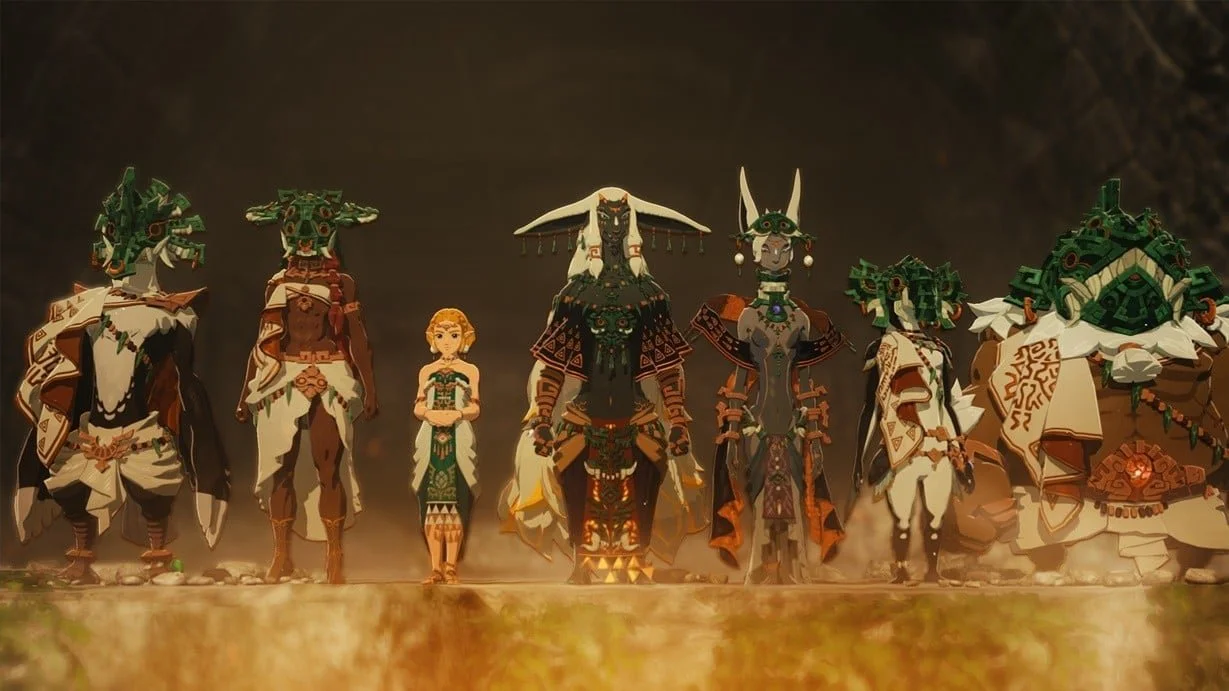
Hyrule Warriors: Age of Imprisonment features a cast of characters that are mostly original to this game. While the Sages were briefly seen in Tears of the Kingdom, they get proper screen time here. However, most characters introduced or expanded upon in Age of Imprisonment are relatively surface-level, save for Calamo and the Knight Construct. // Image: Nintendo, Koei Tecmo
Unfortunately, engaging with some of these mechanics - namely the three new mechanics added in Age of Imprisonment - comes with a dismal, clunky user experience. Breath of the Wild and Tears of the Kingdom both feature a clumsy menu system when switching between different items. Breath of the Wild got away with this issue more easily, since the player only ever needed to consistently switch items in real time when switching weapons, shields, and types of arrows. However, Tears of the Kingdom exacerbated this UX issue exponentially since it opened the door on how many items that the player needs to cycle through. The player picks up an incredible amount of resources throughout their adventure, and nearly all of them can be applied on to weapons, shields, and arrows - as well as be thrown on their own.
In order to select the desired item to Fuse or throw, the player has to navigate a horizontal bar that includes every item that the player has in their inventory. While the action is paused, the player has to scroll through items with the right stick, then select the desired item they want to Fuse or put in Link’s hands to throw. There are simply so many items to go through and manage that it makes this simple menu to access every item feel ill-equipped for the task. Since navigating through this menu to access items is cumbersome at best, most players will inevitably opt to use this menu as little as possible. This takes the form of players only selecting a small number of items to actually fuse onto weapons, shields, and arrows. Tears of the Kingdom does feature a few ways to filter items to make the process of scroll through this damagingly simple menu more organized, but it fails at making a complicated process feel quick and streamlined.
This is a problem that the Zelda franchise has yet to fix, as 2024’s The Legend of Zelda: Echoes of Wisdom also features this issue, which arguably creates an even greater negative impact on its gameplay. In a baffling decision, Age of Imprisonment doubles down on this poor UX and retains a lot of the issues that made Fuse not incredibly fun to engage with in Tears of the Kingdom. Namely, the menu featuring healing items, Unique Skills, Zonai Devices, and Fuse Items are all presented with the same horizontal bar that pauses the action.
There is a small workaround for this, as a shortcut menu allows players to map five options to a quick combination of button presses, but having only five shortcuts is not enough given how many combat options that the player regularly needs to take advantage of. If the player wants to map Unique Skills to their shortcuts, they inevitably have to sacrifice shortcut slots that could also be used for Zonai Devices or Fuse Items. In the cases where the player needs to use either of these options to account for different combat scenarios, the player will have to lean on this infamous horizontal menu at some point. It’s disappointing that Age of Imprisonment doesn’t find a way to streamline this UX to accommodate for the game’s snappier action - so much so that I’d consider this design decision to be the game’s greatest missed opportunity.
In fact, many of Age of Imprisonment’s missed opportunities come from inherited shortcomings of Tears of the Kingdom. Like the 2023 source material, Age of Imprisonment includes three total maps - the Depths, the Surface, and the Sky. However, the vast majority of this game’s content is on the Surface map, with only a few main story missions and Challenges being on the Depths and Sky maps. Much like Tears of the Kingdom, Age of Imprisonment underutilizes the potential of its multiple maps, however Age of Imprisonment struggles with this issue even more than Tears. Battles that take place in the Depths and in the Sky are relatively few in number, and feel mostly disconnected from the bulk of the game’s combat scenarios that take place on the Surface.
That said, Age of Imprisonment is at its best when it deviates from this norm and crafts scenarios that take advantage of multiple maps. Some combat scenarios feature two phases that take place on multiple layers. Some of the very best missions in the game, however, take place with the delightful aerial battles with Calamo and the Knight Construct.
Aerial battles see the Knight Construct transform and fly through the skies as he shoots down various enemies. These Star Fox-esque missions are excellent breaks in the tedium of the game’s typical Musou action and are paced throughout the adventure just enough to come as a fun change of pace without overstaying their welcome. These battles are the replacement for Age of Calamity’s Divine Beast battles, which, while taking on the same mission of breaking up the action, primarily offered spectacle at the cost of clunkiness. Aerial battles in Age of Imprisonment still provide flashy spectacle and creative ways to illustrate battles with the Hydra-like Gleeoks while feeling like polished gameplay instances in their own right.
The polish presented in these aerial battles is representative of Age of Imprisonment’s overall refinement. Like Age of Calamity before it, Age of Imprisonment faithfully captures the art direction and style of Tears of the Kingdom, in no small part thanks to Nintendo’s Zelda team helping with Imprisonment’s cutscenes. New to Imprisonment is the visual boost provided by its Nintendo Switch 2 exclusivity - which only bolsters the game’s overall polish. While Calamity pushed the original Nintendo Switch to the point where the game’s frame rate regularly hovered around 20-25 frames per second, Imprisonment takes advantage of the Switch 2’s increased power by offering a far more stable frame rate. This increase in performance and fidelity gives the action a smoothness that’s much appreciated considering Imprisonment’s inherently fast-paced action.
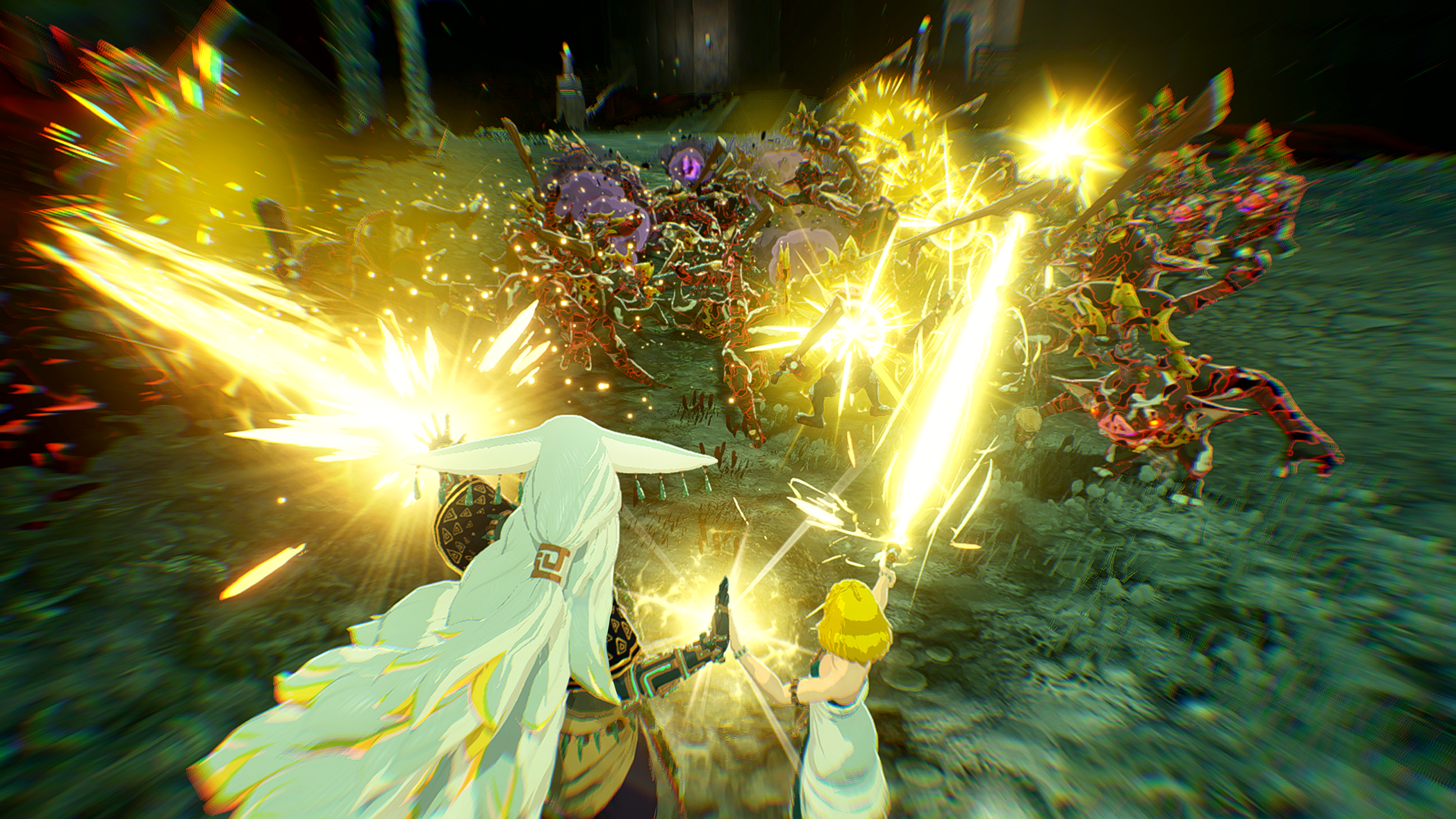
Sync Strikes are Age of Imprisonments’ greatest new offensive mechanic, allowing two characters to team up and deal devastating damage together. Every character participates in these Sync Strikes differently, encouraging players to try Sync Strikes with as many combinations of characters as possible. // Image: Nintendo, Koei Tecmo
I want to speak further on the cutscenes in particular, as they serve as something of a microcosm for Age of Imprisonment as a whole. Since Imprisonment is committed to telling a fully canon prequel to Tears of the Kingdom, this game offers a chance to tell Zelda’s entire story and perspective that was teased throughout much of Tears of the Kingdom. Many of the game’s biggest events, such as Zelda’s introduction to Rauru and Sonia as well as Ganondorf’s attack on Hyrule Castle, are all scenes that players have seen before in Tears of the Kingdom. Age of Imprisonment now allows players to see all of these scenes play out in a linear fashion with many additional scenes that provide greater context for the weight behind certain plot beats.
While the story of Zelda’s perspective is interesting, I think a lot the wind has been taken out of Imprisonment’s sails by virtue of many of the story’s biggest moments being cutscenes that players have already seen in another game. The new scenes that Imprisonment adds in, while admittedly plentiful, are largely inconsequential and primarily service character-building rather than additional drama and action. That character-building is solid for what it is, but many of the new characters introduced in Imprisonment, namely the Sages that players only saw glimpses of in Tears of the Kingdom, are largely shallow, surface-level characters that players don’t get to know too well here.
The exception to this rule is that of Calamo and the Knight Construct. Calamo, the Korok explorer, is the first character that players will see when starting Age of Imprisonment. Upon meeting the Knight Construct, the two become friends and fight alongside each other. The Knight Construct is an effective way for Koei Tecmo and Nintendo to not have Link in the game while still having a character that fills a similar role. The Knight Construct even has different movesets for each weapon - just as Link did in Age of Calamity.
The highlight of Imprisonment’s entire story, I’d argue, is not actually the conflict that plays out between Zelda, Rauru, and Ganondorf, but rather, the dynamic that Calamo and the Knight Construct share throughout the journey. Their friendship smartly contextualizes the game’s aerial battles and the game’s conclusion, as well as helping inject a lot of the game’s cutscenes with a fun charm. The bond these two characters share is simple but extremely successful at injecting heart into this narrative. Age of Imprisonment tells a mostly unimpressive tale in my eyes, but Calamo and the Knight Construct help elevate to being a story that’s worthy of being one of the few canon Zelda spinoffs.
An unfortunate consequence of Imprisonment’s commitment to being canon is that the main narrative simply doesn’t offer enough characters to constitute a full roster befitting of a Warriors game. To fill out the game’s roster, the player recruits two additional characters from each primary race across Hyrule. This helps fill out the roster and each character still has their own combat style and moveset that makes them all play differently from each other, but this comes at the cost of the fact that the player has to play as a lot of randos.
Age of Imprisonment is a cool opportunity to get to play as Zelda, Rauru, Mineru, and the four additional Sages that were tied to each of Tears of the Kingdom’s dungeons. But that same opportunity has you getting to play as characters like…Quino? Or how about Vence? Maybe Pinnec? Surely Ronza?
If you’re scratching your head over whether you should know these characters’ names, worry not: you don’t know them. These are original characters whose existences were never mentioned in previous titles. On one hand, it’s cool that we get to see more characters that inhabit this ancient era of Hyrule, and I want to stress again that each of these characters are fun and unique to play as, but these characters are ultimately just random people.
These characters’ existences are an antithesis to what a Musou / Warriors crossover is typically expected to deliver. A lot of the fun of these games is to provide fan service and feature characters that we’d never imagine getting to see fight alongside each other. Seeing original characters constitute half of the game’s roster of playable characters is as anti-fan service as you can get. This isn’t necessarily a bad thing, but it does lead to the player taking control of characters that they mostly don’t have a reason to care about. None of these original characters get moments to shine in particular, making it hard to become attached to these new characters in any way aside from their combat styles. Put another way, these new characters are really only here to be more playable characters to pilot and little more.
That said, I can understand why these characters are here. There were only so many characters in Tears of the Kingdom’s Memories to make into playable characters for this game. Original characters were the only option to fill out the game’s roster - bringing in characters from other games or from a different time period in the Breath of the Wild incarnation of Hyrule couldn’t be options if this game was to be canon.
It’s for that reason that I find myself asking: did Age of Imprisonment really need to be canon? I talked earlier about how I felt that the criticism for Calamity not being canon was silly to me, but I respect that people wanted something additive to Breath of the Wild’s universe. Now that we’ve gotten that in Age of Imprisonment, was it worth it? Did this game’s narrative cohesion with other Zelda games make it a more worthwhile experience? I don’t really think so, to be honest.
There is little fan service to be found in Age of Imprisonment - to a shocking degree for a Warriors game. While it’s a shame to not have a ton of familiar characters to latch onto compared to every other Warriors crossover, Age of Imprisonment uniquely positions itself as the poster-child for the appeal of these games. Warriors crossovers often get treated like fan service-bait that lean on familiarity with other media to sell copies, and yet Age of Imprisonment retains an identity that feels far more unique than any other Warriors crossover up to this point. Age of Imprisonment proves that these games are more than just fan service, as the game’s combat and structure make for an undeniably fun experience.
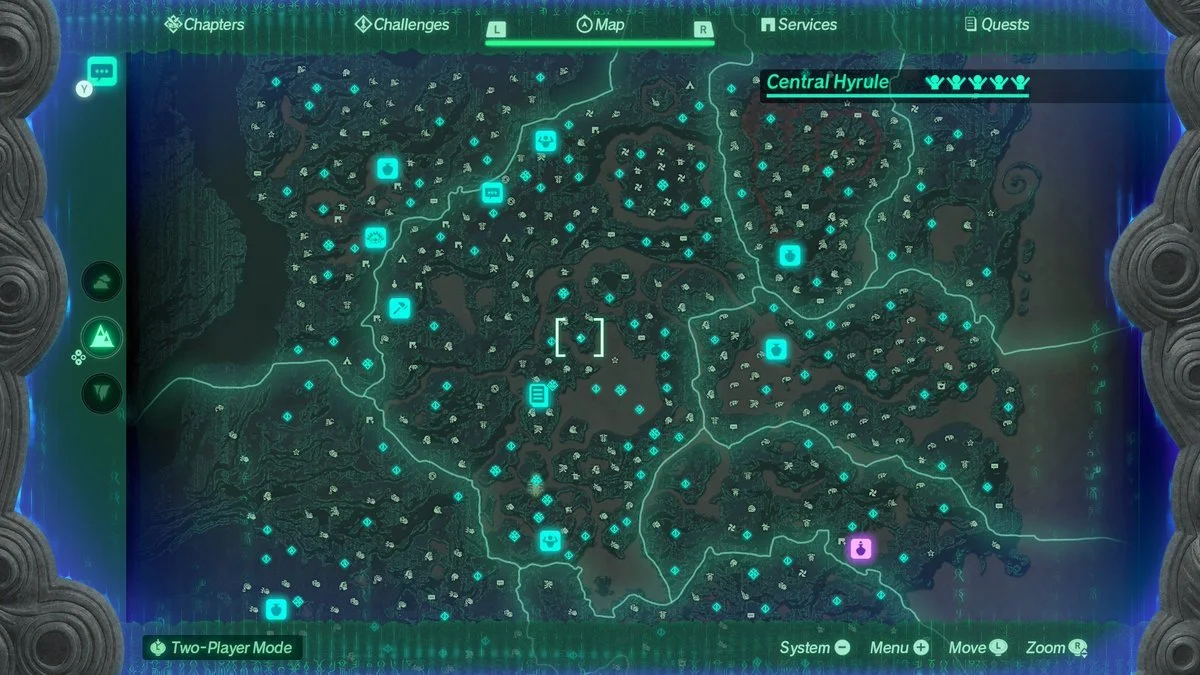
Like its predecessor, Hyrule Warriors: Age of Imprisonment is at its best when going for completion. Completing Challenges to receive rewards to then spend on completing quests that turn the map from orange to blue is an intoxicatingly addictive process. // Image: Nintendo, Koei Tecmo
As for what you actually do in Age of Imprisonment, it’s largely unchanged from Age of Calamity. The player will select Story Chapters and Challenges from the game’s map, which divides the map of Hyrule to multiple regions. Every completed battle showers the player with rewards - all of which have some kind of meaningful application. Some resources can be used at Camp to increase characters’ movement speeds or the rate at which they gain experience points. Other resources are used to fulfill Quests that can expand a character’s utility. This can take the form of adding new attacks to a character’s moveset or providing them with more health or additional Special Attack meters.
An essential part of the power fantasy brought forth by Warriors games is the process of getting stronger, and Age of Imprisonment’s structure helps make such a process be an ever-present one throughout the player’s 20-30 hour-long journey. Much of this progression system has been unchanged from Age of Calamity, and rightfully so - this system worked fantastically there and it continues to work fantastically here. A point where Age of Imprisonment could have improved upon Age of Calamity, however, is with regard to Aside Quests.
This is another disappointing instance of poor UX that makes the overall play experience become more cumbersome than it needs to be. Some Quests throughout the map require each character to complete all of their Aside Quests - meaning that if players want to go for completion, they need to complete every Aside Quests. The Aside Quests themselves are fun ways to incentivize the player to engage with all of the game’s mechanics. They often boil down to objectives like “defeat X amount of Y type of enemies with Z character”, “upgrade weapons a certain amount of times”, or “exploit enemy weaknesses a certain amount of times”. The presence and quantity of these objective consistently give the player additional tasks to juggle as they go about combat encounters. Since these objectives often require using different mechanics or using different characters, the Aside Quests succeed at diversifying the players’ many different combat encounters to keep them from becoming stale.
The issue is that of UX - the way that the player views Aside Quests. While on the map to determine which characters to bring with to complete a Challenge, there is no graceful way to quickly check on what Aside Quests can be completed with certain characters. To check on Aside Quests, the player needs to access the “Services” tab of the map’s menu, navigate to the “Aside Quests” option, then scroll throughout each character to see what Aside Quests are available for each character. The player has to take note of what objectives they can or can not complete with an upcoming Challenge, then go back to their Challenge in question and make their character assignments accordingly.
The player can more quickly check Aside Quests during combat encounters, but by that point, the player’s selected character have obviously been locked in, and so this more convenient menu mainly serves as a way of checking an Aside Quest’s completion status and the player keeping track of their progress towards an Aside Quest’s completion. I feel the need to call out this poor UX because it played a significant role in elongating the amount of time I spent on selecting my characters for encounters. I had to spend a lot of time flip-flopping between different menus in order to optimize the efficiency of my combat encounters. If better UX for the Aside Quests had been implemented, I could have spent less time fumbling through menus and more time participating in what Age of Imprisonment does best: its combat.
This issue leads to UX becoming one of Age of Imprisonment’s most pressing issues that holds it back. These poor instances of UX make the game spend more time than necessary in static menus when they could otherwise be in the throes of the fast-paced, power-fantasy-inducing combat that Warriors games uniquely provide.
When the player has gotten through navigating the poor UX and can just battle through hordes of enemies and complete Quests - Age of Imprisonment provides wonderful bliss. Combat is frantic, fun, well-paced, and features various offensive options that make the repetitive task of defeating hundreds of enemies never feel boring.
I’m aware that I’ve done a lot of complaining over this game’s shortcomings. For every promising new addition made to Age of Imprisonment, there’s a caveat or two that holds it back from elevating the game towards greater heights not seen by previous Warriors crossovers. But don’t let such a thing trick you into thinking that there isn’t a fun game here. Hyrule Warriors: Age of Imprisonment is, at its core, more Age of Calamity with even more mechanics to make fights feel more dynamic and more interesting. That still makes for a doubtlessly fun time.
Age of Imprisonment doesn’t reinvent the wheel for this formula. This is a clear instance of iterating on what worked in a previous installment of a series and simply providing more of it with some improved visual and mechanical flair. Despite its various new offensive options, Age of Imprisonment delivers an unmistakably familiar experience that feels more like an extension to the great Age of Calamity while never committing to fully improving upon it. In that sense, Age of Imprisonment is a safe follow-up to Age of Calamity.
I’ve critiqued Age of Imprisonment as much as I have because I think this game was in a unique position to have taken the solid framework of its predecessor and further build upon it to create something truly spectacular. Age of Imprisonment unfortunately does not do that, but this doesn’t doom the game into being a bad game. It’s one that I found myself getting addicted to just as much as I did in 2020 with Age of Calamity. Completing missions and Challenges, collecting resources, and spending resources to improve characters and expand their movesets all make for an addicting and fun gameplay loop. Imprisonment retains a fun gameplay experience by providing more of what we’ve seen before.
Warriors games regularly get brought up as “junk food” video games, but I specifically view them as popcorn video games. You can’t fully enjoy it unless you’re in the right setting and mood, but once you are in the right setting and mood for a Warriors game, it just feels right. Age of Imprisonment, like previous Hyrule Warriors games, hits a solid balance of foundational simplicity and mechanical depth to create a game that’s easy to pick up and have fun with while rewarding players that take advantage of different mechanics to maximize their advantages in combat. Coming to Age of Imprisonment after not touching a Warriors game in over a year felt nice, it felt right, it felt…comfortable.
Hyrule Warriors: Age of Imprisonment basks in the comfortable fun it provides. Its story provides a charm in the face of an otherwise relatively basic, unsurprising narrative. Its presentation is polished and serves as a solid benchmark for just how much more powerful the Nintendo Switch 2 is versus the original Switch. Most of all, Age of Imprisonment is a testament to what has made the Warriors / Musou subgenre prevail all these years: the power fantasy. Despite having significantly less fan service than any other Warriors crossover to date, the gravity of the power fantasy is inescapable. Hyrule Warriors: Age of Imprisonment has the admirable spirit to innovate on what’s come before, but stumbles with imperfect improvements that hold the game back from being a considerable improvement over what’s come before.
Age of Imprisonment is a game that is itself imprisoned. Its commitment to tell a canon story and inherit the best (and worst) of Tears of the Kingdom’s mechanics and identity limits its overall potential. That isn’t enough to make the game a disappointment, but it is enough to bring into view the chasm that separates the game that Age of Imprisonment is versus the game it could have been. Should future Hyrule Warriors games be free from this imprisonment, I look forward to seeing where further innovation and refinement can take this series.
Final Grade: B-
Thank you very much for reading! What are your thoughts on Hyrule Warriors: Age of Imprisonment and how it streamlines Musou action? How does this complement Tears of the Kingdom? As always, join the conversation and let me know what you think in the comments or on Bluesky @DerekExMachina.com!