Dragon Quest I & II HD-2D Remake Review: Beauty in Simplicity
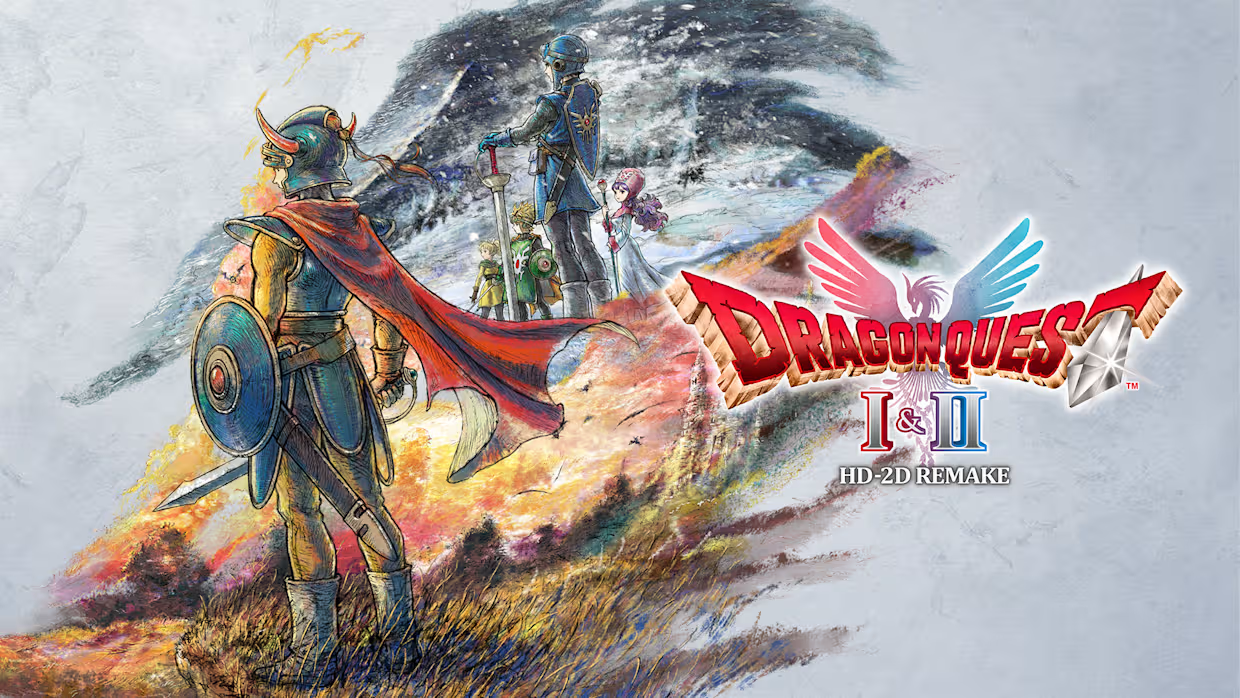
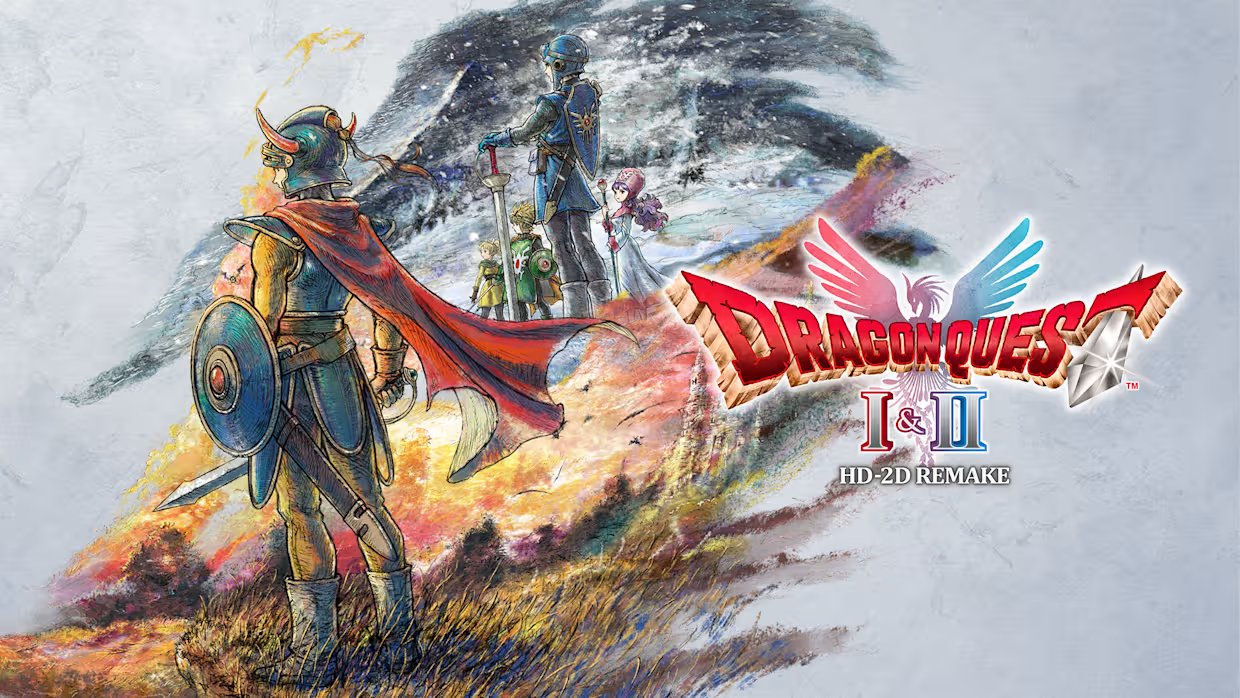
Dragon Quest I & II HD-2D Remake is a release that steps up to the plate in the face of immense pressure. This remake tasks itself with modernizing some of the most important games in JRPG history, and it does so smartly. Both titles in this remake package are practically new games, yet feel unmistakably Dragon Quest. // Image: Square Enix
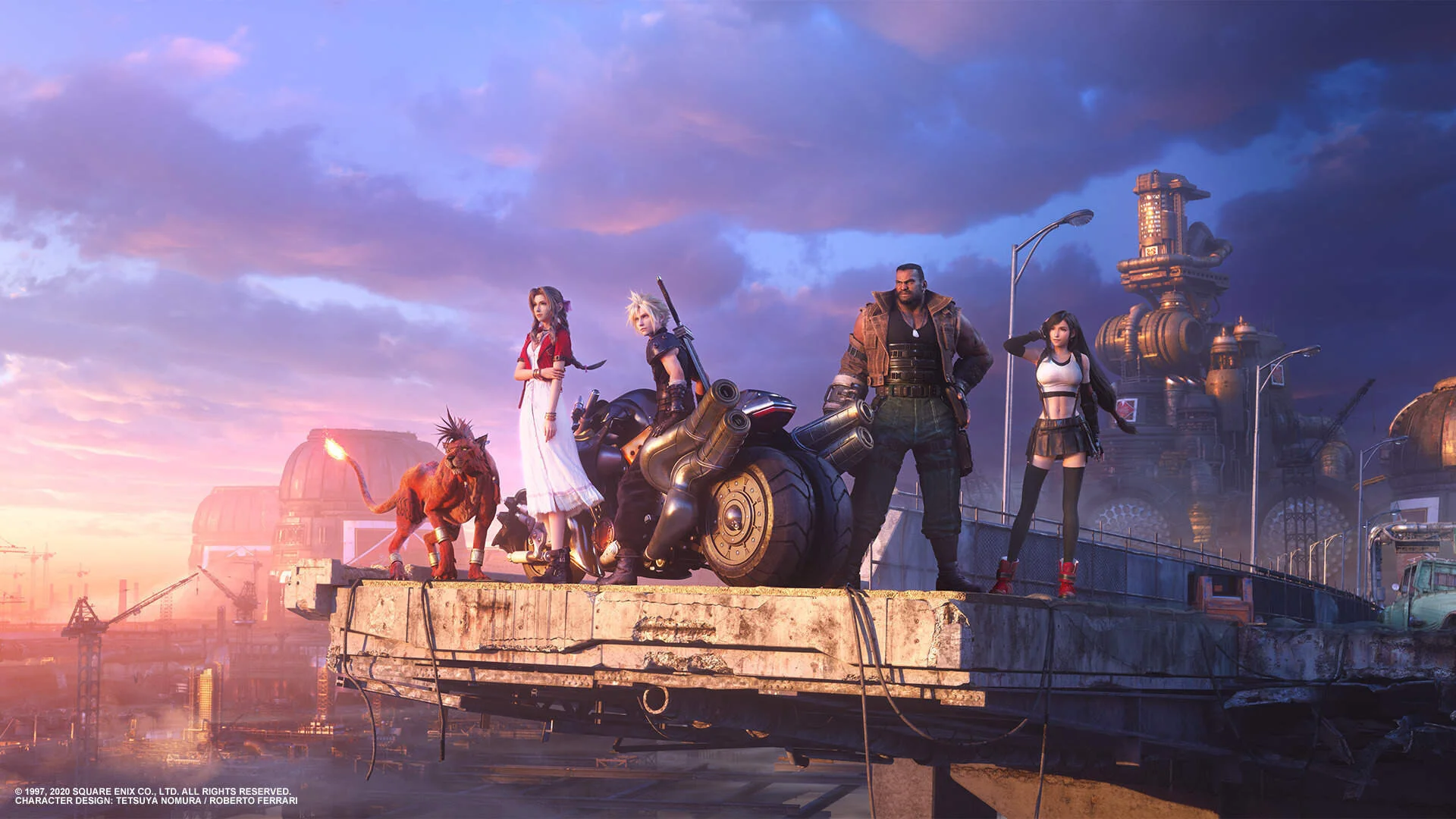
Video game remakes are ripe with recency bias. The vast majority of video game remakes that have released over the last decade have prioritized modernizing fan-favorite titles that are still familiar and comfortably in the games culture. The Final Fantasy VII Remake series, undoubtedly the highest-profile remake project of recent memory, sought to remake the legendary PS1 title over twenty years after its original release. And yet, clamors for a Final Fantasy VII remake were plentiful as far back as the 2000s, with the now-infamous PS3 tech demo showcase of FF VII’s opening inspiring false hope in fans that a full remake was coming soon circa 2006. It wasn’t, and yet fans were hungry for a remake of a beloved title less than a decade after its original release.
In the two decades since, little has changed. People still loudly clamor for remakes for relatively recent games. From Software fans repeatedly beg for a Bloodborne remake - a 2015 title still playable on modern hardware via backwards compatibility. Other PlayStation IP that have actually received modernized remakes, such as 2022’s The Last of Us Part I and 2024’s Until Dawn. Both of these examples were titles that remade less-than-decade-old titles, leaving many players scratching their heads as to why these remake projects were necessary. But then, this focus on remaking recent titles is a product of the very culture of remake anticipation within the broader video game culture.
I’m not an anti-remake person - in fact, I welcome the idea of remakes in any medium. One of the greatest cases for remakes, in my mind, is the 2024 film, Nosferatu, directed by acclaimed horror director Robert Eggers. A remake of 1922’s Nosferatu: A Symphony of Horror (itself a knockoff adaptation of 1897’s Dracula), Eggers’ 2024 remake gave an opportunity to tell a familiar story, but now empowered by an entire century’s worth of improvements and changes in filmmaking. 2024 Nosferatu does many things that simply weren’t feasible in 1922 and thus achieves its own unique identity while preserving the spirit of the original film. That’s what makes it a strong remake: it takes the soul of old elements and modernizes it with new techniques and stylings to make something truly transformative.
The original film’s age absolutely played a role in this. Every decade has brought with it new filmmaking techniques, new horror films to build upon and take inspiration from. So, by the time Eggers made his 2024 retelling of Nosferatu, the film he would direct would take on a completely different than the original by nature, and that’s what led to a strong, distinctive film.
My point in this is that there’s incredible value in remaking decades-old classics rather than remaking more recent affairs because they can showcase the incredible developments that have been made in throughout the history of each medium’s respective industry. In the case of the video games industry, there aren’t too many instances of games from the 1980s or before being remade from the ground-up for a modern audience. Despite many video games released during this era being instrumental in laying the groundwork for the future of the industry, there are exceptionally rare instances where these games have been preserved and repackaged for the modern games audience.
Many early arcade, console, and PC games are not available on modern hardware in any way, making it difficult for audiences to learn about the history of games and specific subgenres in games. Remakes can be a fantastic gateway to present how foundational older ideas in the games industry were, while also offering opportunities to polish up dated aspects of these games born from either technical limitations or a simple lack of other works to take inspiration from and bounce off of. Remakes of older games may bring forth the value of something that has perhaps been lost in some capacity in the modern video games landscape: simplicity and its inherent beauty.
Enter Dragon Quest, an instrumental game that introduced many Japanese players to the idea of the role-playing game, effectively birthing the JRPG subgenre as we know it upon its release. Dragon Quest is a monumentally important game, as it inspired many other developers that would produce legendary franchises in their own right - namely Square’s Final Fantasy series and Game Freak and Nintendo’s Pokémon series. That said, Dragon Quest is as old-school as it gets. It’s mechanically simple, narratively straightforward, and unforgivingly grindy. It’s clearly influential and iconic, but it makes for a challenging replay forty years after its original release.
In 2021, Square Enix hosted an event where they announced multiple Dragon Quest games to celebrate the series’ 35th anniversary (including Dragon Quest XII: The Flames of Fate, a game that still has no foreseeable release date as of writing). During this presentation, Square Enix announced an HD-2D remake of Dragon Quest III, one of the most important titles in the series, particularly in Japan. While this announcement took place in 2021, this remake wouldn’t release for over three years after the fact. Square Enix went dark on the project until it resurfaced during a 2024 Nintendo Direct, looking significantly more polished than before. Of course, the impact of the game’s rereveal wasn’t just the fact that the game had been delayed for so long because of additional polish, but because the scope of this remake project had expanded far beyond just Dragon Quest III. Indeed, this HD-2D remake of Dragon Quest III had ballooned into a remake of the entire Erdrick trilogy that encapsulates the first three Dragon Quest titles. While Dragon Quest III HD-2D Remake would release in late 2024, a remake of the first two Dragon Quest games would release the year after.
Dragon Quest I & II HD-2D Remake’s release taking place after that of Dragon Quest III’s remake makes narrative sense, given that the third title is a prequel to the first two games. Dragon Quest III added many complexities into Dragon Quest, such as its Vocation system, Dragon Quest’s interpretation of RPG classes, and that naturally meant that the game would require less modernization than the first two games. Comparatively, Dragon Quest I and II are more challenging games to modernize due to their inherent rigidity. Dragon Quest only features a single playable character, which is exceptionally rare for turn-based RPGs. Dragon Quest II features three characters, but recycles a fair amount of towns, dungeons, and other content from the first game. Both of these games have unique traits and issues that make them interesting remake material.
Perhaps more importantly, though, these games represent an era where RPGs, much like the broader games industry at the time, were the Wild West of ideas. Many early JRPGs circa the late ‘80s threw ideas into their game design because there was no clear definition on what an RPG even was yet, and that led to experimentation and iteration. It’s for that reason that Dragon Quest’s simplicity and straightforwardness stands out that much. In a time when RPGs were very much inaccessible, Dragon Quest sought to introduce players around the world to what an RPG was and how it could reframe the perception of games altogether. Dragon Quest was among the first games to not be about a score or achieving an arbitrary goal, but rather, an adventure. A tale of heroism that the player got to personally partake in.
With the forty years since Dragon Quest’s original release, there is immense value in informing the modern RPG audience just how far games could go with relatively simple design. This remake would go on to preserve much of Dragon Quest’s inherent simplicity while also injecting the fantastic art direction, music quality, and quality of life features made possible by advancements in game development. Additionally, Dragon Quest I & II HD-2D Remake opts to inject new narrative content to make an originally simple story hit just a bit harder, with additional scenes working towards character development, narrative foreshadowing, and more.
All this comes together to create a brilliant remake that I think many games and remake projects can learn lessons from. Dragon Quest I & II HD-2D Remake balances its ambitions of modernizing a classic game while never forgetting the appeal of the simplicity that made these games classics in the first place. By going back to some of their earliest works, Square Enix has produced a remake that respectfully honors its original counterparts, while still feeling distinct and proving to be showcases for how far games have come in the four decades since Dragon Quest’s original release.
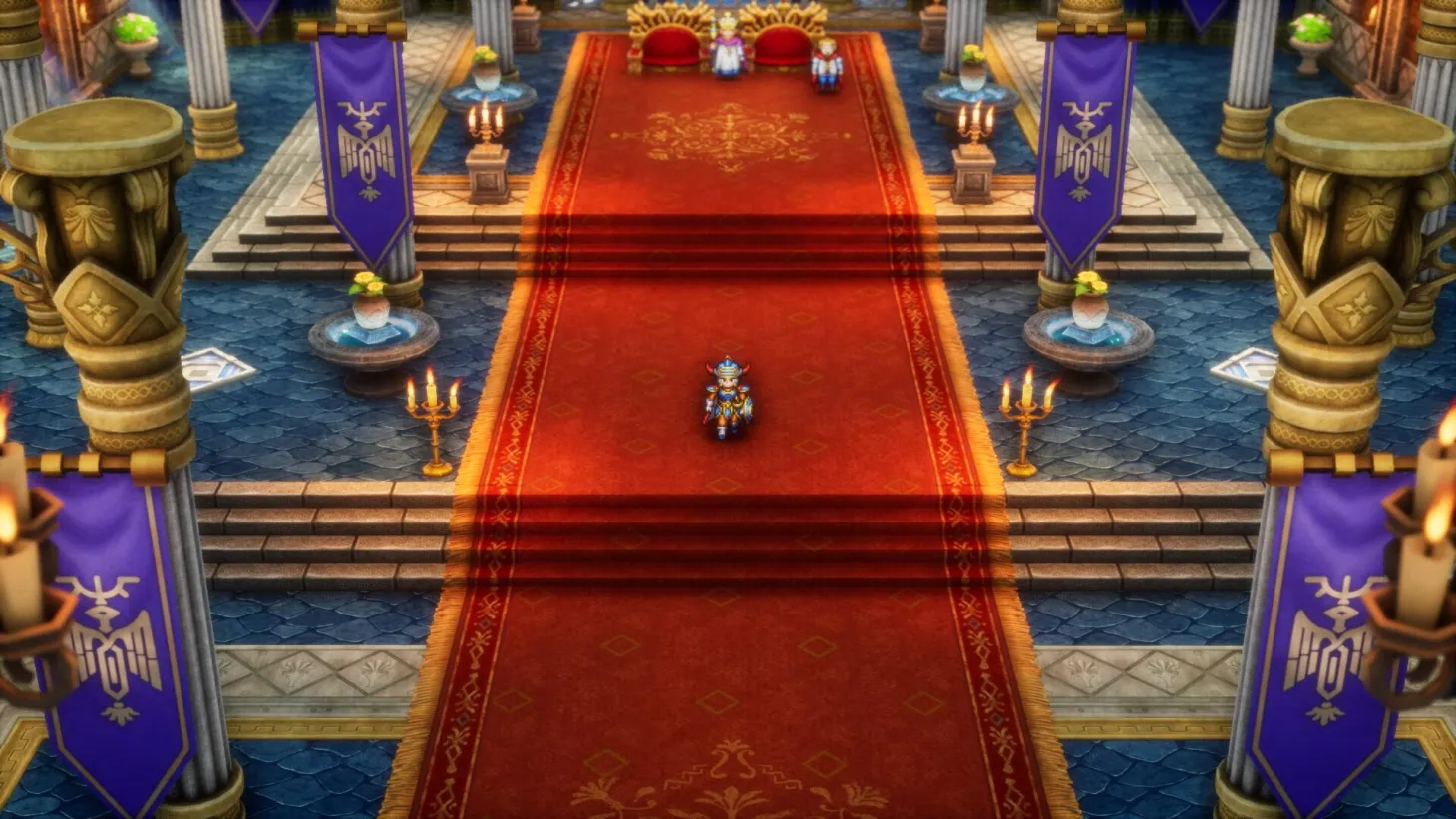
Dragon Quest tells a simple story about a hero saving the world from impending darkness that has slowly started to infect the world. The HD-2D remake adds new scenes to give this journey more narrative weight while never forgetting that simplicity makes this narrative work as well as it does. // Image: Square Enix
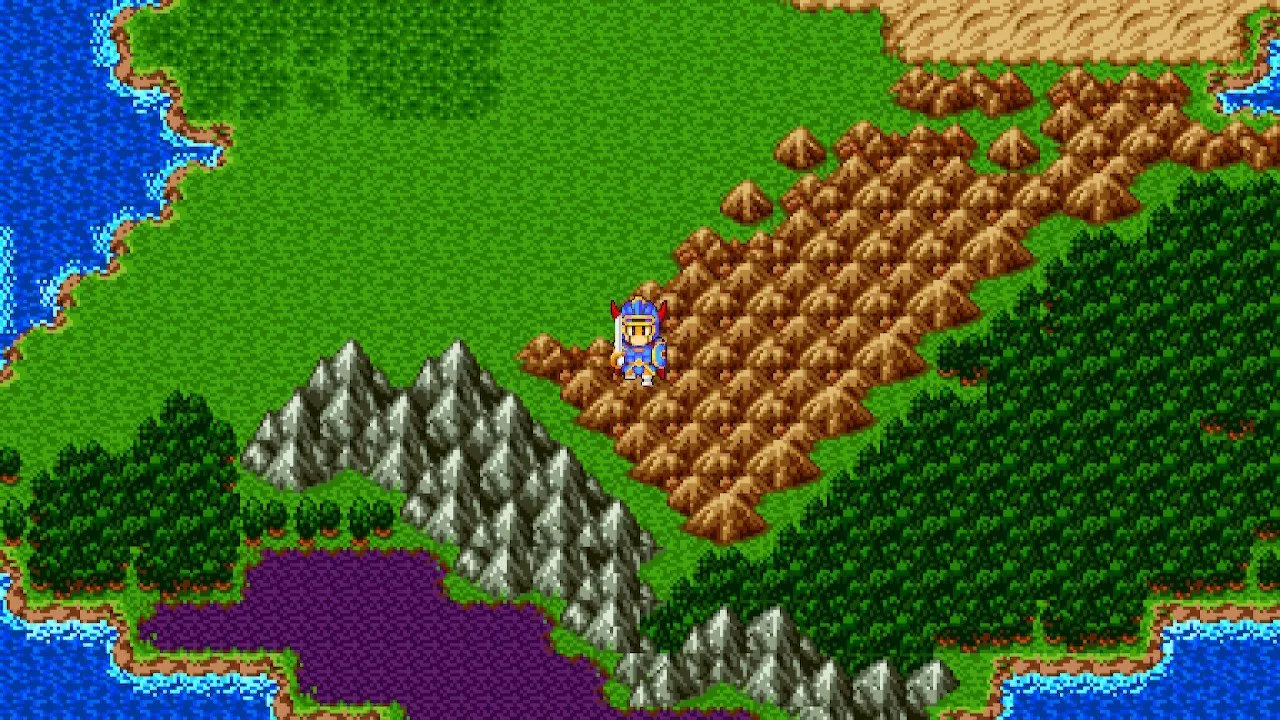
Although this is the most modernized version of the original Dragon Quest, it’s far from the first time that the game has been remade. After being ported from the Famicom/NES to late ‘80s PCs like the MSX, the first two Dragon Quest games would be remade on the Super Famicom, featuring more advanced graphics to bring it in line with later entries, namely Dragon Quest V and VI. A couple years later, the first two Dragon Quest games would be rebuilt for the Game Boy Color. In the 2010s, a mobile port of the game was released, featuring an ugly-as-hell art style typical of Square Enix’s mobile efforts of the time. These versions of the game would be released on Nintendo Switch internationally, and served as the basis of my first playthrough of the first three Dragon Quest games.
Given that these games have been ported and rereleased throughout the years so much, what makes this specific package so special? Why should people care about the HD-2D remakes of these games when there are so many alternative versions to play?
While older versions of these games are perhaps more suitable for those seeking a purist experience that encapsulates the grindy, rough-around-the-edges feel of an early RPG, I would argue that these HD-2D remakes serve as, by far, the most accessible and feature-complete versions of these games.
Of course, that begins with this remake’s very namesake: the HD-2D artstyle that first debuted in 2018’s Octopath Traveler. In the eight years since the art style’s first implementation, the influence that HD-2D has left on the broader games landscape is immense. On top of Team Asano’s later efforts with Octopath Traveler sequels and spinoffs as well as the underrated Triangle Strategy and the upcoming Adventures of Elliot, other games have taken clear inspiration from this style that combines pixel art for character, diorama-like aesthetics for environments, and heavy lines for illustrations. Games such as Eiyuden Chronicle: Hundred Heroes, Star Ocean: The Second Story R, and Wandering Sword have all showcased the versatility inherent to combining the retro aesthetic of pixel art with high-fidelity environmental detail and particle effects to make something that looks consistently remarkable.
And yet, I would argue that Dragon Quest’s utilization of the HD-2D art style is perhaps the best this style has ever looked. Dragon Quest has always crafted colorful worlds populated by stylish yet simple character designs. These HD-2D remakes understand the value of that and don’t use the HD-2D art style to overcomplicate the classically straightforward aesthetic of Dragon Quest, and they use the added detail of a modern remake in order to make Dragon Quest’s colorful world and character pop that much more.
Indeed, if I could describe Dragon Quest I & II HD-2D Remake’s aesthetic in a word, it’d be: clean. These are remarkably clean-looking versions of these games, with the visual variety popping even further thanks to the added detail that never goes too far in making the world feel too detailed and visually complicated. Across both of these games, the player will venture through poisonous swamps, across the ocean’s floor, through dank caverns, and upwards through ancient towers. There’s no shortage of imaginative locales in Dragon Quest, and the gorgeous aesthetic afforded by this art style makes every visual stick in the player’s mind.
I think something that really helps is the attention given to relatively small details. The way grass blows in the background of battle screens, the way enemies animate and bounce around while the player is deciding their combat actions, and the fact that characters’ sprites change if wearing the complete set of Erdrick’s armor - these remakes inject a nice attention to detail that makes the game far more pleasant to look at compared to the often static backgrounds of previous incarnations of these games. The vivid color and visual variety makes this, in my eyes, Square Enix’s best-looking HD-2D game to date.
Another improvement made to this remake’s presentation is that of its music. With the passing of Koichi Sugiyama in 2021, Dragon Quest games are no longer restricted from having orchestrated music for the sake of Sugiyama being able to sell orchestrated arrangement albums. That means that all Dragon Quest games released since 2021 have included fully orchestrated music internationally, meaning that these are the first times that Dragon Quest I, II, III, and the recently released reimagining of VII have included a fully orchestrated score in all territories. And that’s a genuine win for everyone, because orchestrated Dragon Quest music hits like nothing else.
Indeed, listening to a Dragon Quest soundtrack is essentially to listen to a contemporary classical album. Sugiyama may have had shady business practices in life with respect to the use of his orchestrated music, but he was doubtlessly a very talented composer, as his tracks now live beyond him. While the arrangements and recordings for all tracks heard in Dragon Quest I & II HD-2D Remake have been recycled from their respective orchestrated album releases, the music in question hasn’t aged a day. As such, while the lack of brand-new tracks or arrangements could be disappointing to some, it’s hard to argue that the tracks on display have a timelessness inherent to them that suggests that any new music added here would be unnecessary additions.
Dragon Quest I & II HD-2D Remake is in a remarkably good place in terms of its presentation, as it’s hard to imagine how more perfect a remake of these games could look and sound. The HD-2D style feels like a perfect fit for the original games’ art styles and preserves the imagination on display in every previous version of these games.
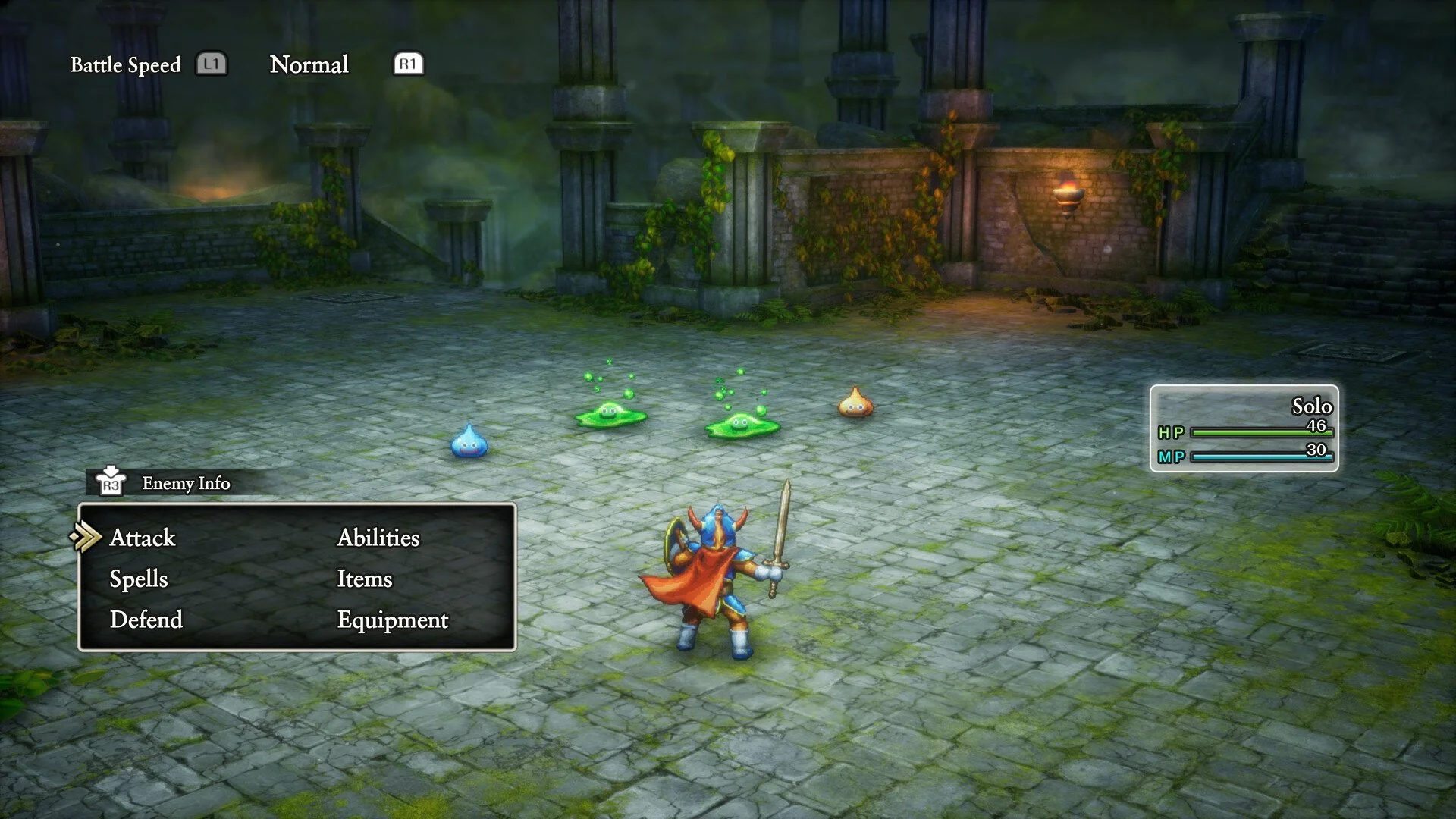
Dragon Quest’s combat is inherently limited by the fact that it features turn-based combat with only a single playable character. This limits strategic possibilities - something that becomes apparent when Dragon Quest II’s addition of party members makes combat more strategic and fun by nature. // Image: Square Enix
An essential aspect of Dragon Quest is the mission of its design. As mentioned above, Dragon Quest was a game brought to life in order to introduce RPGs to an audience whom had never seen anything like it before. To Dragon Quest’s intended audience at launch, RPGs were quite literally a foreign concept. As such, the original Dragon Quest was designed with simplicity and accessibility in mind. RPGs, a genre notorious for having complex and deeply interconnecting mechanics, needed to be made simplified and streamlined for an audience becoming familiar with the capabilities of this style of game.
Part of what caused Dragon Quest to become so culturally relevant upon its release was how it streamlined complex RPG terminology and mechanics and presented them in a way that was charming and accessible, yet carried enough complexity to satiate the few already familiar with the genre. The result is a game that, for better and for worse, basks in its simplicity. The challenge of remaking the first Dragon Quest, is that it must retain this aspect of the original game’s DNA - namely, the fact that the game is built around having a single party member.
Creating a turn-based RPG with a single party member isn’t an impossible task, but it certainly brings challenges. Turn-based RPGs typically excel when strategizing around multiple factors, and adding multiple party members and enemies to fight during combat is an easy and intuitive way to add more factors for the player to consider during their turns in battle. Having a single party member to work with inherently means that there are less factors to consider, and therefore, there are less things for the player to think about for combat, which, for a game like Dragon Quest, is the main attraction of the entire game.
Every previous release of Dragon Quest I has featured 1-on-1 combat, meaning that the player only has to factor in having a single party member to control and a single enemy to defeat. This naturally leads to less options made available to them in combat. There is a relatively small pool of options at the player’s disposal - between basic attacks and a small collection of spells to heal or inflict elemental damage, there’s some strategy to be had, but it’s relatively straightforward due to the lack of options. This causes Dragon Quest I’s combat to regularly become cyclical. Many battles in previous versions of this game devolve into becoming cycles where the player attacks for two turns, then spends a turn to heal, attacks for two more turns, and so on until the enemy’s HP is depleted. It conveys the power fantasy afforded by an RPG, but it’s prone to becoming monotonous after a few hours.
Much of this is simply Dragon Quest I’s identity and can’t simply be removed without stripping the entire game of what it originally sought to achieve. HD-2D Remake grapples with this and settles with something that I feel is a great compromise. On one hand, Dragon Quest I HD-2D Remake brilliantly preserves the simple single-party-member design while injecting more complexity to give players more mechanical depth to chew on to make the longer runtime of this runtime feel more justified, gameplay-wise.
The biggest addition in Dragon Quest I’s combat is the fact that the player now fights multiple enemies while in combat. This greatly expands the pool of moves made available to the player, as some spells target individual enemies, some spells target groups of the same enemy type, and some spells target all enemies on screen. On top of an increased spell list that gives the player more options to consider during combat, they also now have a list of abilities. While many abilities are effectively alternate attacks that deal extra damage to certain enemy types, there are a couple abilities that give the player options to expand their strategic approaches to fights. Options like Muster Strength provides a buff for the next attack the player does, while an ability like Wild Side lets the player act twice in a single turn for a few turns.
These additional strategic layers to combat are still ultimately limited, since the player can only select a single option for every turn in combat, but it’s something to give the player more options while still maintaining Dragon Quest I’s intentionally limited design philosophy. On top of learning spells and abilities through leveling up, a fantastic inclusion in HD-2D Remake is that of scrolls, items found while exploring the environment. Reading these scrolls lets the player add even more spells and abilities to their repertoire. Skills learned through scrolls are often some of the most worthwhile and mechanically interesting options in the game. This greatly incentivizes and rewards exploring environments to their fullest. Going off the beaten path in dungeons to find hidden treasure chests or burrowing through barrels and pots in towns is well worth the effort, not only for finding other goodies like weapons and armor, but for finding some of the most fun-to-use combat options in the game.
With all this said, Dragon Quest I’s combat is inevitably fated to be flawed, even with the expansions afforded by HD-2D Remake. While the player is certainly given more options to consider and more mechanics to take advantage of, having a single party member is still an extreme limitation that’s placed on the player. Such a limitation creeps its way into the spotlight in the back half of the game as more challenging boss fights stand against the player. Many fights will doubtlessly require multiple retries, but the many deaths that the player will experience in these fights feel less like a punishment for implementing a losing strategy and more like not using the right options in the right order.
Since you play as a single party member in Dragon Quest I HD-2D Remake, you can (mostly) only do one thing at a time. Do you spend your turn attacking? Do you spend your turn healing? Do you bother using buffs? For games with additional party members, you don’t necessarily have to definitively choose one - you can mix and match depending on the needs of the situation. But because you have only one choice that can be made each turn in this game, that means that you have to entirely commit to something for that turn. Even though there are more options afforded to the player, they still effectively have to go through the cycle of options that plagued previous release. Attack, attack, heal, attack, attack, heal, and so on. Maybe throw a buff or two in there and get creative with whether you use an immediate heal that restores you for more on one turn or a regenerative heal that heals you a little over multiple turns.
Truthfully, there aren’t too many different strategies that the player can try out for some of the game’s more challenging fights. So, if none of the few strategies available to the player are proving most effective, then that means that the player needs to resort to upping their character’s numbers to make the battle easier. Put another way, it’s time to grind.
Grinding is another essential aspect of Dragon Quest’s DNA, for better and for worse. While many modern JRPGs have streamlined their design to prevent the need for grinding as much as possible, HD-2D Remake still preserves the clear advantage of grinding. Indeed, taking a few minutes to hunt down Metal Slimes to quickly gain levels is still a part of the experience that makes the challenging boss fights of Dragon Quest I more manageable. And it’s a part that I think is unfortunately essential. Dragon Quest I actively encourages (and nearly requires) players to grind to some extent to see success in its late game, and I think that leaves room for frustration.
Many of Dragon Quest’s late game bosses are tough, and it’s genuinely discouraging to know that, for the most part, you don’t have the room to use strategy, flexibility, and cunning to get through a challenging fight. Because of the limited options, grinding and gaining levels is the most viable and efficient way to overcome challenges, and that doesn’t feel as satisfying or meaningful as getting through a boss while underleveled but taking advantage of every mechanic you have available to you to pull through. It’s a disappointing aspect that unfortunately makes playing through this modern version of Dragon Quest I still feel annoying and clunky at times.
The commitment to Dragon Quest I’s limitations and simple design unfortunately puts a ceiling on the quality of the game’s combat. By design, it can’t reach the greater heights of strategic depth seen in other JRPGs. That said, HD-2D Remake does almost as good a job as possible in presenting the original mission of Dragon Quest I, save for the relatively low EXP output leading to necessary grinding or Metal Slime hunting. That said, the framework built in HD-2D Remake is incredibly strong, and it truly gets to shine as an incredibly in-depth battle system in the Dragon Quest II portion of this package.
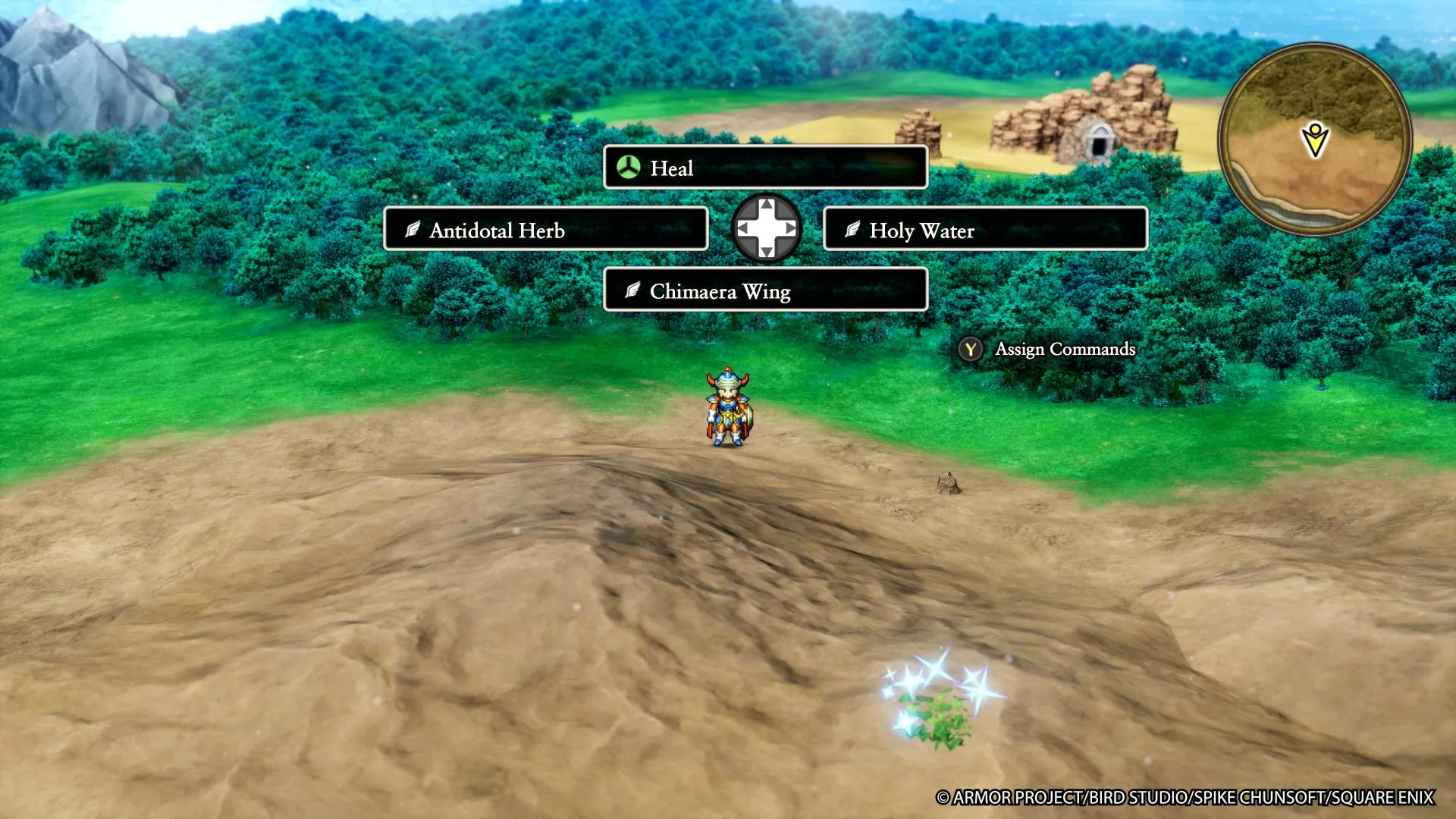
Aside from looking better and featuring more options in combat, Dragon Quest I & II HD-2D Remake improves upon the original games by offering various quality-of-life features, such as being able to quickly access spells and items, which makes grinding, healing, or fast traveling between locations far smoother. // Image: Square Enix
It can be argued that Dragon Quest I HD-2D Remake is the appetizer, while Dragon Quest II HD-2D Remake is the main course of this remake duology. Through adding new story sequences and offering more to explore, Dragon Quest I HD-2D Remake clocks in at about 16 hours, which is triple my playtime of the old Nintendo Switch version of Dragon Quest I. By comparison, Dragon Quest II HD-2D Remake is roughly 30 hours in length, with even more in the game’s surprising addition of a postgame that adds more dungeons and boss fights to tackle.
The reason for Dragon Quest II HD-2D Remake’s longer runtime is more than just the fact that the game offers a larger world with more dungeons and towns to explore. The story and gameplay on offer in Dragon Quest II are more involved by the very nature of now featuring more playable characters. While Dragon Quest I was given a lot more cutscenes and story to give more character to the world and build up the Dragonlord as an antagonist that the player can get familiarized with before the final battle, Dragon Quest II spends a lot more time developing its cast of characters and their resolve to save the world from nea antagonist Hargon.
At the game’s onset, the Kingdom of Moonbrooke is destroyed, causing the kingdom’s surviving princess to seek out help from the other two kingdoms. Like the DQ I protagonist, the Prince of Midenhall is a blank slate that the player is given free reign to roleplay as, but the additional party members are full-on characters with quirks and character traits and even get entire arcs - all of which are brand new to this remake. The Princess of Moonbroke, Peronel, is given a character arc where she hates all monsters due to their involvement in destroying her kingdom and its people. This causes her to be willing to kill a good-mannered monster that commits to being an ally, which ultimately causes Peronel to become more sympathetic and forgiving.
Likewise, Caradoc, the Prince of Cannock, features a character moment that turns one of the most annoying sequences in the original Dragon Quest II and turns it into a memorable, cool side quest. While in one of DQ II’s towns, Caradoc will fall ill, causing the rest of the party to search for a cure. In previous versions of DQ II, this required the player to find a specific healing item to give to Caradoc, putting an abrupt halt on the pace of the game. In HD-2D Remake, however, this leads to an arc where the party ends up teaming up with Caradoc’s sister, Matilda, in order to find the cure. In fact, Matilda, while present in the original game, is given a far larger role in HD-2D Remake by becoming a full-fledged party member that joins the party after this side quest takes place.
None of these character arcs are particularly deep or innovative, but they do a good job in adding further character and charm to the world of Dragon Quest II. Moreover, the addition of more narrative content generally makes this world feel a lot larger and more complicated than the smaller, comparatively more simple world of DQ I. Even though the player can explore the entire map of DQ I’s world in DQ II, it becomes apparent that the world map of DQ I is just a small fraction of the grand scale of DQ II’s overall world. This makes exploring Dragon Quest II’s world feel incredibly cool not only in how it feels like a meaningful extension of the world as seen in DQ I, but a true evolution of the way the player navigates through it.
Nowhere is that evolution more apparent in Dragon Quest II HD-2D Remake than in its gameplay. Indeed, Dragon Quest II is where this package truly shines, as I found the turn-based combat now equipped to become as mechanically dense and nuanced as it was destined to be. Although Dragon Quest II has historically been a three-party-member game, the addition of Matilda in DQ II’s plot means that HD-2D Remake makes DQ II a four-party-member game. This makes the difference of options afforded to the player between the two games in this package become all the more striking. Controlling four party members greatly opens the door over for what’s possible with Dragon Quest’s combat framework in the best way possible. Indeed, Dragon Quest II HD-2D Remake is a massive improvement due to how ripe it is with viable strategic options afforded to the player.
Each party member in Dragon Quest II fulfills a role, unlike the protagonist of DQ I who, by necessity, was equipped to do everything. The Prince of Midenhall is incapable of using magic and is thus more specialized in dealing damage through regular attacks and abilities. Peronel is a dedicated mage that’s capable of healing, casting offensive magic, buffing, debuffing, and doing crowd control on groups of enemies. Caradoc is effectively a hybrid between the two that can flex between dealing damage and offering support as needed. The newly added Matilda is somewhat of a wild card on top of everything - she learns some uniquely powerful abilities and wields an incredibly high Luck stat, but is prone to ignoring commands and acting independently of the player’s choice. It’s an at-times frustrating mechanic but meaningfully represents her presence in the game’s narrative, leading to a solid instance of gameplay-narrative cohesion.
Due to having four party members, the player has four commands that they can issue for each turn. Since each party member is designed to fulfill a different purpose, the player has to take advantage of each of those different purposes to ensure success in combat. The Prince of Midenhall can focus on dealing damage to single enemies, so Peronel and Matilda can spend their turns buffing Midenhall so he deals even more damage per turn, then cast debuffs on the enemy as needed, meanwhile Caradoc flip-flops between healing party members, buffing the party’s defense, and dealing additional damage if he has capacity to do so. This is just one of many viable strategies afforded to the player - and the freedom given to the player, especially given the general limitations of DQ I’s design, feel liberating here.
What makes that so surprising is that DQ II is still a relatively simple game at its core. When I got to most boss fights in the game, there would be a typical method to setting up the fight, not too dissimilar to the cyclical nature of DQ I’s combat. In DQ II HD-2D Remake, I’d often spend the first turn of any boss fight charging Prince of Midenhall’s next attack, casting Kabuff with Caradoc, casting Oomph on the Prince of Midenhall to buff his attack, then cast Sap with Matilda to reduce the enemy’s defense, causing them to take more damage. Taking the time to do this setup often led to big damage that was effective enough to get me through most of DQ II’s boss fights. I only ended up having to switch up and diversify my strategy for some of the very late game boss fights and postgame, where bosses begin hitting very hard, forcing the player to adapt accordingly.
In some ways, Dragon Quest II HD-2D Remake is an easier game because of the additional strategies it gives players the keys to - but that, in turn, also makes it a more deeply satisfying one to play. Dragon Quest II still accomplishes Dragon Quest’s overall mission - by presenting RPG systems in an accessible context. The difference with this sequel compared to the first game is that DQ II simply trusts the player to have more tools and take greater advantage of the many RPG systems to exploit to overpower enemies. Dragon Quest II HD-2D Remake is a beautiful execution in simplicity. The game features a lot of depth but presents it to the player in a gradual, accessible way that ultimately leads to fun, exciting fights. The annoyance from the apparent need for grinding in DQ I is far less pronounced here, given that the player can very much get through boss fights by playing with smarter strategies and not just resorting to beefing up their stats through leveling up.
There’s still some of that here - and such a thing is truly the norm for all Dragon Quest games to follow. The player always has the capacity to grind a bit and will reap the rewards by having a comparatively easier time in fights, but challenging fights always feel possible if the numbers aren’t as high as they can possibly be - and that’s what leads to fun, dramatic fights.
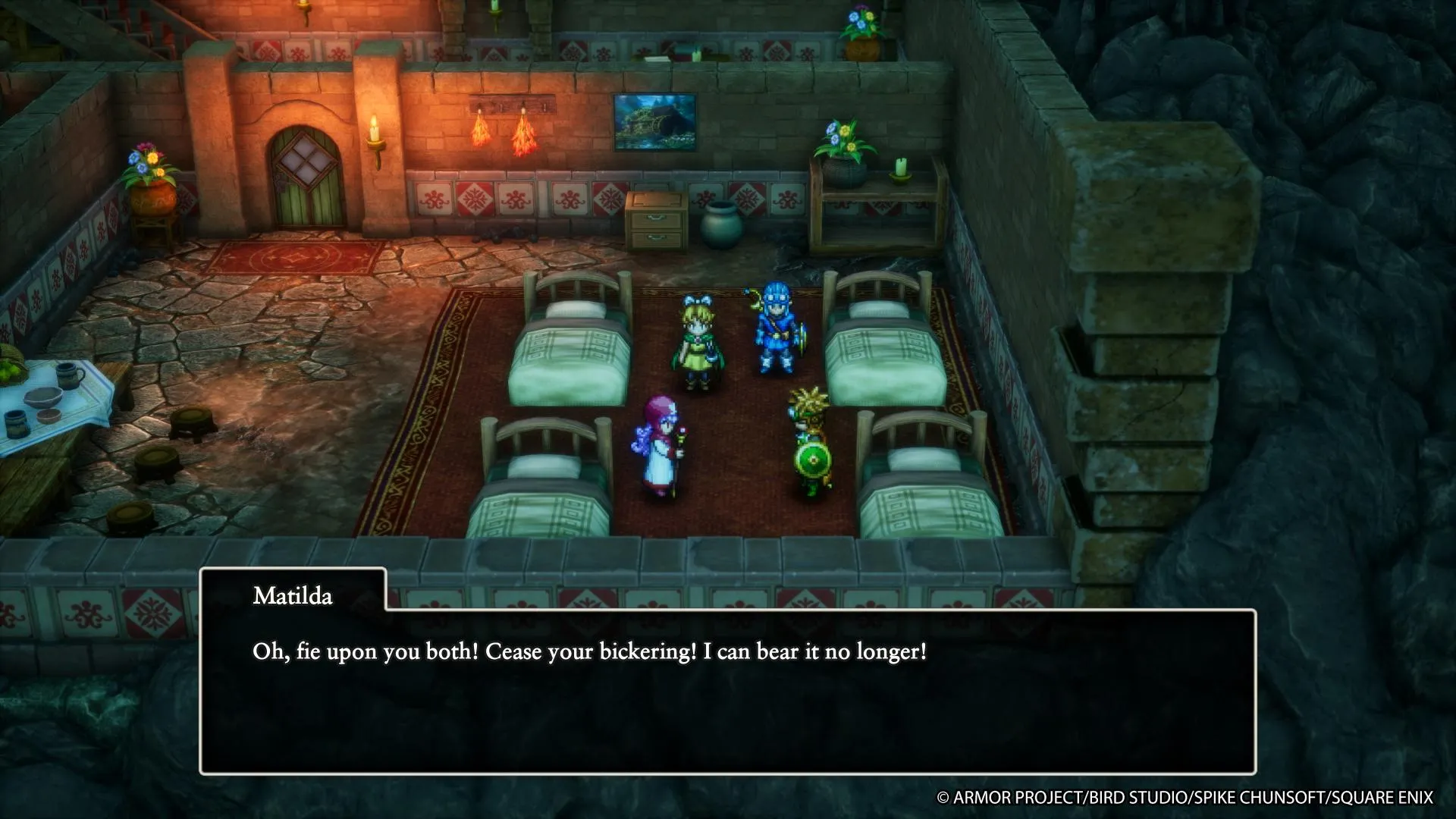
HD-2D Remake’s inclusion of new story elements, cutscenes, and voice acting transforms DQ I and II into feeling like substantially bigger games. This is doubly so for Dragon Quest II, a game featuring more characters, side quests, arcs, and locations. // Image: Square Enix
It’s doubtless that Dragon Quest scratches a very particular itch. This is a franchise that has been historically very conservative with regard to changes. While Dragon Quest has ben tactically iterative with each installment, every Dragon Quest game feels mostly similar in their overall feel. And there’s something genuinely warm about that. Playing a Dragon Quest game often feels like an escape to a familiar, yet imaginative world. A lot of that is thanks to relatively cheery language and visual identity of the series. Even when dark moments occur within the games’ narratives, there’s a constant sense of classic JRPG optimism that makes the quest to see good overcome evil an intoxicating one to engage in.
I find the series’ high bar in localization to play a large part in that. And indeed, Dragon Quest I & II HD-2D Remake carries on the series’ legacy of having a fantastic English localization. From the commitment to Shakespearean English used for all characters, to the talking quirks of certain monsters with dialogue (such as DQ II HD-2D Remake’s addition of Elmoo) - there’s great attention to detail and charm within the writing. What helps is the consistently strong voice acting, with British accents adorning every character in the English dub drenching the game in the atmosphere of a classic Western fantasy setting.
The only issue I found with the game on a presentation level was the inconsistency of voice acting for cutscenes. While many important cutscenes have voice acting, there are certain equally important, unavoidable scenes that do not have voice acting. The inconsistency in the voice acting’s presence is a bit jarring, and the kind of irregularity that’s not as common that is used to be. Aside from that, engaging with this world is regularly as inviting and enjoyable as it is because of the great writing and production value on display.
The last major addition in HD-2D Remake is the wealth of quality-of-life features that significantly improve the adventuring experience. A generous auto-saving system, optional quest markers to help point players in the right direction if they’re feeling stumped, shortcuts for using items or spells - there are plenty of features that make this the definitive way for players to comfortably experience these games. The addition of difficulty modes and other optional features like healing upon a level-up gives players the freedom to tailor the challenge of the experience to their liking - which I find to be nothing but a positive. Dragon Quest I & II HD-2D Remake is a fantastic game for genre veterans and newcomers like - especially those that wish to experience the origins of the JRPG genre in an accessible, newcomer-friendly format.
I walked away from Dragon Quest I & II HD-2D Remake genuinely wishing that more legacy titles could receive such a lovingly crafted recreation. It’s undeniable that RPGs from the Famicom era have aged poorly in many ways. While some can shoulder through the design oversights, lack of direction, and overall rigidity of older RPGs, it’s admittedly hard for many to justify spending time with RPGs that are notorious for potentially throwing away hours of progress upon a game over. There’s so much value in preserving older games with a new coat of paint and various accessibility features to boot.
For purists, Dragon Quest I & II HD-2D Remake is problematic. These are liberally additive remakes that greatly expand the stories and gameplay mechanics that were present in the original games. While that could be a recipe for disappointing fans of the original in certain cases, HD-2D Remake walks a fine line between respecting the mission of the original games while making them more mechanically and narratively satisfying to play.
Chasing “modern audiences” for a repackaging of older games can be dangerous if the developers lose sight of how much appealing to new players can get in the way of recreating the very thing that many players fell in love with decades ago. Thankfully, Square Enix, Team Asano, and Artdink all clearly understood what these remakes needed to be: lovingly crafted expansions of the past that don’t lose sight of what originally worked and made this series a household name.
I find myself wishing that Dragon Quest I & II HD-2D Remake won’t be the last time we’ll see 40+ year-old games getting repackaged for the modern day. For a medium that is in the midst of a preservation crisis, video games could benefit from reinterpreting yet honorably preserving the games that played a foundational role in creating some of our favorite games, franchises, and genres. While the game is still ripe with issues of frustration, some inconsistencies, and bloated pacing in the case of DQ II, this is still a great package that elevates these original games by offering what I feel are their respective definitive versions.
Dragon Quest I & II HD-2D Remake is a clear step towards addressing the recency bias in remaking video games - and I think it makes for a compelling argument for why we need to look further into the past to inform the future.
Final Grade: B
Thank you very much for reading! What are your thoughts on Dragon Quest I & II HD-2D Remake? What do you think this approach to remaking games? As always, join the conversation and let me know what you think in the comments or on Bluesky @DerekExMachina.com!